TN Q&A: Hall of Famer Gigi Fernandez on Be Legendary
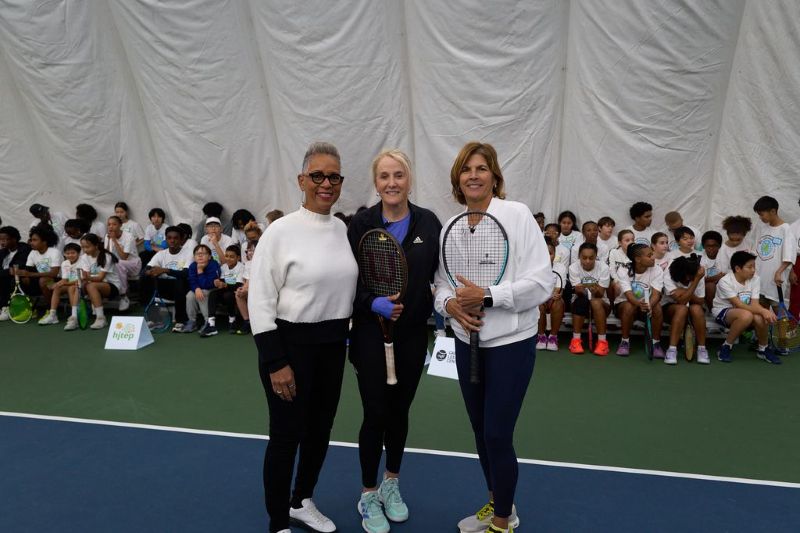
Katrina Adams, Tracy Austin and Gigi Fernandez (left to right) teaching at the International Tennis Hall of Fame’s Be Legendary program in the Bronx on Sunday.
By Richard Pagliaro | Tuesday, December 9, 2025
Photo credits: International Tennis Hall of Fame
The service line was a firing line when Gigi Fernandez began playing tennis.
Physician Tuto Fernandez, Gigi’s father, designed a unique drill to teach his daughter the game. Positioning an eight-year-old Gigi on one service line, the elder Fernandez stood on the opposite service line drilling a barrage of balls directly at the child.
Gigi Fernandez credits that drill for helping her develop the fast hands and surgical feel she displayed winning 17 Grand Slam doubles championships and two Olympic gold medals.
A tennis trailblazer, Gigi Fernandez made history as the first female athlete from Puerto Rico to play a professional sport. Winning 14 Grand Slam doubles titles over a five-year period with partner Natasha Zvereva in the famed “Fire and Ice” partnership, Gigi Fernandez was the first Puerto Rican ever inducted into the International Tennis Hall of Fame in 2010.
These days, Fernandez is giving back to the game and its players through coaching in the Hall of Fame’s Be Legendary program.
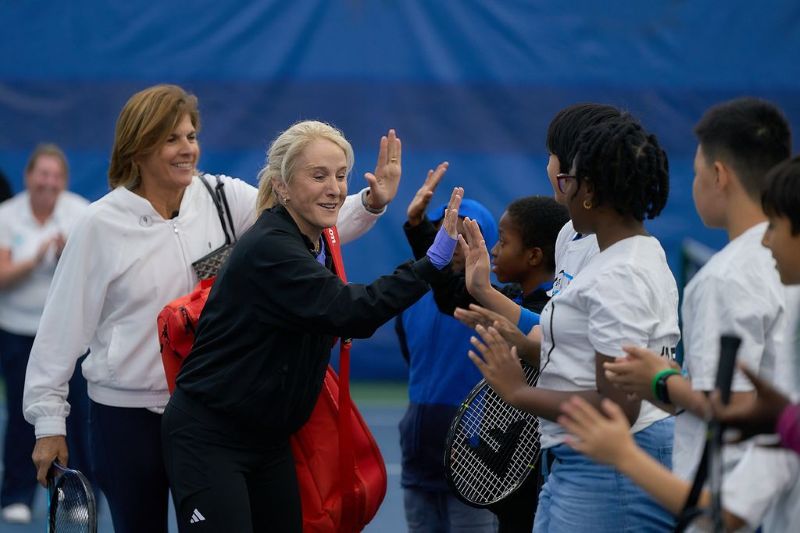
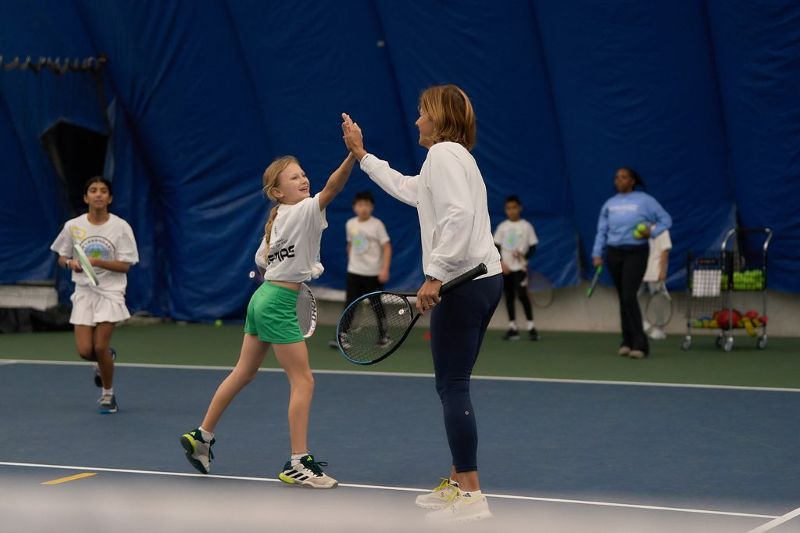
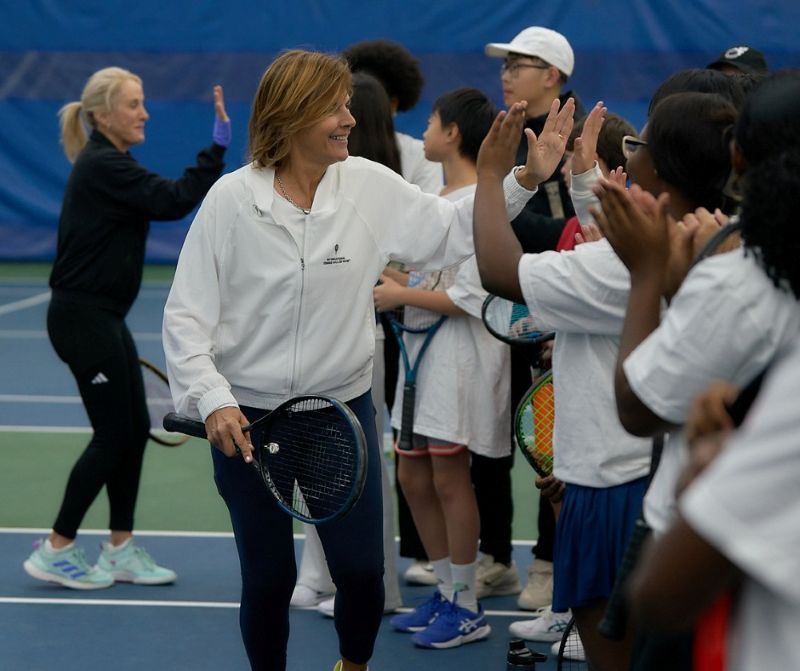
Last Sunday, Hall of Famers Fernandez and Tracy Austin joined International Tennis Hall of Fame President Patrick McEnroe working with junior tennis players from three New York City boroughs at the Be Legendary clinic at the NYJTL Cary Leeds Center for Tennis & Learning—a couple of miles from famed Fordham University where McEnroe’s father graduated with a law degree..
Be Legendary is the International Tennis Hall of Fame’s global youth initiative designed to “inspire and empower players ages 10–18 by connecting them with tennis history, core values, and legendary players.”
The Be Legendary program is more than bringing tennis history to life. It aspires to teach kids valuable life lessons tennis has to offer through the lens of Hall of Fame players, help them foster a deeper connection to the sport, and encourage them to find their personal greatness, both on and off the court.
In 2025, Be Legendary has taught youth around the world through clinics conducted in Melbourne with former No. 1 Lleyton Hewitt, Dallas, Indian Wells, Miami, London (with the Bryan brothers and Maria Sharapova) and Newport, Rhode Island. Each event offers youth players the chance to learn from Hall of Famers.
Gigi Fernandez’s efforts to aid tennis players isn’t confined to the court. She launched Tennis For Hope to provide resources and offer assistance to members of the tennis community suffering the impact of natural disasters. This year, Tennis For Hope has delivered $210,000 to members of the tennis community impacted by the Florida hurricanes, Texas floods, LA fires and Asheville floods.
We caught up with Gigi Fernandez for this interview in which she discusses the most vital quality for a tennis champion, how she and Natasha Zverev would fare against today’s top doubles teams, the greatest instinctual champion she’s ever seen and the state of tennis coaching.
Tennis Now: Gigi, I would think you’re a perfect person to coach in the Be Legendary program. What are some of the life lessons and tennis lessons you’ve tried to share with the kids?
Gigi Fernandez: I think the main thing we try to teach the kids is that you can achieve anything that you set your mind to achieve. I mean, if you can dream it, you can be it, right?
If you go through the steps and start to believe it. I think a lot of what Be Legendary is about is inspiring the kids to believe in themselves and they can be legendary and grow up to win Grand Slams and Olympic gold medals and they’re not so different than we were starting out.
It’s super fun and it’s a really great initiative from the Hall of Fame and really celebrate our champions. I think you can never do enough of that.
Tennis Now: I re-watched your Hall of Fame acceptance speech to prepare to interview you today and it was really great how you detailed how each of your parents taught you life lessons and inspired you. When you were growing up, was there any tennis player, any tennis legend, who really inspired you in your rise up the rankings to become a Grand Slam champion?
Gigi Fernandez: Growing up, Charlie Pasarell came before me [from Puerto Rico], but there was a bit of an age gap and he was not living in Puerto Rico anymore. SoI knew of Charlie Pasarell, but I didn’t know him growing up.
I did have a player from Puerto Rico I looked up to. She was Chrissie Gonzalez. She was four years older than me, she played college tennis and she sort of mentored me. She is who I won a bronze medal with at the Pan Am Games when I was 15 and she really inspired me and just to play. Then, my goal was to just play college tennis. I never really aspired to play pro tennis. I just couldn’t imagine that was an option.
So her and then once I turned pro, Martina Navratilova was my inspiration. Martina was No. 1 in the world when I came up and obviously you always want to look to who is No. 1 and learn from them. And then when Martina picked me to play doubles with her when Pam Shriver was hurt it obviously changed my life. Just to know that the best player in the world thought that I was good enough to play doubles with her was really life changing.
Tennis Now: What was the toughest challenge for you in attaining and sustaining the world No. 1 ranking? What is the biggest misconception people have about being No. 1 in the world?
Gigi Fernandez: I mean I think all of it is challenging. There are so many steps and so many hurdles along the way that you have to overcome. I don’t think there’s one thing, per say, that I would say: This was keeping me from being No. 1. It’s just like a gradual progression to get there. And I always like to use the analogy that it’s a marathon and not a sprint. You can’t get to No. 1 in the world in a year or two years. I mean it’s very rare to do that.
It is just a progression and setting goals of achieving Top 50 and Top 25 and Top 10 and Top 5 and not really just setting the goal to be No. 1 because then you’re setting yourself up for failure. So I set intermediate goals to reach along the way. And then I was just of the mentality that you never quit no matter what’s going on. You know, you just never, ever quit and when you are going through the obstacles, you just have to hang in there.
All through my life whenever I’ve been at my lowest moments, some great thing has come after. Like I remember in 1994 I lost nine first-round matches in a row. I started the year and I did not win a match until July. I got to Wimbledon and I was gonna quit singles. Because my ranking had dropped to No. 99, I wasn’t qualifying for Grand Slam main draws anymore and then I reached the semifinals of the Wimbledon singles. Like out of nowhere, right?
So just recently a personal experience, the worst thing that happened in my life was my house flooding in the hurricanes. But now I started a foundation that helps people in the tennis community whose lives have been impacted by natural disasters. It’s called Tennis for Hope . And that has been the most gratifying work that I’ve ever done in my life. I can’t imagine saying that the best thing that ever happened in my life was my house flooding. And I can say that without a shadow of a doubt because it inspired me to start Tennis for Hope. So I feel like when you’re going through the lowest times in your life, always hang in there, because something better is coming.
Tennis Now: It shows your resilience as a human being to rise from those low life moments. Natasha Zvereva, your long-time doubles partner, said you two were “Fire and Ice” together. What makes good chemistry between partners and do you have to be friends to make a doubles pairing work?
Gigi Fernandez: Let me say something about resilience. Because in tennis, it’s just you. And I think that’s why it’s so important for people, little girls and little boys, to play sports. Because that’s what it teaches you: resilience. You know when you lose and you have to get up and try again, if you’re not in sports, I don’t know how you get that. I don’t know how you get that experience of failing at something, getting up and doing it over if you’re not in sports. So I’m obviously a huge proponent of playing sports for that reason.
As for the second half of your question about Natasha and I being Fire and Ice. Absolutely. She was cool as a cucumber and a lot of times she was emotionless and didn’t get affected by the ups and downs of a match. Natasha was a steady Eddie and I was the one who was sort of up and down and up and down and all over the place.
You 100 percent have to have chemistry to be successful. There’s no question you have to have chemistry. I mean, I call a doubles partner your second marriage. You are literally married to that person. You have go through things together, you have to work on your stuff, you have to talk things out. Because so many divorces happen in the tennis world, right? Partnerships don’t last so you have to work on things. Also there’s the grass is always greener syndrome: That the next partner is going to be better.
For Natasha and I, we actually had a therapist that we worked with. Julie Anthony, my coach, was a psychologist. And we’d talk about our stuff. We only played together for five years but without that, it probably wouldn’t have lasted as long because there’s a lot of pressure when you’re the No. 1 doubles team in the world. We were so dominant. Fourteen Slams in five years, I think that’s a record for the number of [doubles] Grand Slams in a short period of time. So the pressure was pretty large to continue to win that number of Grand Slams every year. If we only won one Grand Slam we stopped playing because it was a failure. So that was a lot of pressure.
Tennis Now: When I think of you as a player, you had all-court skills, you seemed to have all the shots and your hands and your instincts were amazing. Were you better playing on instinct or intellect? And when it comes to playing on instinct, who were the greatest instinctual players you ever saw? Like for me, Federer and Hingis were just incredible instinctual players. Even when the ball was on them quickly, they could make magic.
Gigi Fernandez: I had this uncanny ability to understand the geometry of the court and the structure of doubles points since I was little. Like I was the Puerto Rican national champion in the adult division when I was 12. So for some reason, I understood doubles. It was a God-given talent. And then I really understood tendencies. I studied players and learned their tendencies. So a lot of anticipation is preparation. You are understanding your opponent and what you think they’re going to do in a specific situation.
I’d say the person that I was most impressed with in that regard was Martina Hingis. Hingis knew exactly where to be at all times. It was like never even a question with her: She was always in the right spot at the right time.
Tennis Now: When you look at this era of tennis now, how do you think a prime Gigi Fernandez and a prime Natasha Zvereva would do against today’s top doubles teams? When you look at this era of tennis now, what do you miss and what do you really love?
Gigi Fernandez: Well, we’d kick their ass for sure [laughs].
I wonder that because the game is so different. I always feel like classic doubles, good traditional get to the net doubles still wins. I think the problem nowadays is the people don’t volley well. People don’t have good volleys. I mean they just don’t have good technique on their volleys. It breaks down.
I mean you see some players who have good volleys, like obviously Taylor Townsend has good volleys. But there’s not very many of them.
On the other hand, when I was playing there was plenty of power. Now, there’s power and spin. With the technology, you can make the ball dip from anywhere, right? So you can be three feet from the net, and you’re still going to hit a volley from your shoe tops and that’s really hard. Like low volleys for me, were waist level or knee level, right? It was never at my feet. Once I’m inside the box, once I’m in position at the center of the box at net, I would rarely hit volleys from my feet because people didn’t hit with that kind of extreme topspin that they do now. So the biggest change is the technology has made it easier for anyone to hit the ball down at your feet to force you to constantly have to hit up.
I definitely miss good doubles points and people coming to the net and playing the angles and setting each other up. I feel like when I watch doubles now, I’m watching singles on the doubles court. I mean the top players, yes, obviously there’s some great, Top 3, Top 4, players on the WTA Tour playing great doubles. Yet if you watch quarterfinals or round of 16 or random first round matches from tournaments, I still feel like you’re watching singles on a doubles court. They’re just hitting the ball as hard as they can. No understanding of how to construct a doubles point, no understanding of playing for your partner. When you’re playing doubles, you’re playing for your partner. And whacking groundstrokes from the baseline isn’t playing for your partner. It’s very different, but that’s part of the evolution of the sport. I’m sure we said the same thing when we were playing about the previous generation like Oh my God it’s like slow motion. Now it’s the next generation. It’s hard to compare. It’s hard to say we’re better than them or they’re better than us because the technology has changed things so much.
Tennis Now: What did you learn from coaching that you wish you’d known as a player?
Gigi Fernandez: I wish I knew, as a player, how much patience it requires to be a coach. I wish I had been more patient with my coaches. I didn’t coach [pros] that long. I coached Lisa Raymond, Sam Stosur won the US Open when I was coaching them. I coached Rennae Stubbs. Richard, you’ve kind of caught me with a question I can’t answer.
Tennis Now: We’re seeing more specialization in coaching these days. Like Coco Gauff hired Gavin MacMillan to come in and work specifically on sharpening her serve as he helped fix Sabalenka’s serve. Do you favor coaching specialization like having a serve coach, a volley coach, etc. Or do you prefer having one coach overseeing the technical, tactical, mental aspects of the game?
Gigi Fernandez: I think it’s a little bit of overkill and sometimes you panic. There’s no shortcuts. Again, it’s a marathon, not a sprint.
When Coco hired someone the week of the Open to help her, that’s just a panic move, in my opinion. No one’s going to fix your serve two days before the US Open no matter who they are. So it’s like admitting you have a problem and now you have to deal with it while the whole world is watching. I feel like maybe a coach and a hitting partner is all you need or a coach and a mentor. I don’t think you need a forehand and a backhand coach.
Having said that, when I was playing, I would work on different strokes with different people. Like they wouldn’t travel with me but I’d work on my volleys with a volley coach. I remember doing that. In fact, I worked with him and I didn’t like what he was teaching so I didn’t apply any of it. There’s something to be said for too much information. It gets too much when you have six different opinions coming at you as a player. How do you sift through that? How do you decide who you listen to and who you don’t listen to? So if you have the serve coach saying one thing and the main coach saying something if you’re the player who do you listen to?
Tennis Now: Last question, anything I didn’t ask you about what you’re doing these days that our readers should know?
Gigi Fernandez: I still have my experiential travel company so I still bring people to Grand Slams and special events. But I’m really focusing a lot on my foundation Tennis For Hope. We have over 60 members that have pledged $750,000. We want to unite the tennis community in response to natural disasters. So we help people in the tennis community who have suffered from natural disasters.
This year, we donated $210,000 to LA fires, central Texas river floods, Florida hurricanes and Asheville floods. So it’s going really well. Obviously, it’s a lot of work because it’s like starting a new company. We have a dedicated board. We’ve just got Mary Carillo on the board. Pam Shriver’s on the board, Kathy Rinaldi’s on the board.
The WTA Foundation was very helpful when we started because we didn’t have our 501 status and they helped us raise money for the LA fires. And we’re just ready for the next natural disaster to hit. And when it does, we’ll be there helping people.

Post Comment