The Greatest Tennis Rivalries of All Time
By Raymond Lee | Saturday, August 30, 2025
Photo credit: Jed Jacobsohn/ROLEX
NEW YORK—Times Square is called the Crossroads of the World.
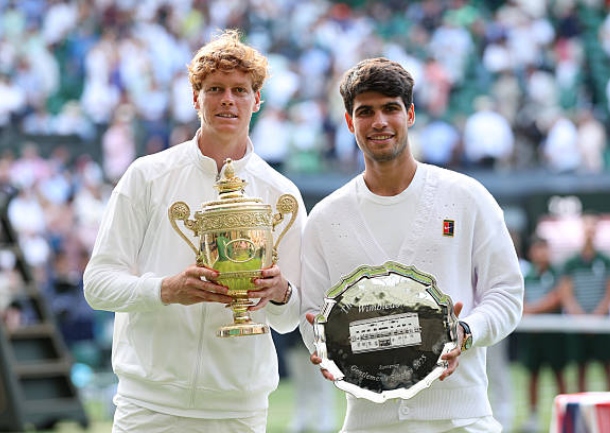
Arthur Ashe Stadium could serve as the crossroads of a pulsating rivalry if world No. 1 Jannik Sinner and No. 2 Carlos Alcaraz square off in the US Open final on September 7th.
If the top two meet in the Flushing Meadows final, it will make the third straight Grand Slam final between the same two male rivals—marking the first time in Open Era history it happens between two men in a single season.
Novak Djokovic and Rafael Nadal faced off in four consecutive major finals from the 2011 Wimbledon through the 2012 Roland Garros, but that spanned two years.
When Rod Laver won his second calendar Grand Slam in 1969, he defeated four different men in the four finals. Laver beat Andres Gimeno in the Australian Open final, topped Ken Rosewall in the French Open final, stopped John Newcombe in the Wimbledon final and completed the calendar Slam defeating Tony Roche in a rain-delayed US Open final.
The Big Four 4—Roger Federer, Rafael Nadal, Novak Djokovic and Andy Murray—gave us intense and historic major rivalry. In any great rivalry it is often the contrast in styles that makes the match great. This is the case in almost any great competition: tennis, boxing or chess.
When Roger Federer rose to No. 1 in 2004, he was virtually unbeatable. He had no rivals. He was on a level all by himself.
Frankly there was very little excitement when he was in a major final because you knew the opponent would offer little competition. Sure, he could be upset at times like when Gustavo Kuerten defeated Federer at the 2004 Roland Garros, but everyone assumed that was because Kuerten was still one of the great French Open former champions and had a great day. That upset at the 2004 Roland Garros was a rarity for Federer once he established himself as an elite champion.
Then in 2005 a young teen named Rafael Nadal rose to challenge Federer. The prior year Nadal had upset Federer on a hard court in their first meeting at the Miami Open though some tried to diminish that defeat as the Swiss wasn’t feeling his best on that day. Federer defeated Nadal in their second meeting also on hard court, recovering from two sets down to win 6-1 in the fifth set at the Miami Open in Crandon Park. Later that year Federer met Nadal in the semifinals of Roland Garros where Nadal prevailed in four sets. It was apparent now that Federer now had a more than worthy challenger to his throne.
Of course, Novak Djokovic and Andy Murray joined in on the fun and the Big Four’s many rivalries and great matches were to begin.
What Makes a Great Rivalry?
Well obviously, the players have to be somewhat competitive with each other. While Arthur Ashe was a great player and played Rod Laver numerous times, it just wasn’t competitive between the two. Laver won the first 18 matches they played.
The rivalry has to have great rallies and close matches. The rivalry that Tennis Hall of Fame writer and historian Richard Evans selected as his favorite in an interview with Tennis Now was Andre Agassi vs. Patrick Rafter, which is a wonderful choice. While Agassi won the majority of the matches, so many of them went to the deciding set, often at major tournaments like Wimbledon or the Australian Open.
At the time, Agassi was regarded as the best returner in tennis, while Rafter had an excellent serve, his serve was to set up his great volley, arguably the best in tennis in his prime. So when Rafter served to Agassi’s great return, his volley had to handle the super returns of Agassi. This set up great rallies when Rafter served.
On the other end, when Agassi served, he seldom serve-and-volleyed. Agassi relied on great groundstrokes to control the point. Rafter also had a terrific return and excellent groundstrokes. Rafter was a tremendous mover. So when Agassi served, it also would lead to high level rallies.
This is essentially what made the Big 4 matches and rivalries so fascinating. It was the contrast of styles and the great rallies. But also the anticipation that each opponent has an excellent chance to defeat the other, assuming the player is healthy and in good shape.
Even though they haven’t played as much as Djokovic against Nadal, I generally preferred the Federer against Nadal matches over the others in the Big 4. One of the reasons is that in the early years it was the anticipation that it was the Battle of Titans.
At their peak, Federer and Nadal were clearly above all other players. I’m not necessarily discussing 2005, but even later in let’s say 2007 when I felt Nadal was maturing into the great player that he eventually became.
Nadal vs. Federer popped with great rallies as per usual in the 2009 Australian Open Final.
Here’s a great match between Djokovic and Nadal at the Australian Open in 2012.
Here’s Murray against Djokovic in the US Open Final in 2012. It was a long match as may be expected, but the windy conditions were horrible.
It’s all subject to opinion, of course, but I will share my view of the greatest rivalries and matches between some of tennis’ most iconic champions.
Personally I enjoyed the drama of the Federer vs Nadal matches the most. I suppose it was because of the anticipation in the beginning years of that rivalry that the invincible Federer finally had a foe who had a decent chance to defeat him.
Here’s a few of my favorite matches among the Big Four rivalries.
The 2008 Wimbledon final between Nadal and Federer.
The 2007 Wimbledon between Federer and Nadal.
Hall of Famer Richard Evans also named the Chrissie Evert against Martina Navratilova rivalry as one of his top favorites. For me, the Evert vs. Evonne Goolagong rivalry was even more enjoyable.
When I saw Evert and Goolagong play against each other, not only were the rallies fantastic but I would be shocked at some of the ridiculously creative shots by Goolagong and Evert.
Evonne Goolagong wasn’t just a fantastic mover, she seemed to float on the court. Stavo Craft, one of the world’s greatest experts on the career of Chris Evert along with Hall of Famer Steve Flink mentioned to me that he read that someone described Goolagong’s court presence as “skipping through a field of flowers.” I couldn’t find the author of this quote to credit for that image, but to me that is a wonderful picture that he or she painted of Evonne Goolagong.
Goolagong had superb groundstrokes and great variety in her shot making ability. Her backhand overall was probably her better shot but the analyst in the video (I think it was Julie Heldman) mentioned on clay Evonne’s forehand was the superior shot.
Evert of course was the great problem solver. By that I mean whatever imaginative shot Goolagong would hit, Evert would generally figure out a solution. Of course sometimes the shot by either player could be too good and there is no solution.
Here’s a video of their Virginia Slims final in 1976.
Here’s the 1975 US Open final.
Here are the rest of my choices for greatest tennis rivalries of all time.
Pancho Gonzalez vs. Lew Hoad
Pancho Gonzalez is one of the greatest players in the history of tennis. That’s not hyperbole, that’s the truth.
When he was playing well very few could keep up with him. Many players like, including Jimmy Connors have said that if they had to choose one champion to play for their life, Pancho Gonzalez would be their choice.
Pancho Gonzalez said repeatedly that Lew Hoad was his toughest rival. That’s saying a lot when you consider that Gonzalez played many greats like Laver, Kramer, Ashe, Newcombe, Rosewall, Sedgman among others. And, as a young man, Gonzalez also hit with Hall of Famers Don Budge and Ellsworth Vines.
Hoad was a tremendously gifted player. Many tennis historians felt that the two greatest players when they are playing their best were Ellsworth Vines and Lew Hoad.
Hoad was a physical specimen. His strength, reflexes, speed, and agility were legendary. He had incredible timing and his wrist strength was enormous! Hoad could flick shots with great topspin and speed. It’s especially amazing since with the tiny heavy wooden racquets at the time it was hard to hit. Hoad had fantastic versatility. He could hit any shot from any position. The problem was that because of his tremendous talent and variety of shot making that he had too many choices and often picked low percentage shots. It didn’t matter if he was on his game because seemingly all the low percentage shots would go in leaving his opponent feeling helpless. But if he was off, Hoad was very vulnerable to defeat.
When Gonzalez and Hoad played each other, it was the Battle of the Titans! Gonzalez with his enormous talent, skill, power, and great will to win against Hoad, the player who some think is the most gifted player ever along with Ellsworth Vines.
To be fair many also thought Gonzalez was as gifted as any player. To paraphrase Bobby Riggs, Riggs essentially said that if you had a tournament in which the player who lost had to jump oƯ a bridge and the winner would be the one who survived, Pancho Gonzalez may very well be the last player standing. I’m not 100% certain it was the exact words but the meaning is overall correct.
The two played close to 200 matches against each other with Gonzalez winning the majority. It was their first tour of 87 matches that is almost legendary. This tour was for the top player in Professional Tennis. Hoad was, as I wrote earlier, a low percentage player but greats like Jack Kramer and Pancho Segura worked with Hoad to shore up his game. Hoad was prepared as he could be to play the juggernaut of Pancho Gonzalez.
Hoad jumped oƯ to a large lead of at least 18 wins to 9, some have it as 21 to 9. The matches were of unbelievably high quality.
Gonzalez eventually adjusted to his opponent as went on to win the tour 51 matches to 36. Here is a little video of Gonzalez playing Hoad.
Chris Evert vs. Martina Navratilova
Many have called this the greatest rivalry in tennis history. I’m not sure about that but it could be. There have been many rivalries in tennis history but this is certainly up there. It depends on what factors you consider important for a great tennis rivalry. I personally prefer the Evert against Goolagong rivalry.
Certainly both Evert and Navratilova are GOAT level players and seemed to be in every final that they played in those days. Combined both of these players have won close to 320 tournaments and 36 singles majors in their careers.
The rivalry was 43 to 37 in favor of Navratilova but about 10 of those matches were played with Navratilova using I believe a graphite racquet and Evert a wood racquet. A huge difference in quality and power of racquets.
Just the fact both played each other 80 times in the Open Era when they played tournaments and not tours like on the Old Professional Tour where one player could play 100 matches against another player shows the great dominance of both players.
On the ATP Tour the record for the Open Era is the 60 that Djokovic played Nadal. That’s an unbelievable 20 less than Evert against Navratilova.
So for most of those years you had the best serve and volleyer in tennis versus the greatest returner and baseliner in tennis. The lefty Navratilova versus the righty Chris Evert. Yet Navratilova was also a very good baseliner and Evert could be very effective at the net.
The key was whose game would be dominant in that match or at least in control most of the day.
Here’s the 1986 French Open Final which was Chris Evert’s last major tournament win.
Steffi Graf vs. Monica Seles
Steffi Graf not only won the Grand Slam in 1988, but made history capturing the only Golden Grand Slam in history, which included the Olympic Gold medal she won in Seoul played after the US Open that year.
Who could possibly beat her? Yes, the old guard of Evert and Navratilova were still threats, but they were getting older and Graf would be at her peak for years. I would almost like to mention Arantxa Sanchez Vicario and Gabriela Sabatini also would win some majors at times but generally it was Graf versus the field.
Then all of a sudden, this young left hander who hit with two hands on both sides and blasted unreal on- -the-rise groundstrokes arrived on the scene.
Monica Seles reached the final of the WTA tournament in Houston on clay in 1989 and won the tournament by defeating Chris Evert in the third set 6-4. Incidentally Evert would get revenge by playing a fabulous match against Seles in the fourth round of the US Open a few months later by a score of 6-0, 6-2.
Seles was just getting started and she would improve tremendously. This was clearly helped by the fact she grew several inches and had more power. The skill level would improve also. Still, Graf was the mountain no player seemed to be able to reach. Could even a player this gifted be able to snatch the No. 1 ranking from the great Graf?
The answer was partially answered when Seles, as the second seed to Graf defeated the German great in the Roland Garros final in 1990 by 7-6, 6-4 score.
The next year in 1991 Seles won every major she played in. Seles won the Australian, French and the US Open titles. Seles did not play Wimbledon that year. Graf won Wimbledon in 1991 over Sabatini 8-6 in the third.
The next year in 1992 Seles again won three of four majors. Seles in 1993 won the first major of the year in the Australian Open defeating (who else?) Graf in the final 6-2 in the third set. At this point in their rival Graf led the head-to-head series 6-4.
However, I would venture to say that the first three matches, all won by Graf were prior to Seles reaching her eventual peak level so in my opinion when both were at their best, Seles led the series barely by 4 matches to 3.
This rivalry seemed at this point to perhaps come close to Evert versus Navratilova status. Unfortunately, tragedy struck and in Germany on April 30, 1993, when Seles was stabbed by a madman.
The physical and psychological problems were huge. Seles at that point won seven of the last eight majors she played in and was clearly the best player in the game. Seles lost years of playing time at her peak. Though she courageously returned to the sport, Monica Seles was never the same player again.
Eventually Graf ended with a 10 to 5 match edge over Seles. It was a rivalry that was great, but it should have been far greater.
Here’s Seles against Graf in their great 1993 Roland Garros final.
Speaking of rivalries, here’s Graf defeating another rival Martina Navratilova in the 1988 Wimbledon final. Graf’s backhand return was unbelievable.
And here’s Seles showing her great will to win in defeating another great rival in Jennifer Capriati in the 1991 US Open semifinal. This was a superb match between two teenagers. Seles went on to defeat Navratilova in the final 7-6, 6-1.
Bill Tilden vs Henri Cochet
Bill Tilden was the player of the 1920s and to this day arguably still the greatest ever. Tilden was considered invincible in the early 1920s and in some years only lost one match. From 1920 to 1925 Tilden entered 8 majors and won all 8. That streak was ended in 1926 by Henri Cochet at the US Nationals by a score of 6-8, 6-1, 6-3, 1-6, 8-6. Tilden had won 6 straight US Nationals before Cochet ended his run.
Probably the most amazing of the Tilden against Cochet matches was when Tilden led two sets to none at Wimbledon and 5-1 in the third set before Cochet rallied to win in stunning fashion.
I discussed this match and the 1927 Wimbledon in a previous Tennis Now article. They both were gifted players.
It is said Cochet often made the toughest shots with ease and the easiest shots tough. Cochet took the ball very early and was gifted in his net player. He had wonderful touch. Tilden, according to some sources, eventually won the rivalry 38 matches to 28 but there were so many memorable matches in many majors.
Don Budge vs. Bobby Riggs
Most people recall Bobby Riggs as simply the man who was beaten by Billie Jean King in straight sets in their 1973 Battle of the Sexes match at the Houston Astrodome.
Riggs, however, was a great player who won Wimbledon in 1939. In fact he won the doubles and the mixed doubles also that year sweeping the Wimbledon triple crown.
Riggs became the No. 1 player in the world when he defeated Don Budge (who was the first Grand Slam winner in 1938) by a margin of 24 matches to 22 or 23 to 21 depending on the source. He later defeated Budge by 12 to 6 on another tour.
Riggs easily became the best player on the Professional Tour. In 1946 Bill Tilden organized a tour of 31 tournaments. Riggs won 14 of them and finished first with 278 points. Budge was a distant second, winning 3 tournaments with 164 points. Clearly, Riggs was by far the best player on the Professional Tour in 1946.
These two had many tremendous matches. Budge was the power baseliner with a backhand that many believe was the greatest backhand ever. Riggs had no major weaknesses and was a counter puncher although he had a good attacking game with a fine serve in his prime.
Ellsworth Vines believed that Riggs at his best had a superior serve to Budge when Budge was at his best. Riggs also had a tremendous lob to neutralize Budge’s approaches to the net.
All of this made for great tennis.
They played over 130 matches, many of them with big tournaments on the line.
Stan Smith vs. Ilie Nastase
Stan Smith against Ilie Nastase is an interesting rivalry. Smith had the reputation as a virtually perfect serve and volley power player. He had a huge first serve, an excellent volley and a great overhead. Yet Smith was capable of good touch and had solid groundstrokes at his best.
Some people believed Nastase to be among the most gifted players in history with an unlimited number of shots he could hit. Nastase had excellent speed with a great running forehand.
Temperamentally, the were total opposites. Smith was a quiet and classy sportsman, while Nastase was a wild man who would sometimes stop matches to go ballistic on chair umpires.
These two met in majors and great Davis Cup matches. Their Wimbledon Final in 1972 was one of the best matches in Wimbledon history. This was another year in which many of the top players like Laver, Rosewall, Ashe, and the defending champion John Newcombe were unable to play because of International Tennis Federation did not allow World Champion Tennis Tour to play ITF sanctioned tournaments like Wimbledon.
Stan Smith, who was the top seed now and Nastase the second seed both reached the final and played one of the finest and most entertaining matches in Wimbledon history.
They played in four Davis Cup singles matches and other important tournaments like the French Open, the US Open and the Year End Masters. Smith won the majority of the matches but only by 11 matches to 10. Here is their great Wimbledon final in 1972.
John Newcombe vs. Stan Smith
Often a great rivalry is between two players with conflicting styles of play. A good example of this is Evert against Navratilova.
However in John Newcombe and Stan Smith you have two strong serve and volleyers with powerful serves, strong volleys and good returns. Often it depends on just a few points here and there to decide the match.
Newcombe was possibly the premier grass court player of the early 1970s. Newk had the perfect game for the serve and volley. Smith, however, was not far behind. There were some minor divergences in their games.
Both had excellent first serves with Smith at 6’4” tall had a slightly faster serve although Arthur Ashe thought Newcombe’s serve was a very heavy serve loaded with spin.
To quote from Ashe’s excellent book Arthur Ashe: Portrait in Motion: “But if you ask me who has the best serve in the world, I would say Newcombe, and John really doesn’t have a fast serve. He hits a heavy serve, which mixes spin with velocity. Neal Fraser had a great heavy serve when I first came up; Pasarell and Tony Roche are a couple of others who hit tough heavy balls. If you are returning a heavy serve, you need more than timing to get it back; you need strength too. A good heavy serve from somebody like Newcombe can turn the racket in your hand.”
Here’s Newcombe against Smith in the 1971 Wimbledon final.
I believe the 1971 Wimbledon final between the two was an excellent match, but I think the greatest match between the two was the 1973 Davis Cup Finals singles in which both men played the first match. Newcombe had won the US Open several months earlier and had regained his form after playing poorly for much of the year.
Smith was considered to be the No. 1 player in the world for the first half of 1973 after winning the WCT Finals over Arthur Ashe.
Newcombe won the first and third sets, Smith the second and fourth set. Smith broke early to lead by a break at 3-1 and had Newcombe at break point at 30-40 which may have clinched the match. Newcombe held serve and broke back to tie the match.
Smith served at 4-5 down in the fifth to stay in the match. At 30-40 match point against Smith, Newcombe moved way into the alley threatening to drive his great forehand, possibly the best in tennis, to attack the second serve of Smith. Newcombe left the opening for Smith down the center line. It was perhaps a psychological move. Smith went for it, double faulted and lost the match. It was a great epic.
Rod Laver vs. Ken Rosewall
This is the rivalry many believe is the greatest rivalry ever. These two may have played close to two hundred times with many of match results lost. Laver, as far as the records that have been found, led the rivalry by a clear margin.
Laver was the lefty power player who had every shot plus touch. Rosewall was a brilliant groundstroker with one of the greatest returns of all time. The Rosewall backhand was legendary but so was the Laver backhand.
When Laver first turned pro Rosewall was the reigning Professional Champion. Eventually Laver took over and led the rivalry at the end. Because of the great speed of both players, the great attacking and counterpunching skills of both the rallies were of the highest quality. These were two of the greatest players of all time.
One of the greatest matches Laver and Rosewall played was the 1972 WCT Final. Some have called it the greatest match of all time. I don’t think so even up to 1972. First of all, Laver and Rosewall were older and they played higher quality matches I’m sure for great stakes when they were younger.
There was a match at Wembley in 1964 which Laver won 7-5, 4-6, 5-7, 8-6, 8-6. I believe Rosewall was serving for the match at 5-3 in the fifth set when Laver raised his game to break Rosewall and won 8-6 in the fifth. I believe that was most probably a greater match than the 1972 WCT Final due to the comments about the 1964 match and the fact both were at their peaks, which they weren’t in 1972.
The 1972 WCT Finals match in Dallas also did wonders for the popularity of tennis. Many scheduled television positions were canceled or postponed in order to show the epic match in its entirety.
Here is some highlights of the great 1972 Dallas WCT Final.
Here is the 1970 Sydney International final in Melbourne, Australian which essentially was sort of a major because the Australian Open was boycotted that year, so the players played here.
Of course there are some rivalries in which I wished both players were at their peaks at the same time.
A prime example: Bjorn Borg against Rod Laver. These are two players who at their peaks were incredibly dynamic and powerful players. In 1975 when they met in the WCT Finals semifinals, Borg was several years from his peak and Laver was several years past his peak. So in some ways they are both equal in this manner because neither was in their playing prime. The match is widely considered to be a classic.
Laver met Borg later that year at the 1975 US Open in the round of 16 on Har Tru. Borg won that match 6-1, 6-4, 2-6, 6-2.
After 1975 Laver eased up on his tournament activity so Borg won the last three matches to lead the series 6-2. However, if we don’t count the matches after 1975, Borg would lead only by 3 matches to 2.
It would have been wonderful if both were reasonably close in age instead of the 18-year age gap between the two. Both had no weakness and many great strengths. Laver was the serve-and-volleyer, but capable of excellent baseline play. Borg was the baseliner, but Borg was more than capable of serving and volleying extremely well.
Each player had great speed, stamina, and versatility. Incidentally I think Borg’s versatility has been extremely underrated. The man won the French and Wimbledon three years in a row playing different styles of tennis on two disparate surfaces.
In those days, the grass at Wimbledon was far different than now. It was much harder to play on grass from the baseline. Borg had super versatility. Here are two matches of Borg against Laver. The first is some highlights of their great 1975 WCT Finals semifinal match and the second is a match on clay called the World Invitational Tennis Classic in 1976.
The Connors-Borg-McEnroe Triumvirate
When it comes to rivalries, the matches between these three all-time greats were absolutely astounding.
There are so many unbelievable matches between these three, many in the finals or semifinals of major tournaments.
Borg essentially stopped playing full-time in 1981, apart from a brief and aborted comeback bid. I am sure that deprived us of so many more great matches between the three.
There were a lot of great matches between Connors and Borg but I think some of my favorites are the ones at the Pepsi in the late 1970s. Here’s the match from 1977, which I believe was still considered a part of the 1976 season. Connors had dominated Borg up to this time, even on Har Tru, which is commonly called American green clay. Connors defeated Borg at the 1976 US Open on Har Tru just a few months earlier.
I think the best match Borg and Connors played at a major final was the 1977 Wimbledon final.
Incidentally, the semifinal of that 1977 Wimbledon between Borg and Vitas Gerulaitis is considered to be one of the finest matches in Wimbledon history.
The thing about the Connors versus Borg matches was that they were both brilliant groundstrokers and it made for wonderful rallies. Connors dominated early, but Borg eventually took over. Borg ultimately led the head-to-head 15-8. No matter what, it was always compelling tennis.
Jimmy Connors vs John McEnroe
These two were interesting in that Connors was known for his brilliant return which was known to take down even the greatest serve and volleyers. And obviously John McEnroe was one of the greatest serve and volleyers ever.
It made for an interesting contrast. Connors was in his prime in my opinion until 1983 when the rivalry stood at 12 matches apiece. After that McEnroe took over and eventually led the head-to-head 20 to 14. The problem with head-to-head records is that sometimes it doesn’t always indicate how strong the player was at their best. Connors was about 7 years older than John McEnroe so the later matches weren’t Connors at his best. Despite what I wrote earlier I thought their best match was the 1984 US Open match in which McEnroe at his peak defeated Connors in a brilliant five set match.
What about the Borg-McEnroe rivalry?
Well, they only played 14 matches against each other. The rivalry is noted for the exciting 1980 Wimbledon Match which was wonderful to watch. However that match had a very one sided first set in which McEnroe won 6-1. Borg struggled but eventually won the second set and won the third set. McEnroe did play some great shots to break Borg while Borg was serving for the match in the fourth set. The tiebreaker was super exciting, widely considered a classic breaker, but there were errors made before McEnroe pulled it out. Borg was untouchable on serve in the fifth and eventually won the match.
As the great writer Joel Drucker wrote: “Bjorn Borg brought John McEnroe to heaven. Jimmy Connors took John McEnroe to hell.”
The rivalry between Borg and McEnroe was excellent, but I thought the others I mentioned ranked a bit higher due to the greater number of matches played. For me, the Connors vs. McEnroe rivalry oozed tension and electricity and lasted longer as well.
Those are my picks for top tennis rivalries. Please feel free to share yours in the comments section below.



2 comments