Manuel Orantes’ Miraculous 1975 US Open Title Trip
By Raymond Lee | Thursday, August 28, 2025
Photo credit: UPI/Bettmann/Getty
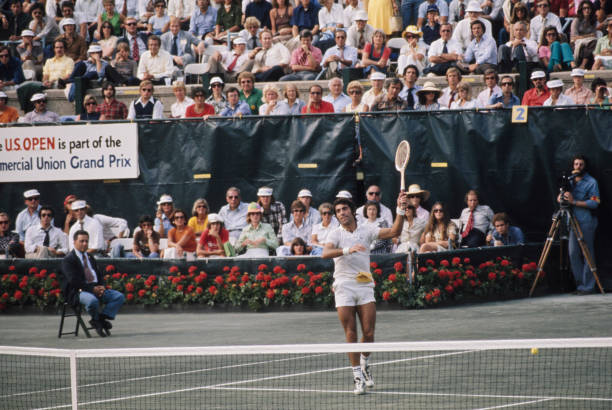
NEW YORK—The 1975 US Open was the start of a new era at the West Side Tennis Club in Forest Hills, New York. Over the decades, the tournament was played on grass.
Often by the end of the tournament, the grass surface was in such unruly condition that it was unbelievably hard to have long baseline rallies or often even to return serve. It could make for difficult tennis with unpredictable bounces.
That changed in 1975 when the surface was changed to Har Tru, a surface commonly called American green clay, which was conducive to better rallies and more variety of play. Some of the baseline players who could be overpowered by the big serve and volleyers now often stood as the favorite against those same players.
You did have some excellent all-court players like Jimmy Connors, Rocket Rod Laver, Guillermo Vilas and Bjorn Borg in that tournament who could play well on all surfaces.
Manuel Orantes was a lefty all-court player who had every shot and seemingly at times some shots no one else could conceive.
Orantes could play well on all surfaces, but he was at his best on clay. Orantes did not have the pure power off the ground of a Jimmy Connors, nor did he have the strong serve of an Arthur Ashe but he could be a ball machine on clay, which few could surpass when he was healthy and at his peak. Unfortunately, Orantes had a number of injuries in his career.
Nevertheless, Orantes was a great ball striker, was an excellent mover and had every shot. His touch was as great as any player I have ever seen. He was able to call on good power if he needed it but it was not really his playing style.
When you think of a player going into the Zone in tennis, you normally tend to think of power players overwhelming their opponents with untouchable placements. Roger Federer, Rafael Nadal, Pete Sampras, Lew Hoad, Arthur Ashe, Juan Martin del Potro, Ellsworth Vines and Laver are perfect examples of this historically. I recall Ashe discussing Laver when Laver went into the zone, he said that Laver started by hitting the lines, then he continued by hitting the lines harder and harder. And no one could stop him..
Orantes was one of the only players I’ve seen that when he went into the Zone, it was not the power that made him untouchable but his ball control, angles, anticipation and touch. He seemed to have the ball on a string and no matter where his opponent put it, Orantes would find a weird angle or drop shot which befuddled his opponent. He almost seemed to know where the opponent would hit the ball before he hit it.
When I watched him when he was in his Zone, you would look at the score and think to yourself, he has won six straight games in what seemed like the blink of an eye. How did he do it?
Bear in mind, that I am generally speaking of clay court surfaces when I discuss Orantes entering the Zone.
Orantes was one of the top favorites at the 1975 US Open, seeded third behind only Connors at top seed and Vilas at second seed. Ashe was fourth seed, Borg fifth, Okker sixth, Roche seventh, Nastase eighth, Laver ninth and Tanner the tenth seed.
Vilas was on a hot streak during the summer clay circuit, winning a number of tournaments. Going into the semi-finals against Orantes, Vilas did not lose a set in the tournament. Perhaps his most impressive performance in the tournament was defeating Jan Kodes, the former French Open Champion and 15th seed by an astounding score of 6-2, 6-0, 6-0 in the fourth round.
Vilas, also a lefty player was in some ways similar to Rafael Nadal. If you never saw Vilas, think of the young Thomas Muster, another powerful lefty, whose game looked like a copy of Vilas’ game. Vilas had heavy topspin from both sides, was extremely quick with a very good serve and good volley. Of course, with the equipment in those days, even if we used a time machine to put peak Nadal into 1975, Nadal could not have reproduced the same type of shots due to the inferior racquets and strings.
Vilas had an excellent one-handed backhand which some thought was his best shot. Argentinean Vilas had an extremely powerful wrist which allowed him to flick shots on the backhand that was impossible for most other players with the possible exception of Laver.
Like Orantes, Vilas had great passing shots on both sides and had great mobility.
Orantes was playing extremely well also in the tournament. He defeated the great Ilie Nastase in the quarterfinals in four sets. Frankly, Orantes was clearly the superior player to the talented Nastase that day.
The other two semifinalists were Bjorn Borg and Jimmy Connors. A great matchup on paper but imo at the time, Connors’ groundstroke power was just too much for Borg. Later these two would meet in many majors, often in the finals.
The Connors approach shots allowed Connors many easy winning volleys. It was an odd match in that the same sequence of games happened in every set! Connors won the first game on serve of every set, Borg the second, Connors won the next three games to lead 4-1. Borg won the next three to tie it at 4. Connors and Borg both held their serves to tie it at 5-all. Connors held serve to lead 6-5 and broke Borg to win the set 7-5. So, Connors defeated Borg 7-5, 7-5, 7-5. A close match but Connors was clearly the superior player at the time.
On a side note, in the fourth round Borg defeated the legendary Rod Laver in four sets in the only meeting in a major between these two legends of the game. Borg won 6-1, 6-4, 2-6, 6-2.
They met earlier in the year in the WCT Finals semifinals with Borg winning in five sets in a match for the ages.
I have always felt that if they were at similar ages that the Borg versus Laver rivalry could have been as great as any. Borg, the super-fast power baseline topspin player against Laver, the also extremely fast player with an infinite amount of shots. Both could play any style needed to win.
Vilas continued looking like a juggernaut in winning the first two sets against Orantes 6-4, 6-1. He broke Orantes early in the third set to lead 2-0. Many thought that at this point Vilas would just steamroll Orantes. All of a sudden, you blinked, and Orantes won six straight games to win the third set with his astonishing variety of touch, angles and spin.
Both players were great baseliners who rarely missed. You expected long extended rallies, and you got them.
Vilas recovered from his loss of the third to lead 5-0 in the fourth set with Orantes serving at 15-40, double match point.
Many in the crowd left their seats to get closer to the nearest portal with the assumption that the match would be over soon. To say they were wrong is an understatement. Orantes went into his particular zone and fought off five match points in an astonishing display of will and skill. That stand sparked the Spaniard to win seven straight games to tie the match at two sets apiece.
You could tell the inevitable was about to happen. Despite the long rallies, Orantes won the fifth set 6-4 to prevail in one of the greatest comebacks in US Open history.
The final was the next day against the great Connors, who finished earlier in the previous day by defeating Borg in straight sets.
Orantes had a long match until fairly late at night. Orantes apparently had plumbing problems which didn’t allow him to sleep until late at night. Obviously, all this was not in Orantes’ favor.
Connors was the clear favorite if you logically look at all the information. Of course logic doesn’t always work out in tennis. Logically Orantes shouldn’t have been there in the first place.
Some articles said that no one gave Orantes any chance to win. If someone thought that, well to say I disagree is an understatement.
Orantes was a fantastic player and to write that he didn’t have a chance to win was just plain wrong. Orantes just defeated two extremely strong players in Nastase and Vilas in consecutive rounds. He was very young at age 26 so recovery time is less of a problem. He stood a decent chance at worst especially considering it was on a clay surface which suited Orantes the best.
They mentioned how Orantes threw Connors off with less pace. Frankly, Orantes was never a power baseliner in the first place. There weren’t too many in those days when many still played with small heavy wood racquets.
The best power baseliner at that time in 1975 was Jimmy Connors. Borg of course hit with great topspin and power but he wasn’t at his peak yet in 1975. I suppose Vilas did hit with power and spin also to a degree, but I never thought of Vilas overwhelming players on pure power.
The final looked fascinating in that it was a great contrast in styles. The powerful groundstrokes of Jimmy Connors versus the great groundstrokes and variety of Manuel Orantes. Not that Connors didn’t also have great variety. He did.
Orantes’ game wasn’t about power, it was about touch, control, spins and angles. He also moved extremely well. It was hard to attack either side because he was so solid and his passing shots on both sides were excellent!
This made the matchup so enticing. Both could reach extremely high levels.
Could Connors’ power and approach shots neutralize the great touch, variety and consistency of Orantes or would it be the other way around?
Orantes was apparently healthy, and he was in top form. When he played Nastase in the quarterfinals, it seemed like he was on another level in that match.
Connors, as always, played at a high level throughout the tournament, losing only one set to the tough Harold Solomon, the human backboard.
Orantes, when he was playing well, almost seemed like an artist on the tennis court. And he played extremely well against Connors in the final. His touch, angles, spins and consistency were all on display. Orantes won the final 6-4, 6-3, 6-3 in a beautiful display of tennis.
Afterward, Connors credited Orantes’ precision and passing-shot prowess as keys to the final.
“He played unbelievable,” Connors told Sports Illustrated. “I didn’t believe that it would be possible for him to hit passing shots and play like he did all the way through.
“But unfortunately for me, he did.”
I’m not sure if even Orantes understands how he won 50 years later. It was just so miraculous. An incredible display of great tennis under pressure.
Orantes was a magnificent player at his best a champion to remember on this 50th anniversary of his US Open triumph.

Post Comment