He Couldn’t Walk—He Still Won: Inside Atmane’s Miracle Win over Humbert in Madrid
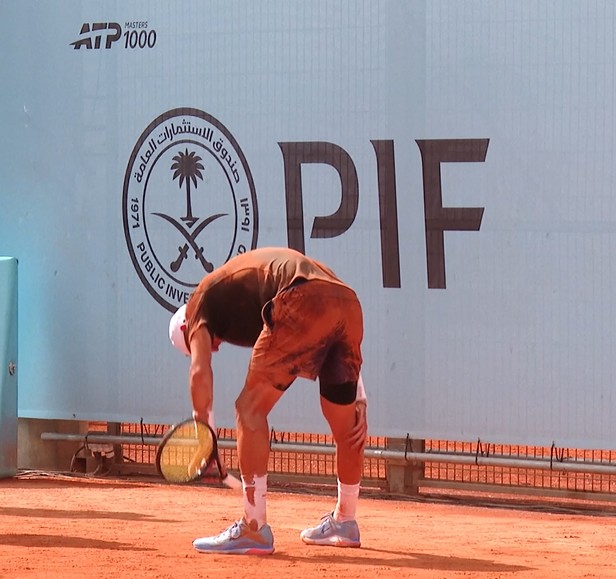
When Terence Atmane began cramping in the second set of his 7-6(3), 7-6(5) win over Ugo Humbert on Saturday in Madrid, it was hard to imagine he would survive the encounter—let alone win it.
“I’ve been through hell—there’s no other words,” Atmane told Tennis Channel a few hours after the win.
“To be honest, I started to fully cramp at 5-4 serving for the match. Somehow, I survived. I was trying to win as much as him,” Atmane said. “I was trying my best because my team was here so I also wanted to fight for them. I sacrificed my entire life to be here so I didn’t want to give up. I think that’s the mentality I try to have on court and it paid off so I feel very lucky to be here, but here we are.”

He had already failed to serve out the match at 7-6, 5-3 when the cramps set in. What followed was a rapid unraveling. The Frenchman could barely move as Humbert broke back to level at 5-5.
At 4-5, 40-15 on Humbert’s serve, Atmane leaned against the back fence, grimacing in pain. Minutes passed without a point being played. Even after medical staff arrived, he remained hunched over, struggling to move.
The umpire eventually returned to urge him to continue, but Atmane could do little more than gesture—he simply couldn’t move.
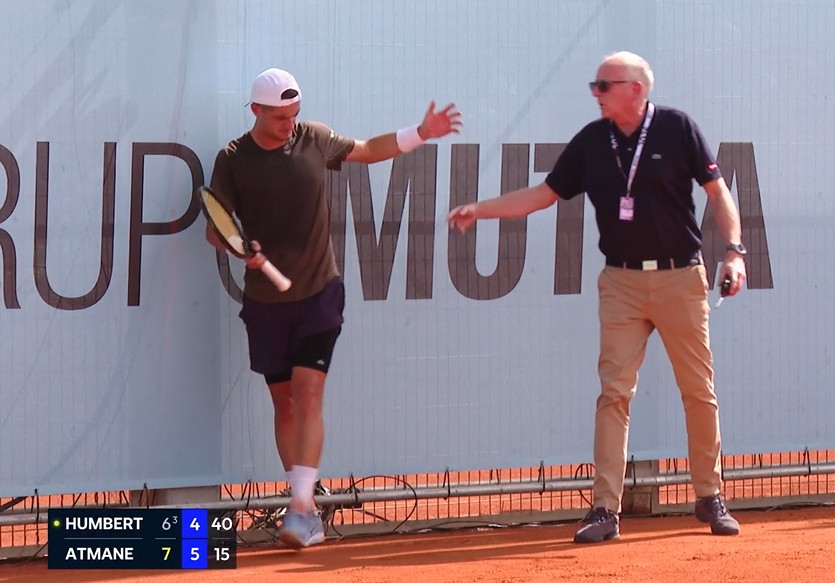
Could he possibly survive this bizarre encounter?
Somehow, he did more than survive. Atmane resorted to rolling in heavy topspin serves and, improbably, held for 6-5. He remained standing during the changeover, avoiding the agony of sitting down.
All Humbert needed was composure. An underarm serve might have sufficed—but he didn’t go there. Instead, he held to force a tiebreak, serving conventionally and trying to ignore what was happening on the other side of the net.
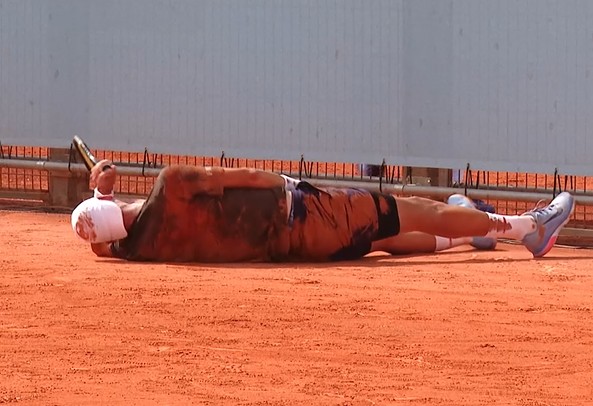
When Humbert surged ahead 4-2 in the third set breaker, Atmane collapsed back onto the fence, writhing in pain for nearly three minutes.
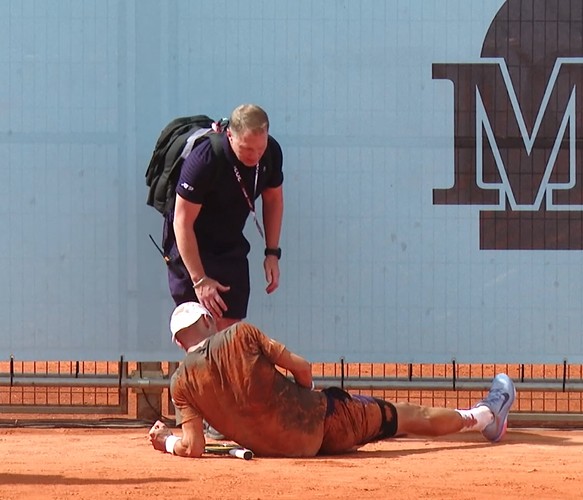
After 90 seconds, he had barely managed to get to his feet. Thirty seconds later, he dropped into a squat mid-court, shouting in pain.
Play resumed after a change of ends that stretched two minutes and 45 seconds.
Throughout it all, Humbert did not protest. He didn’t press the umpire for time violations. And for reasons that remain unclear, none were issued, at least not audibly.
The contrast with Acapulco in February was stark. There, in a quarterfinal against Miomir Kecmanovic, Atmane had been penalized on match point while dealing with physical issues—effectively ending the match.
Back in Madrid, he trailed 5-2 in the tiebreak.
Surely this was over.
No.
Atmane won the next five points to complete one of the most surreal victories in recent memory.
At 5-5, he connected on a body serve and followed with a forehand winner from mid-court. On the next point, he simply kept the ball in play—long enough to draw an error from a tightening Humbert. Match point, 6-5.
Atmane summoned one last surge, firing a strong serve before watching Humbert’s backhand drift wide.
“At 5-5 somehow the pain was going away,” Atmane said. “At 6-5 finally I was able to serve a first serve. I was just trying to put the serve in because I didn’t want to take any risk. And try to play the plus one as good as I can with the capacities that I had—and get the win.”
The crowd erupted—then fractured. Cheers mixed with boos and whistles, and Atmane gestured for silence.
There was little joy in the aftermath. He appeared sympathetic to Humbert, aware of the circumstances surrounding the finish.
In the end, the match left behind more questions than celebration.
What is the right way to handle a situation like this—when a player is clearly in physical distress, yet play continues?
Atmane: You Have to Ask the Umpire
French journalists later asked Atmane if he understood that Humbert and his coach Jérémy Chardy were complaining about the fact that no time violations were handed out during the match.
Here is is response, translated:
“I understand completely. But unfortunately, these are things—things that Jérémy (Chardy, Humbert’s coach), Ugo, and I myself—have no control over. You have to ask the umpire why he didn’t issue me a time violation. I have nothing to do with it. I’m just trying to fight using whatever strengths I have at that moment. I don’t collapse to the ground on purpose; it’s simply because I genuinely can’t stand up anymore. I try to respect the rules to the best of my ability. As for the time violations, those are questions that need to be directed to the umpire and the tournament referee. As for me, I just try to do my thing; I tried to fight as best I could, and that’s it.”







1 comment