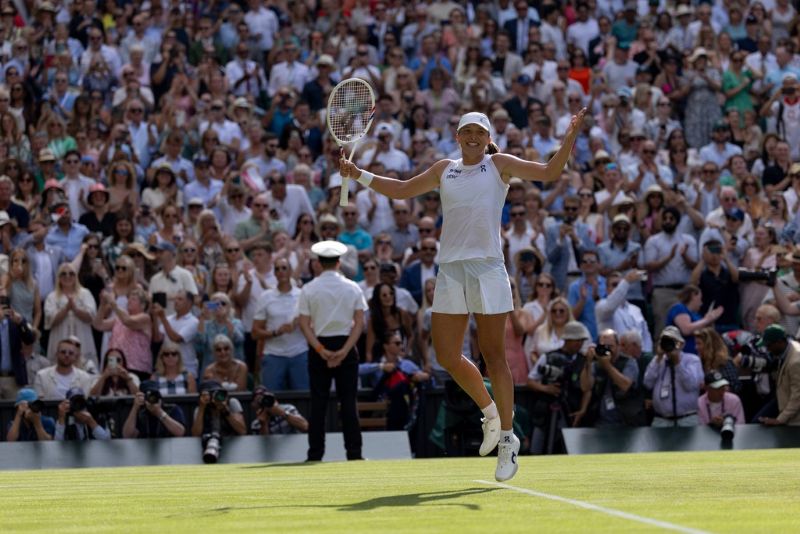
Richard Pagliaro | Friday, June 26, 2026
Photo credit: Jon Buckle/ROLEX
Visions and revisions pop off the page when viewing the Wimbledon draw.
The singles draws for The Championships were conducted today and present plenty of possibilities for major champions and comeback queens as well as early high hurdles for a few fan favorites.

Draw day is the time to assess the adventure that lies ahead on the London lawn and the degree of difficulty for leading contenders.
Nine different women have raised the Rosewater Dish in the last nine years and world No. 1 Aryna Sabalenka will try to stretch that streak.
2026 Wimbledon Ladies Draw Click Here
2026 ESPN Wimbledon TV Schedule Click Here
A total of 36 Americans—18 men and 18 women—have spots in the Wimbledon singles main draws, which is the most Americans since 37 in 1996.
Here are our Top 5 Takeaways from the Wimbledon Ladies draw.
Williams Welcome Sight Line
Team Serena has cause for celebration before she’s struck a shot.
In an ideal start, 44-year-old Serena Williams will play 20-year-old Aussie Maya Joint in her Wimbledon opener. The counter-punching Joint, who has dropped 13 of her last 14 matches, does not own the weapons to trouble the former world No. 1.
If wild card Williams wins that match she’d play either left-handed Filipina fan favorite Alexandra Eala, who has a win over Coco Gauff this year, or Mexico’s Renata Zarazua, who upset 2025 Australian Open champion Madison Keys at the 2025 US Open, in round two.
Stylistically, Williams’ all-court explosiveness matches up well through those first two rounds with a potential third-round blockbuster looming against reigning champion Iga Swiatek, who has a tricky opener in former doubles No. 1 and serve-and-volley specialist Taylor Townsend.
It’s been a decade since Serena stopped Angelique Kerber to collect her seventh Wimbledon championship in 2016. Serena arrives at SW19 seeking her first Wimbledon singles win since 2019—and to snap a two-match losing streak in openers.
If you saw the 23-time Grand Slam champion’s doubles comeback match alongside 19-year-old Canadian star Victoria Mboko then you saw her rock a 120 mph first serve a couple of times, play with clarity and control and actively try to shorten points, including serving-and-volleying a couple of times.
Here’s what we’ll be looking for when watching Serena:
- Footwork. Williams was on balance and anticipated remarkably well given her three year, nine-month layoff in her Queen’s Club comeback. Still, she only had to cover half the court and she was partnering one of the fastest women in the game in Mboko, who was ultra aggressive in that match. The question is: Can a 44-year-old Serena cover the entire court for an entire match against quick players a quarter-century younger? How well will she hit the running forehand and come out of the corners? Can she get off the mark quickly when opponents drop shot her?
- Recovery. Remember, Serena has not played a complete singles match in nearly four years and she’s entered in both singles and doubles. How will the mother of two, who has shed 35 pounds using weight-loss drug Ro (and earned a prominent place as brand ambassador), recovery if she wins the opener for round two? In the latter years of his career, Pete Sampras would often get blisters on his racquet hand when returning to the Tour Down Under. A seemingly simple occurrence like a blister on a finger or big toe, a back strain, a sore ankle, etc. can have major repercussions when you’re a 44-year-old returning to the highest level of your sport with zero singles match play preparation.
- Sustained Explosiveness. If Serena is to win a match, a few matches or even make an inspired second-week run, she must serve with command and play declarative quick rallies. Even icons can’t beat time and it’s losing proposition playing repetitive running rallies against players 25 years younger. Williams must crack her backhand down the line, use her drive volley to detonate points as she did in Queen’s, mix the wide slider serve with rockets down the T and rip returns deep in the court. She did most all of that playing doubles, can she unleash it in singles? We’ll see.
Overall, Williams’ comeback figures to be one of the most highly viewed Wimbledon first round in the Open Era so it will be interesting to see how she handles the nerves as well.
Can a champion who imposed dominance in her 20s and 30s when she made it look so easy now find ways to win at 44 when it will be much more demanding? If Serena plays the dynamic tennis we saw at Queen’s Club (she was not as sharp partnering Karolina Muchova in Berlin), I do see her winning at least the first two rounds.
Sabalenka’s Best Shot
Tiebreak queen Aryna Sabalenka knows how to create closure.
That’s why it’s so unsettling to see Sabalenka’s recent collapses at closing time. Left-hander Diana Shnaider dispensed a third-set bagel to the world No. 1 in the Roland Garros quarterfinals before Jessica Pegula shut Sabalenka out in the third set of the Berlin semifinals on grass.
So Sabalenka, who opens with Serbian qualifier Teodora Kostovic, starts the tournament with both baggage from those meltdowns and a major opportunity with one of her more favorable Wimbledon draws.
The world No. 1 could face either 2021 US Open champion and home hero Emma Raducanu or 2017 Roland Garros champion Jelena Ostapenko in what would be a high-profile third-rounder. If seeds hold true to form, Sabalenka would face former No. 1 Naomi Osaka in the fourth round. Sabalenka has scored three wins over Osaka this season and the four-time Grand Slam champion concedes she’s still finding her footing on grass. Sabalenka would face Roland Garros champion Mirra Andreeva in the quarterfinals. The semifinals could bring a rematch vs. Pegula or Coco Gauff, who has not excelled on grass, but beat Sabalenka in the 2025 French Open final.
The good news for Sabalenka is players who have beaten her before, including Amanda Anisimova, who edged her in the 2025 Wimbledon semifinals, Elena Rybakina, who rallied from 0-3 down the decider to beat her in the Australian Open final, Iga Swiatek, Diana Schnaider, Madison Keys, and Sorana Cirstea are all in the bottom half of the draw.
Though none of Sabalenka’s 24 titles have come on grass, you can argue this is her best shot to reach the Wimbledon final after three straight semifinal appearances. In fact, despite her recent struggles, I’d say it’s a disappoint if she does not reach the final given her draw and game. Sabalenka has worked for nearly a year with co-coach and former doubles No. 1 Max Mirnyi, who famously partnered Victoria Azarenka to the mixed doubles gold medal at the London Olympics on Wimbledon’s lawn, to refine her net play and transition game. This is the time when that work comes to fruition.
Best Draw Top Contender: Elena Rybakina
The 2022 Wimbledon winner Rybakina is one of the top favorites to regain the Rosewater Dish.
Ace leader Rybakina’s serve, her flat strikes and ballistic backhand are all reasons to back the power player who owns a 21-4 record at SW19.
The draw is another.
Rybakina opens vs. Frenchwoman Lois Boisson, who is at her best on red clay. Caty McNally, a fine volleyer capable of serve-and-volleying could test Rybakina in round two. McNally took a set off Swiatek at the 2025 Wimbledon, reached the ‘s-Hertogenbosch quarterfinals this month and has split two career meetings vs. Rybakina. On this surface, if Rybakina is landing her first serve in the 60 percent range, you’ve got to like her chances to make a deep run.
The very dangerous Amanda Anisimova, who toppled Sabalenka en route to the 2025 Wimbledon final, could await Rybakina in the quarterfinals. In their lone meeting, Rybakina shredded Anisimova 3 and 1 at the WTA Finals. If seeds hold true to form, Rybakina would play six-time major champion Iga Swiatek in a blockbuster semifinal of former and current Wimbledon champions.
Worst Draw Top Contender: Iga Swiatek
It’s not easy being queen of the green.
Today’s draw made it a whole hell of a lot harder for reigning champion Iga Swiatek to become the first woman since Serena in 2016 to defend Wimbledon.
First, former doubles world No. 1 and dangerous left-hander Taylor Townsend awaits in round one. Townsend is not only one of the most skilled net players in the sport, she can displace opponents sliding the lefty serve out wide and play the low slice to Swiatek’s extreme western grip topspin forehand making it demanding to dig out low balls.
Should Swiatek prevail in that opener, there are more flashpoints to follow. Swiatek could face this path:
R2: Karolina Pliskova
R3: Serena Williams or (29) Alexandrea Eala
R4: (13) Jasmine Paolini or (24) Clara Tauson
QF: (8) Elina Svitolina or (12) Marta Kostyuk
SF: (2) Elena Rybakina
F: (1) Aryna Sabalenka
Credit Swiatek for a phenomenal performance to win her maiden Wimbledon last July, but this month she faces a minefield of major explosive obstacles that will be tough to survive. Remember, Kostyuk knocked Swiatek out of Roland Garros, Svitolina has beaten her twice already this season, Eala beat her last year.
Wimbledon Must-See First-Round Matches
Serena Williams (USA) v. Maya Joint (AUS)
Head-to-head: First Meeting
(3) Iga Swiatek (POL) v. Taylor Townsend (USA)
Head-to-head: First Meeting
(32) Katerina Siniakova (CZE) v. Zheng Qinwen (CHN)
Head-to-head: Siniakova leads 3-1, including Wimbledon first-round wins in 2023 and 2025.
(5) Mirra Andreeva v. Magda Linette (POL)
Head-to-head: Andreeva leads 3-1
(13) Jasmine Paolini (ITA) v. Robin Montgomery (USA)
Head-to-head: First Meeting
(23) Emma Navarro (USA) v. Paula Badosa (ESP)
Head-to-head: Badosa leads 2-1
(24) Clara Tauson (DEN) v. Maria Sakkari (GRE)
Head-to-head: First Meeting
0 comments