By Richard Pagliaro | Tuesday, May 4, 2026
Photo credit: Tim Clayton/Corbis/Getty
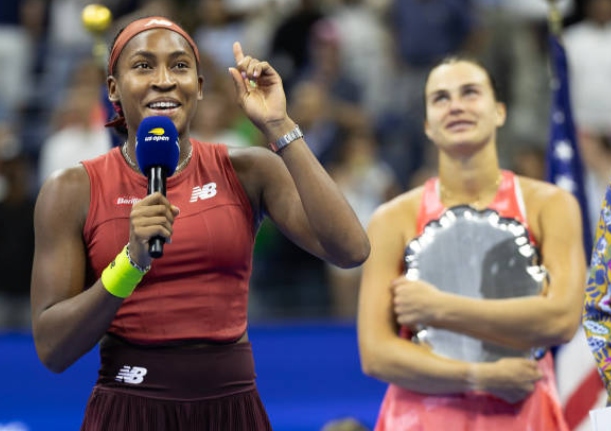
Aryna Sabalenka and Coco Gauff squared off in the 2025 Roland Garros final.
Today, Gauff stood shoulder-to-shoulder with Sabalenka stating a player boycott of Grand Slams is possible if the majors don’t commit to greater revenue sharing with players.

“Yeah, if everyone were to move as one and collaborate, yeah, I can 100% see that,” Gauff said of Sabalenka’s prediction of a player boycott of Slams. “It’s not about me. It’s about the future of our sport and also, like, the current players who aren’t getting I guess as much benefits maybe as even some of the top players are getting when it comes to like sponsorship and things like that.
“We’re making money off court. When you look at the [Top] 50 to 100, 50 to 200, how much money each slam makes, it’s kind of unfortunate where the 200 best tennis players are living paycheck to paycheck,
whereas other sports it’s not even a discussion.”
Jannik Sinner, Sabalenka, Gauff, Iga Swiatek, Novak Djokovic, Alexander Zverev and Daniil Medvedev are among a group of about 20 stars who have signed a letter slamming Roland Garros’ 2026 prize money.
Last month, the tournament announced the total prize money for the 2026 Roland Garros is €61.723 Million, up 9.53% compared with last year.
While the tournament touts the prize money increase, players say scratch beneath the surface and that number actually represents a decrease in player percentage of revenue.
Today, Sabalenka said if negotiations are unsuccessful, players are prepared to boycott Slams as “the only way to fight for our rights.”
“I think at some point we will boycott it, yeah,” Sabalenka said. “I feel like that’s going to be the only way to kind of, like, fight for our rights.”
Two-time Grand Slam champion Gauff says the only path for players to make meaningful change is to unionize and collectively demand it.
“Honestly I kind of agree with [Sabalenka], just taking what the WNBA kind of accomplished. They also have a union, so I think that helps,” Gauff said. “I definitely think, from my not experience, because I don’t
have a lot of life experiences, but from the things I’ve seen with other sports, usually to make massive progress and things like this, it takes a union. Yeah, we have to become unionized in some way.”
he Grand Slams counter they take all financial risk by building infrastructure and actually running the events—and say they are raising prize money totals, sometimes to record levels, annually.
In a statement, Roland Garros said it’s prize money increases are greatest in the qualifying rounds and first three rounds of the tournament. That’s designed to financially aid the lower-ranked players who need the money most to continue competing on the global tour.
“The total prize money for the qualifying event has been increased by 12.9%. The prize money for the main draw is up 10.1% compared with 2025,” Roland Garros said. “A particular effort has been made for the first three rounds of the singles draw, with an increase of between 11.11 and 11.54%.”
Gauff said some frame the debate as top players just wanting more money, but she insists it’s about equitable pay for all at Grand Slams.
“I think this conversation can sometimes get twisted as wanting more and more and more. Us as top players understand that maybe our voices are amplified a little bit more because of the reach that we have,” Gauff said. “That doesn’t mean we’re only doing this for us.
“I definitely think there’s a consensus around that this needs to be addressed for all players of all levels, especially the lower-ranked players, too. I definitely think that’s something that I care about. I want to leave the sport better than I found it. If I can say I played my part when I retire, that’s something I can be
proud of.”
Former world No. 1 Iga Swiatek said she believes player are more unified on important issues, but does not envision a Grand Slam boycott, which she called “a bit extreme.”
“The same thing happened with scheduling when the changes have been made about mandatory tournaments,” Swiatek said. “Unfortunately, we were a bit late in terms of the reaction. I think we have, like, pretty clear and similar vision.
“But boycotting the tournament, it’s a bit extreme kind of situation. I don’t know. I guess we as players are here to play as individuals, and we’re competing against each other.
“There have been, like, situations like that, so it’s really hard for me to say how it would work, if it’s even there on the picture. For now, I haven’t heard anything.”
0 comments