By Richard Pagliaro | Tuesday, May 4, 2026
Photo credit: Miami Open Facebook
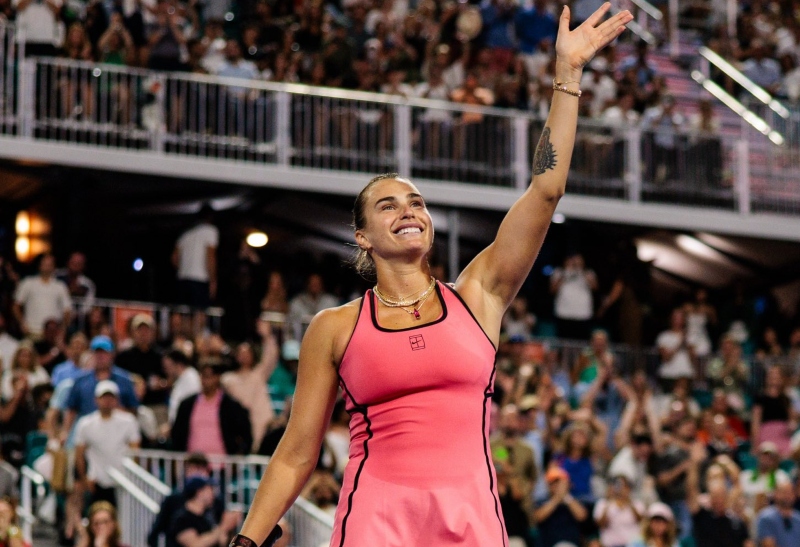
Players will stage a Grand Slam boycott if the imbroglio over prize money remains unresolved, says Aryna Sabalenka.
The world No. 1 said: “I think at some point we will boycott [Slams],” if players’ request for a greater share of Grand Slam revenues aren’t met.

“Definitely when you see the number and you see the amount the players receiving… I feel like the show is on us,” Sabalenka told the media in Rome today. “I feel like without us there wouldn’t be a tournament and there wouldn’t be that entertainment. I feel like definitely we deserve to be paid more percentage.
“What can I say? I just really hope that all of the negotiation that we are having, we at some point are going to get to the right decision, to the conclusion that everyone will be happy with.”
Jannik Sinner, Sabalenka, Coco Gauff, Iga Swiatek, Novak Djokovic, Alexander Zverev and Daniil Medvedev are among a group of about 20 stars who have signed a letter slamming Roland Garros’ 2026 prize money.
Last month, the tournament announced the total prize money for the 2026 Roland Garros is €61.723 Million, up 9.53% compared with last year.
While the tournament touts the prize money increase, players say scratch beneath the surface and that number actually represents a decrease in player percentage of revenue.
Stars criticizing Roland Garros—and the Grand Slams’ prize money totals—cite three primary issues:
- Players’ share of Roland Garros tournament revenue has declined from 15.5% in 2024 to 14.9% projected in 2026, they say.
- The Slams have issued no response to players’ proposals on welfare, including pension and long-term health, according to players.
- There has been “No progress on fair and transparent player representation within Grand Slam decision-making,” according to players.
Fair pay comes down to revenue sharing from the Slams’ total bottom line and stars say the players are not getting it.
Today, Sabalenka said if negotiations are unsuccessful, players are prepared to boycott Slams as “the only way to fight for our rights.”
“I think at some point we will boycott it, yeah,” Sabalenka said. “I feel like that’s going to be the only way to kind of, like, fight for our rights.”
The Grand Slams counter they take all financial risk by building infrastructure and actually running the events—and say they are raising prize money totals, sometimes to record levels, annually.
In a statement, Roland Garros said it’s prize money increases are greatest in the qualifying rounds and first three rounds of the tournament. That’s designed to financially aid the lower-ranked players who need the money most to continue competing on the global tour.
“The total prize money for the qualifying event has been increased by 12.9%. The prize money for the main draw is up 10.1% compared with 2025,” Roland Garros said. “A particular effort has been made for the first three rounds of the singles draw, with an increase of between 11.11 and 11.54%.”
Former world No. 1 Iga Swiatek said she believes player are more unified on important issues, but does not envision a Grand Slam boycott, which she called “a bit extreme.”
“The same thing happened with scheduling when the changes have been made about mandatory tournaments,” Swiatek said. “Unfortunately we were a bit late in terms of the reaction. I think we have, like, pretty clear and similar vision.
“But boycotting the tournament, it’s a bit extreme kind of situation. I don’t know. I guess we as players are here to play as individuals, and we’re competing against each other.
“There have been, like, situations like that, so it’s really hard for me to say how it would work, if it’s even there on the picture. For now, I haven’t heard anything.”
Elena Rybakina, who rallied from a break down to defeat Sabalenka in a pulsating Australian Open final in January, said if the majority of players agree to a boycott, then she’s on board and will commit to the cause.
However, Rybakina said she’s skeptical it will happen because “for now, not once [have] players really came together and did any changes.”
“If the majority say we are boycotting, we are not playing, then of course I’m up for it. It’s not an issue,” Rybakina said. “I feel like the improvement we need to have, it’s not only on the Grand Slams and it’s not only about raising the prize money.
“A lot of people are not aware that there is taxes which are big. You even make more prize money, but you giving it all to the taxes. It’s a different topic.
“It’s tough to say about boycotting. As I said many years we had different issues. For now not once players really came together and did any changes.”
I love Aryna, yet it’s hard to fathom a demand for increases in prize money when you’re bedazzled in Jewelry that is valued at what an average person earns in a year or more and are at the top of the Tennis ‘food chain’ (along with most of the other 20 players signing the letter). It’s fair to increase prize money to qualifying and early rounds, as that is where the lower ranked players really need the money to even compete. Most of the world deals with inflation and high taxes, so should Tennis players be exempt?
Do these players realize that they are richer than probably 95% of the people in the world? They are tone deaf in regard to what they think they are owed.
I’m just worried that the way they’ll get the money they want is by raising ticket sales. My dream is to see Aryna play live but I know this will never happen. The seats are already so expensive. I’ll keep watching every match from home. I’ll have to be ok with that.
The tournament organizers say that they are putting capital at risk by building facilities and hosting the tournaments. Where is the risk? They know in advance what the TV revenues will be, and know that they will make a profit. In the almost 60 years of the open era in tennis, what are the examples of major tournaments losing money? If there are zero examples, then the risk is zero or near zero.
If a company invests a billion dollars in a new semiconductor factory, it might not pay off, depending on competition and economic cycles that could cause a downturn in semiconductor demand. That is an example of putting capital at risk. The tennis organizers are repeating boilerplate economic language that does not apply to their situation.
Golfers get a higher percentage of revenues, and as a result, golf has more athletes actually making a living than tennis does. You had better be ranked #100 or better to make a living in tennis, while the #200 golfer makes a good living. The issue is not primarily with the major tennis tournaments. It is the spending of revenue on administrators with cushy jobs throughout the tennis associations.