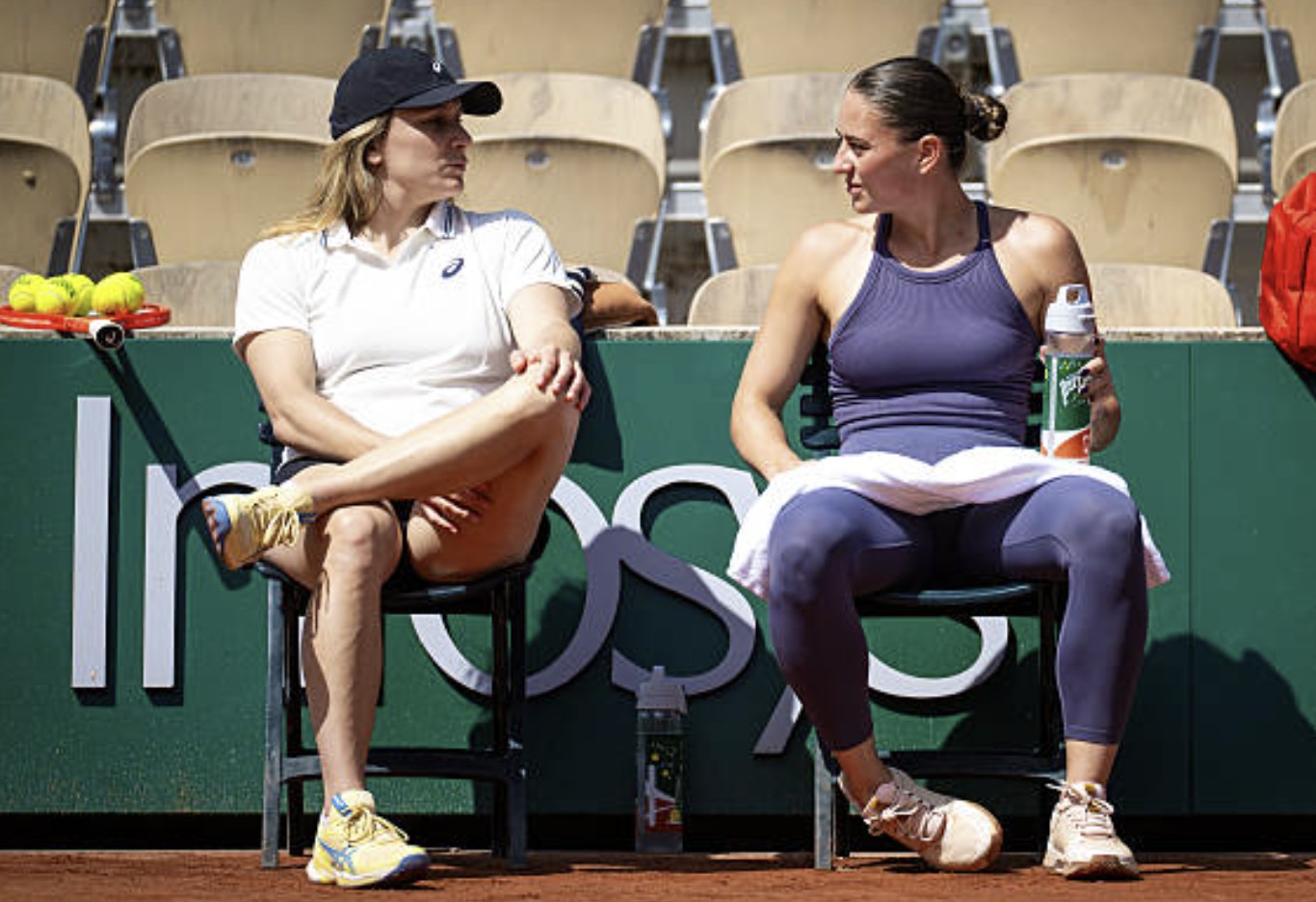
Sandra Zaniewska has operated as the coach of Marta Kostyuk for three year, helping guide the Ukrainian to steady growth and milestones, including her current 15-match clay court winning streak. But the former WTA pro is so much more. She’s a popular blogger on Substack, a published author and a pioneering woman who is doing her best to raise the profile of female coaches in tennis, and all over sport.

Currently, she’s in Paris, preparing Kostyuk for one of the biggest matches of the tournament, on Sunday against four-time champion Iga Swiatek. We caught up with the 34-year-old to talk about her chemistry with Kostyuk, her love of writing and the importance of letting Marta be Marta.
How important is it for you to push this forward, be a role model, influence the shape of tennis coaching in general?
I don’t think about it day to day, but I feel very privileged, obviously, to be in this position, because I feel like female coaches in tennis, there are so few because there are not many opportunities, and I was the luckiest person in the world to get an opportunity like I did from Petra [Martic]where she pretty much was like, ‘Look, I like the way you see tennis. Why don’t you come and help me out?’
And then, from coaching a couple of weeks here and there, it turned to full-time, which I thought was a terrible idea, but it worked. Who gets a chance like that? I was really lucky to get that and to still be here so many years later. After I started with her. For me it’s a huge privilege and I’m happy if I can move the needle forward a little bit.
Yeah, it’s big, right? I love your Substack, too. What inspired you to start it?
I always liked writing. I always wrote a lot, and at one point last year, I started just writing to reflect again. I wasn’t doing it for many years, and then when I was writing, some memories, from the past, were coming to me, I was like, ‘Hey, you know, this could be an interesting thing. And I wrote a couple of essays, and I sent them to Marta, and I said, ‘What do you think?’
And she was like, ‘They’re so good – you should really publish them, nothing like this exists. It will be awesome.’ That’s how I started publishing, and I am still writing.
So for the first year, I was writing two a month, and now I think I’m gonna go with one a month, just to kind of keep it going because I still like it.
But yeah, that was really it. It was just my own reflections.
The last essay really hit me. It was really informative, especially given what you and Marta just went through, when you won Rouen and then Madrid. You talk first about a level that appears in a level that stays. Can you talk me through that a little bit? In reference to you and Marta, where you are right now, and how important it is to kind of embrace that concept.
I think with Marta, it was always very visible. She was a player that could win against anyone, but also sometimes lose against anyone, too. Her level, if it was really good, it was unbelievable, but it just couldn’t hold for a long time. So there was so much inconsistency in the results, I would say. We all see the ability that she has. She has all the tools, and if you just think about it, you’re like, ‘Okay, she should be able to beat any player, right?’ But that wasn’t the case for many years, and I think that what we had been searching for was to take her to another level of tennis, because we knew that this level is there. She has it, the question was always, how do we make it consistent? How can we keep it? So once it’s there, you know, how does it stay? And I think that this is exactly what happened. It’s not like it’s a miracle that she starts putting all the ball in or hitting the ball harder, it’s more like she’s doing all those things. She’s doing the right things, but she’s able to do them all the time, or most of the time, in the match.
And is there truly something that she didn’t have before that she has now? Now that she’s on a 15 match clay winning streak?
I think that before some things cost her emotionally a lot, and when you’re coming to an event that’s 10 days or two weeks long, if your first match is going to cost you so much emotionally, there’s no chance that you can sustain it for another 10 days at an event, right? Now I think in general things are costing her less emotionally, so she has more energy and she’s able to sustain that level, and compete again in the same way.
Before, sometimes, she would be so tired and so drained that she would come on the court, you know, second, third or fourth round and she would be like, ‘Wow, it costs a lot. I have to find this energy from somewhere, but I don’t know from where.’
Right now she starts with a full tank and it just empties slower.
How do you get there? And how did you help her get there as her coach?
It’s a combination of so many different things. It’s the technical changes but it’s also the things that she does in the gym. It’s the things that she does with her physios, the things that she does mentally, you know? It’s also time that passes and her growth as a person because she’s living more and experiencing more life.
So I think I cannot give you one thing, because it’s not one thing. It’s a lot of things done right over a course of time. When I was starting with her, I saw the potential, I saw the ability, but I was a bit like, ‘whoa, there are a lot of things around that we have to put together in order for this to work. And I feel like we did it, you know?
When you step back and you watch what Marta’s been able to do, given the fact that she’s Ukrainian, given the fact that she has so much passion for the cause there, and there’s so much happening in her mind, that she’s been able to compartmentalize and become the player she is right now, what do you think?
I cannot even imagine. Like, I have goosebumps. I cannot imagine, because I always say that I cannot relate to her, because I’m not going through this, and I hope that I will never be able to relate. To be able to live life, to do this work at such a high level and have this at the back of your mind every single day. I don’t know, to be honest. I have no idea how. It’s insane.
Marta is emotional, and I think maybe that a big part of her being able to progress in the way she has been able to kind of calm her mind down and focus more. Have you had a role in that? Are these the conversations that you refer to over dinner that get discussed over beers or whatever?
Marta interrupts the interview. Sandra says she wanted to crash her presser but barely missed it. The interview continues.
It happens in those moments. But not always, you know? I think we have such a good chemistry and such a good connection that Marta feels safe opening up and talking about what she feels, and she knows that there’s always space for it. For me, this was the most important thing from the beginning – I always saw the fact that she’s emotional is a good thing. I never saw it as a bad thing. I was like, okay, this is a big part of who she is. Why would we change that? It can be such a positive thing too, you know? And I think over time, when she just felt comfortable because I gave her the space and everyone in our team and around her gave her space to be who she is. I was like, ‘Okay, it doesn’t have to be a bad thing.’ Why would I, why would I try to bury it?
I just need to learn to use it to my advantage. And I think that this is the big part right now, that she finds a way to use those emotions in a way that serves her.
How excited are you that she’s been able to follow up the success of Rouen and Madrid, and make the second week here, and how excited are you for the opportunity to face the four-time champion?
I think this matchup, Marta and Iga, it’s unbelievable, you know? You can see that Iga’s finding her flow and Marta hasn’t lost a match on clay this year. Even if I wasn’t coaching her, this is the match that I would be watching on the TV. I think this is great for tennis.
Expectations, have you had that discussion, and what are your thoughts on the fact that there may be some now?
We didn’t even talk about the whole tournament. I think at this stage, when you have played so many matches, you know that you feel good, but you need to preserve your energy, too, right? There’s still a long way to go. So the next match is the one that’s the important one, and that’s it.
I’m very happy about this whole clay season, you know? It’s been unbelievable. There is nothing that I can complain about, nothing that I can say that is going wrong. So, for me, I think, yeah, it’s the same. I do my job, like I do it on any other week, whether she has a couple of bad losses before or not, I prepare the match the same. There’s really no difference. So we try to keep it exactly the same, that there’s nothing out of the ordinary and hopefully, we keep the roll going all the way.
0 comments