By Richard Pagliaro | Monday, June 1, 2026
Photo credit: Robert Prange/Getty
Linespeople will continue calling the shots at Roland Garros.
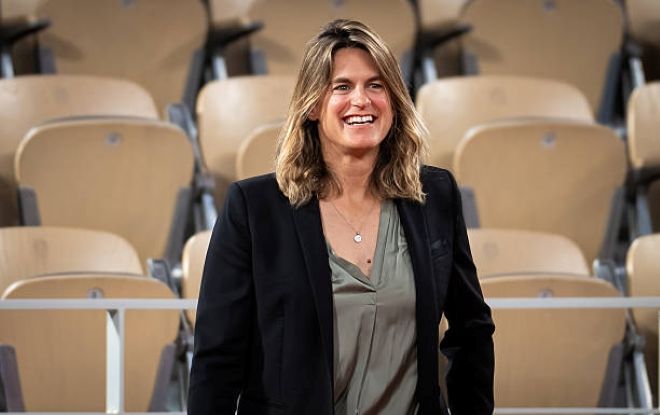
Amid increasing calls for Roland Garros to adopt line-calling technology, Tournament Director Amelie Mauresmo said there’s one main stumbling block: “Hawk-Eye is not totally reliable.”

The French Open is the only one of the four Grand Slam tournaments that does not use electronic line calling.
Debate over the clay-court Slam adopting electronic line calling is intensifying again as linespeople seemed to make a couple of incorrect calls on set points during João Fonseca’s four-set victory over two-time finalist Casper Ruud on Sunday night. Each man appeared to be victimized by blown calls on set points.
Leading 8-7 during a tense second-set tiebreaker, Fonseca fired a forehand down the line that appeared to land on the line. Though the linesman called the ball good a fan in the crowd shouted “out” prompting chair umpire Louise Engzell to inspect the mark. The chair umpire ruled the ball had touched the line and ordered the set point be replayed.
Meeting the media today, Mauresmo said the tournament will review its line-calling policy during its annual debriefing meeting at the end of June. However, Mauresmo reinforced Roland Garros’ stance that “As far as we’re concerned, the Hawk-Eye is not totally reliable.”
Roland Garros officials have said in the past the unevenness of clay courts is one reason why Hawk-Eye is not as accurate on red clay as it is on hard court though supporters say electronic line calling is clearly superior to the human eye.
“I don’t have an answer to [if Hawk-Eye is more accurate than humans] either,” Mauresmo said. “However, it is important to show and say out loud that we trust our system based on umpires and line judges, and we always try to review everything after the tournament.”
Line-calling controversy struck the fifth set of the 2024 French Open men’s final. Olympic gold-medal champion Alexander Zverev built a two-sets to one lead only to see Carlos Alcaraz storm back and win 12 of the last 15 games capturing his maiden Roland Garros crown with a grueling 4 hour, 19 minute victory.
Afterward, Zverev shared his fury and frustration—-over an apparent blown call in the fifth set. Alcaraz hit a huge second serve that was initially called out—-if that call stood, Zverev would have broken back to level at 2-all in the fifth. Instead, chair umpire Renaud Lichtenstein quickly bounded out of his high seat, checked the mark and ruled it was an ace prompting protest from Zverev, who pointed the mark was wide.
Afterward, Zverev called that apparent missed call a “deciding difference” in that fifth set.
Two-time Grand Slam champion Mauresmo said while the tournament will review it’s line-calling policy, officials are convinced electronic line calling is not completely accurate.
“This question we ask ourselves after the tournament each year, because obviously we stay open to everything, every new technology that is available for us,” Mauresmo said. “The thing is that as of
today and from what we’ve seen in the previous clay court tournaments in the last few months is that it
appears that the technology on the clay is not 100% reliable.
“It’s also when you see Casper’s reaction also last night, I mean, from what I see, he wasn’t shocked by the
umpire’s decision. I think it’s also we have to keep in mind that this technology, as of today, is not 100%
reliable.”
Critics say not only is the human eye inferior to Hawk-Eye, many times chair umpires or linespeople select the wrong ball mark in a sea of marks dotting the salmon-colored surface so sometimes the inspected mark itself is incorrect.
Former world No. 1 Roddick said it’s ridiculous umpires, many of whom never played the sport at the highest level, are authorities on ball marks over players.
“An umpire explaining to a player how a ball travels and how to read a mark is always laughable to me,” Roddick said. “Most tour umpires have barely played. Can’t replace a lifetime of up close reps.”
Mauresmo counters the actual ball mark on the red clay is more accurate than a Hawk-Eye computer simulation of the mark.
“The system is not reliable as of yet,” Mauresmo said.
Why Mauresmo lying about Hawk-eye? Her umpires and line judges only 78% accurate
The line calling and Umpire reviews have been Horrendous in the 2026 RG. One player stopped play because the ball was so Obviously out. I think Mauresmo is a lousy TD and should be replaced.
Neither are the lines people and umpires. I’ll take Hawkeye anytime over humans. There is no arguing with the umpire.