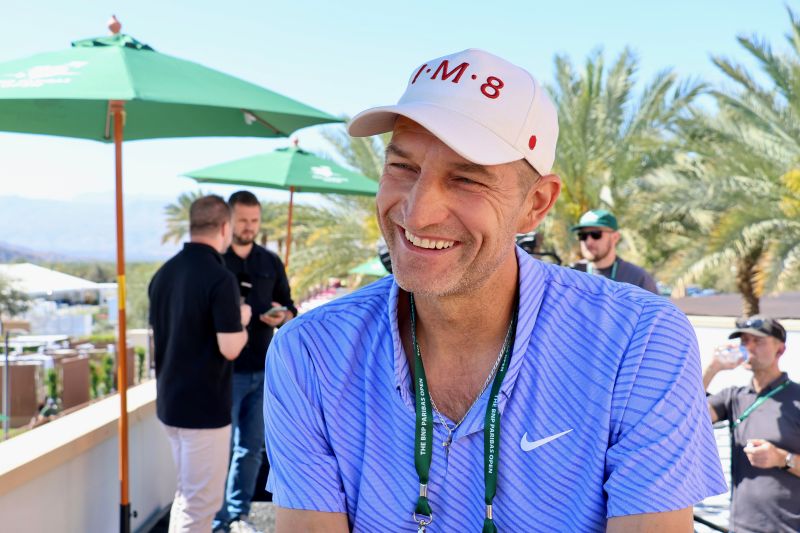
By Richard Pagliaro | Thursday, March 5, 2026
Photo credit: Rob Stone/@RobStoneTennis
INDIAN WELLS—Max Mirnyi spent his 25-year career imposing his personal rush hour on opponents.
These days, Mirnyi brings a lifetime of tennis knowledge to Aryna Sabalenka’s coaching team.
The man nicknamed “Beast of Belarus” for his fearless and fearsome serve-and-volley style is a former doubles world No. 1 who joined world No. 1 Sabalenka’s coaching team at Wimbledon.
Together, the Belarusian pair have sharpened US Open champion Sabalenka’s net skills—and even added some serve-and-volley to her aggressive baseline style.
The 48-year-old Mirnyi knows all about adaptation.
Mirnyi moved from Belarus to Brooklyn as a kid where he honed his skills on public park courts, changed his two-handed backhand to a one-handed backhand and then moved on to the IMG Academy in Bradenton.
The 6’5” Mirnyi infuses extensive experience as a champion and and coach into Sabalenka’s team. Mirnyi played 98 ATP doubles finals, captured 52 doubles titles, including the 2003 Miami Open partnering Roger Federer and the 2000 US Open with Lleyton Hewitt, won 10 Grand Slam doubles crowns and partnered Victoria Azarenka to capture the mixed doubles gold medal for Belarus at the 2012 London Olympic Games.
I M 8 Ambassador Mirnyi won a combined 1,024 singles and doubles match in his career, which is 25th on the Open Era’s all-time list.
Remarkably, tennis iron man Mirnyi never once retired from a match in his entire quarter-century career.
Mirnyi earned his law degree from Belarus State University in 2008 and remains a devoted student of the sport.
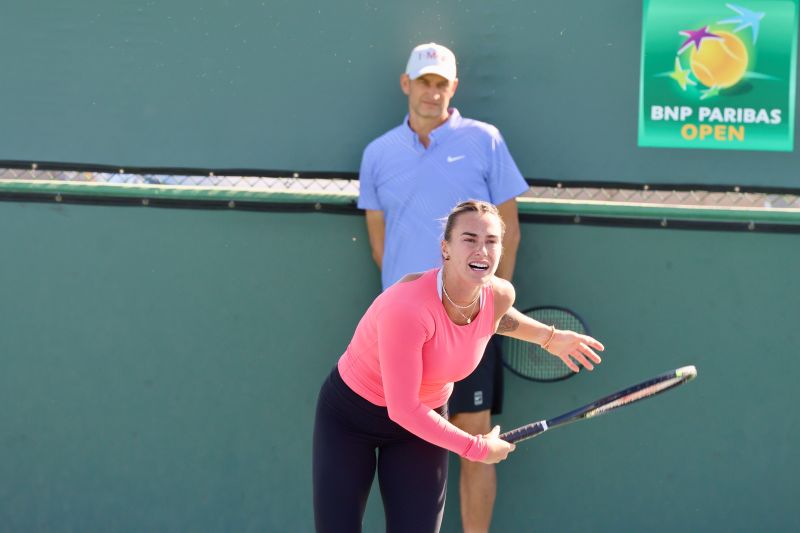
Photo credit: Rob Stone/@RobStoneTennis
In this interview conducted overlooking the grass field at Indian Wells today, Mirnyi discusses his partnership with Sabalenka, her potential to be an all-time elite champion, recalls the moments he recognized the young Roger Federer and 16-year-old Rafa Nadal would grow into iconic champions and names the toughest opponent he ever faced.
Tennis Now: Max, how did you get involved with I M 8 supplements and why does it work for you?
Max Mirnyi: I got into this by the virtue of joining Aryna’s team. As soon as I entered her team, which happened a couple of weeks after Wimbledon last year, I basically got immersed in this I M 8 culture. Aryna is very much behind the product—this is one of her main sponsors.
The whole team: physio, hitting partner, the coach, has been using it. They started talking to me about it: Have you heard about it? Do you know about it? What are you taking for supplements? I was like: Whatever, stuff off the shelf.
That very afternoon, I go back to my room and I have like six, seven different bottles. Vitamin C, B complex, the Omegas, I was like thank you. I kind of dug into this I M 8 concept so I started asking questions.
What I learned is this is a new innovative concept of going about a healthy lifestyle. I believe what completely sold me on the product was the further I researched, the more people I got to know. A lot of them with a medical background. So the scientific research made and put into it was not just like by some businessmen to be successful.
What really I believe separates this product from every other one: There is so much medical research put in by very well reputable clinics, medical institutions and the doctors who are still practicing today. Heart surgeon, Jeremy London, for example. There’s a list of doctors who participated in the research and creation of this product. I think this is very important to know. Because a lot of athletes are not medically savvy enough to know.
And sometimes we make assumptions or we guess what I should or shouldn’t take based on what a friend or a neighbor says or a trainer says. It’s not always ideal for that one individual. With this particular product I believe the homework that we should do before putting anything in our mouth has been done and relies on pure, hard-core science.
There’s a whole line of the products. They have products for an older population like you and I for longevity that has their enzymes and micro elements that affect our hormonal production. I really like it, it’s very simple. You pour it into your bottle water or your favorite drink, you drink it up, it tastes great. They’ve recently come up with a few new flavors and it goes down easily. You know the demanding lifestyle we all live whether you’re a journalist a tennis player a doctor or a lawyer, we have our priorities and knowing the supplements we put into our bodies is important on a daily basis. With the jet leg not being able to eat what you wish or should be based on your training cycle, your body goes through a lot physically and emotionally. I believe this is a good way to neutralize the side effects of a demanding lifestyle.
Tennis Now: I’ve watched you working with Aryna in practice and you’re helping with her net play. We’ve seen Aryna incorporate serve-and-volley tennis in Brisbane, in Melbourne. How is the process going?
Max Mirnyi: Well, it’s been going really well due to the fact she’s been very receptive and open to advance, to learn and to enhance her playing style. I mean some may say it’s easy to coach the world No. 1 player.
Sure, to a degree, but at the same time there’s very little room that she can improve. Because she’s already so good—the best in the world yes. There’s actually much more downside because any little thing can derail the train, right?
So I’m very cautious and aware of the fact my main goal is to facilitate and to give more options to Aryna to work with on the court. But I’m always constantly aware to be selective with what I say, where I say, when I say and how I say it. Because it’s a very physical and emotional position she’s in. You know, she’s dealing with a lot of demands physically and psychologically, she’s combating pressure non stop.
Because she’s No. 1 and everyone wants a piece of you. On the court as an opponent and in the world of media and sponsors, she’s devoting a lot of her time and energy to everyone. And that’s a very difficult situation to be in. So I’m trying to be sort of, I wouldn’t say a mentor, but someone who has come on a path, maybe to a different degree.
But I’ve done this many years. I’ve done it successfully from a standpoint that I’ve played many matches, many tournaments. My career lasted 25 years and with the help of people around me I was fortunate enough to never have had a withdrawal or to never have had pulling out of a tournament. I was very disciplined and thorough about my lifestyle and priorities and I hope that I can relay that message and leading by example for Aryna to go about her career.
She’s very successful now, but this spur of the moment is so minute. You know, I wish for her to dominate for another three, four, five, 10 years. But realistically, it’s not possible.
You have very little window in sports in general, in tennis in particular because it’s a never-ending cycle. We start in January, we compete until December, pretty much every week. Every week, it’s impossible to be at the peak of your performance for that long.
Having said that, those that make it last longer are usually the greatest of all time. The Federers, the Nadals, the Djokovics, the Serenas, the Venus’. Steffi Graf. I wish for Aryna to be one of those athletes and she certainly has the capability and if I can in anyway share my experience and lead by example of being positive, you know, bringing good energy onto the practice court or sitting in the box supporting her in the tournament.
That energy transpires and a player feels it. I want to make sure I send the best possible vibes to her to do the best she can.
Tennis Now: I remember when you were young, you changed from a two-handed backhand to a one-handed backhand.
Max Mirnyi: I can’t believe you remember that.
Tennis Now: How challenging is it to help an elite player transform aspects of her game—you’re not asking her to make a wholesale change, I get that—but how tough is it just to make an enhancement or tweak at the top level to improve?
Max Mirnyi: It’s very easy, but it’s very difficult at the same time.
And what I mean by that is from a technical standpoint, you know you look at at a player, it’s apparent what one can do and what one can’t—especially for somebody like myself who has been in the sport and I consider myself a student of the game.
I studied my own game, I studied players around me when I played on the men’s tour. Now, I’m studying, in the same way, players on the women’s tour. So from a technical standpoint, professionally, it’s very easy to say: Oh, you’ve got to do that or not do that. Don’t do that.
But when it becomes challenging is recognizing the fact you’re dealing with a player who is very successful and does what she does successfully already that’s gotten her the biggest result that’s in the game.
So it’s a combination of psychological adjustment as much as technical. Because part of it is once a player, Aryna, in this particular instance, realizes whatever I may suggest or whatever I may think or envision for her to use in the future. If she buys into that psychologically, mentally, if she thinks it makes sense it becomes much more of a smoother road.
If she’s open to explore and try and trusts me on my experience then the road is pleasant and it’s much more rapid, I would say, to achieving what I think she is capable of. Then it becomes totally, the other way cycle, if she says: Whatever it is you say doesn’t matter because I’m used to doing this, this and this—not Aryna in particular—usually this is the tendency with people who have reached success. Who are you to say? You know, I’m No. 1 in the world and I’m No. 10 in the world and I’ve done so much more than you have, you know what I mean? Figuratively speaking, it’s just a type of a character you’re dealing with.
It’s an important part of my job to learn these nuances about Aryna as a personality. Not so much as an athlete in this instance where I’m dealing with an emotional ability to receive.
Tennis Now: You spoke about the discipline it requires to be a champion. I was at the US Open match when you beat Roger, it was fourth round, a night match.
Max Mirnyi: Yes, correct.
Tennis Now: You also won three doubles titles with Roger as your partner. In fact, Roger won more doubles titles with you than any other partner, including Stan. When did you realize: This guy, Roger Federer, is going to be a once in a generational talent? When it comes to great champions like Roger, Novak, Rafa, Serena, how much of it is you’re born with a God-given gift and how much of it is the discipline, the hard work? Are great champions born or made in your view?
Max Mirnyi: I can only bring up a few scenarios of when you sometimes, without any preparation, going looking for talent. Because if you’re going to have 20 soccer players playing soccer on this field behind us, we’re gonna be zoomed in and trying to separate No. 1 from No. 20.
Sometimes, when you realize that specific person or athlete has something that others don’t have is when you’re not looking for it—when it appears in front of your eyes.
And for me, I remember a particular match, this was after the Sydney Olympics. I played Roger in Vienna. He beat me in that match. And there I felt, and remember this is three years prior to Roger winning his first Wimbledon. There, I felt, because by that time I had already been five, six years on Tour. So I played the Agassis, the Sampras’. I’ve already played the best of the time.
And here I played Roger and I’m seeing that the ball does something different when it comes off his racquet. It’s something that I haven’t seen before. I lost the match and at the time there were VHS tapes. So I want to the tournament and said: Can I please have a copy of the match?
I go home. I plug in the VCR and I’m looking and as much calmness and control that he has at the point of contact, I felt wow. I put the tape in really slow-motion, I stopped it and I zoomed in. Not a wrinkle tightens up on Roger’s face, which usually, is not the case. We hit tennis balls, it’s like a boxer hits his shot, there’s a lot of grimacing.
Roger was so calm and confident and so accurate in that match, that I’m thinking: Who is this guy? Well, obviously I knew him by the name. But I was like what is this player doing. So from that point onward, from October of 2000, I started to play closer attention to him.
A year or two later, we started to play doubles together, so I got to know him even more in depth. I practice a lot with him, spoke to his coach, Peter Lundgren, at the time.
So fast forward a few more years, I come to Monte-Carlo.
I sign up for practice with some Frenchman, I go to the practice court to get my balls. And I said: Can you please confirm which court Mirnyi has with whoever I was going to play with. They say: You have Court 13, but there’s a little change. The Frenchman, who I signed up with, he said he couldn’t come practice. But the practice court attendant says: I’ve got you another player who’s in the main draw. You don’t know him yet, but he’s pretty good.
I say: Who is he? Who are you sending me to practice with? He says: You go to 13 and someone will be there. I get to Court 13, I do my usual warm-up. I make sure I’m ready and this guy comes in on the court with a man. And he says: Hello, I’m going to practice with you. They told me to come here and this is my coach, okay?
The boy, being Rafa Nadal at 16 years old, comes in to hit with the coach being Toni Nadal. I said: Okay, what do you want to do? He said: Just hit, that’s fine. So we start hitting and obviously I realize this guy is younger than me considerably and someone I’ve never seen before. So the feeling I get is this is a guy trying to make an impression.
We’re trying to hit and like after the first or second ball, this 16 year-old is basically ripping the cover off the ball and pushing me back. Like I felt uncomfortable right away. So I took a few steps back from the baseline just to buy myself some more time and start rolling balls back.
And he’s going “Whooo! Whooo!” when he hits. And I’m like: Chill out, dude. So this was the most uncomfortable practice for me at the time. I go back and I say: Who is this guy? They say, he’s a qualifier and then I look in the draw it says Rafa Nadal and Richard Gasquet. And I’m thinking I’ll keep an eye on him. Sure enough, 14 French Opens later the guy is just the God of the game.
I got to first practice with him on the clay of Monte-Carlo and I’m like: Who is this punk trying to impress me?Just hitting so hard from like the first ball in the warm-up. I can’t get my rhythm, his ball is jumping all over the place, he’s grunting and Toni Nadal is like walking around pacing, always like keeping the intensity. And I’m like: Just let me breathe, just let me hit some balls.
So when I first hit with Rafa, I wasn’t looking for anything specific. I just wanted to hit some tennis balls. And just like with Roger, when I was zooming in on that camera trying to pick one wrinkle, the same with Rafa in that practice.
There’s another phenom, right there, of that same caliber. I’m lucky to be part of the generation. Being a student of the game, and learning about Rod Laver winning the Grand Slam in ‘62 and ‘69 and feeling like the game has lasted for so long before me and will be for so many years after me. I feel the era of me being part of the game is so golden, that I feel so fortunate and so grateful to be around at a time with these great champions. Knowing some of them on a personal level and it’s fantastic. I couldn’t be happier to be born in this lifetime and playing tennis with these guys that are gonna be in the history books in bold print forever.
Tennis Now: Given your experience with and against the Big 3 and your lifetime in tennis, do you think Carlos Alcaraz and Jannik Sinner can reach or eclipse 20 Grand Slams? Also, you were a big-time serve-and-volley player, you played serve-and-volleyers like Sampras, Krajicek when Federer beat Sampras at Wimbledon he did it serving and volleying. Can serve-and-volley come back, even in a featured or limited format, as kind of an antidote to these exceptional baseliners? Or do you think that time has passed because of the technology of racquets and strings?
Max Mirnyi: You know I feel the vibe of your question.
The best way I can answer it is: We all live in incredible anticipation of what will happen. Because when I was a kid, I knew Emerson had 12 [singles] Grand Slams. At the time, Pete had just won his first US Open. Nobody had any idea or anticipation that Pete might beat his record.
And so me living through my professional career, witnessing it first hand, was very similar in what we’re living through now. With me now on the sidelines coaching end of the spectrum. Seeing what these guys are doing to the history of the game is incredible. There are certainly capable [of winning 20 Slams]. They’ve already showed to the world they are the next in line to make new records.
Time will tell.
That’s what makes it exciting: We all are living in a historic time. Every time they hit a new benchmark that’s what makes it so entertaining and exciting, I believe, right?
To your serve-and-volley question, it’s not so much Federer and Nadal—they’re great—but in my mind, they’re not that good to change the game. The way the game evolves is it picks their best cases to represent the game.
What I mean by that is there’s a general field of players that play these Grand Slams on a regular basis. Everybody is so good—everybody.
I want to pay respect and gratitude to every single one of the players on the men’s and women’s side who make it to the top of the ladder. And to be among the Top 100 best in the world is an incredible achievement.
But what makes these couple stand out is that they are the best at adjusting to the evolution of the game.
To answer your question: Will we see serve-and-volley get back to the style and trends of the game? Probably we will. We’ll just have to see when will the game take a new turn. I can go on forever and ever starting from the era of Rod Laver. The courts they played, the equipment they used, it was advancing, changing, not necessarily for the better, but the game was changing. Bjorn Borg, was the first one to really start using topspin because the racquet became a little bit bigger, the change to the courts. Pete Sampras, Richard Krajicek, hitting 40 aces at Wimbledon, the grass was faster around their time even when I played.
Then around 2002 at Wimbledon that was the first eye opener to me when there was Xavier Malisse, Lleyton Hewitt, David Nalbandian and Tim Henman. I was like: I know these guys, I’ve played them all, I’ve beaten them some. I should be in that semifinal [laughs]. What’s going on. They’re great players, obviously, we all know them.
But honestly I had no expectation of Xavier Malisse being in the semifinal of Wimbledon. So when that happened, I was like Geez what’s going on. Next year, I get to Wimbledon the ball no longer bounces here, now it’s a little bit higher. So the technology of developing courts, the type of the grass must have changed. Because when Laver was playing, they didn’t want to let the ball bounce.
Gradually the courts became better and as ar result there’s a different sets of players that started going well. So we’ll see. When the game takes a new turn, it’s new racquets, new equipment, new strings, new balls. Whether Sinner or Alcaraz will adapt better or maybe they’ll be a new player some Switzerland or maybe from Belarus, who knows?

Photo credit: Rob Stone/@RobStoneTennis
Tennis Now: You were known as one of the biggest servers of your time. Of all the champions you faced, which server was the most fearsome for you to face?
Max Mirnyi: I was never intimidated or troubled by someone serving big.
Tennis Now: Is that because you knew you could always hold your serve?
Max Mirnyi: No, it’s because usually the bigger servers were the bigger guys. Whoever moved better on court usually was the difference between winning or losing. So I felt like Marc Rosset, Goran Ivanisevic, Greg Rusedski actually here at this event, Mark Philipppoussis–those were big servers—I felt I was a better mover at the time.
Even though my returns were not of any type to cause them trouble. But I always felt I had the upper hand with the bigger servers because at some point I knew I’d get the ball back by blocking it. And once the ball was in play I always felt I had the upper hand because I could defend better and grind and hustle. So that was sort of my approach against the bigger players.
Coming forward, I was very much counting on my athleticism.
I actually felt a lot more discomfort my whole career—I’m sure many players felt it—playing someone like Agassi.
Of all the top players, I’ve never beaten Agassi. The reason being: there are a couple more players of his playing style that caused me trouble. Andre was always effective on serve in terms of his percentage. He was very good hitting high first-serve percentage, not allowing me to attack his second serve.
But Andre was just destroying me anytime I would miss a first serve. He was destroying me. Putting a lot of pressure. The most painful loss to him was the [2002] US Open quarterfinal. I won the first set and I felt: Oh maybe this is the chance I have.
Andre put so much pressure on my second serve that I just couldn’t produce volley after volley around my shoelaces under pressure because he was so good at doing that. So somebody like Andre, like Thomas Johansson, Jonas Bjorkman. The director of this tournament, Tommy Haas, we knew each other very well. Tommy knew exactly when I was coming in to net and even though he had a one-handed backhand, he was very effective at keeping the ball low and I had to volley up every time. So different elements of the game caused problems for my game but it was never the big servers.
0 comments