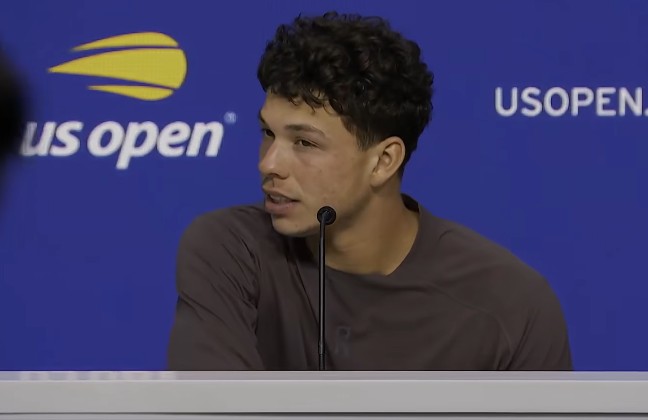
Ben Shelton didn’t want to say it, but he did. And now the rest of us kind of have to talk about it.
Alexander Zverev’s lengthy pre-serve routine became a subplot of Sunday’s US Open final – and left Ben Shelton wondering whether tennis needs to rethink its rules.

Zverev routinely bounced the ball 20 times or more before serving during his 6-3, 7-6(2), 5-7, 6-2 victory, creating an unusual dilemma for Shelton on the other side of the net.
Rather than immediately assuming his return position, Shelton could often be seen waiting until Zverev was several bounces into his routine before setting his feet and preparing to return.
“There’s not an athlete in the world that you’re going to go look and watch them do their thing and they’re going to sit in a ready position for 30 seconds before the play starts,” Shelton explained. “I’m not going to sit there in a ready position with my knees bent, tension in my body for 30 seconds while I’m waiting.”
At one point, the chair umpire spoke to Shelton about getting to the line earlier. Shelton, eager to plead his case, disagreed with the request.
“I promise you there will never be a time where he serves and I’m not ready,” Shelton said. “But I shouldn’t have to sit at the line – if he’s bouncing the ball 20 to 25 times, I shouldn’t have to just sit there for that.”
Shelton also brought up another key point, and one that the rulebook is vague about: how to police time between first and second serves. Though it likely wasn’t Zverev’s objective, since the advent of the shotclock the fact that umpires set no limit on the time used between the first and second serves, there is room for players to game the system and use the time to recuperate when fatigued. Additionally, the time between first and second serves, if long, can extend the length of matches.
Shelton, when questioned during his post-final press conference on Sunday, was particularly interested in the amount of time that can elapse before a second serve. While the server operates under the serve clock before a first serve, the second must be struck “without delay,” leaving considerable room for interpretation.
“I think that there should be some sort of rule,” Shelton said. “I’m not sure exactly how you would do it, limiting time on second serve. You shouldn’t have unlimited time.”
For Shelton, who struggled against Zverev’s serve all match, and never did make inroads against the German’s booming serve, the issue extends beyond the returner’s comfort.
“For our sport, for the fans, I think it’s tough to be sitting there that long for the next play, the next action to happen,” he said. “I’m sure at some point it will be something that these tournaments look at just because there is such a delay in play in some matches.”
It should be noted that Shelton only gave his thoughts when asked, and that he refused to blame Zverev’s routine for his fatigue or his defeat.
“I know everybody wants that to be the story,” he said.
After nearly 30 sets of tennis over two weeks, Shelton admitted that the exhaustion he felt Sunday was cumulative.
“I wouldn’t say my tiredness had to do with standing there and waiting,” he said.
Still, the unusual rhythm of Sunday’s final raised an interesting question: when one player’s routine keeps the other waiting, exactly how long is too long?
0 comments