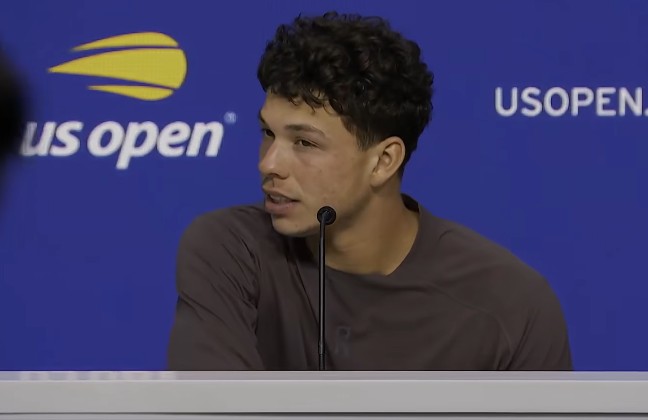
Ben Shelton didn’t want to say it, but he did. And now the rest of us kind of have to talk about it.
Alexander Zverev’s lengthy pre-serve routine became a subplot of Sunday’s US Open final – and left Ben Shelton wondering whether tennis needs to rethink its rules.

Zverev routinely bounced the ball 20 times or more before serving during his 6-3, 7-6(2), 5-7, 6-2 victory, creating an unusual dilemma for Shelton on the other side of the net.
Rather than immediately assuming his return position, Shelton could often be seen waiting until Zverev was several bounces into his routine before setting his feet and preparing to return.
“There’s not an athlete in the world that you’re going to go look and watch them do their thing and they’re going to sit in a ready position for 30 seconds before the play starts,” Shelton explained. “I’m not going to sit there in a ready position with my knees bent, tension in my body for 30 seconds while I’m waiting.”
At one point, the chair umpire spoke to Shelton about getting to the line earlier. Shelton, eager to plead his case, disagreed with the request.
“I promise you there will never be a time where he serves and I’m not ready,” Shelton said. “But I shouldn’t have to sit at the line – if he’s bouncing the ball 20 to 25 times, I shouldn’t have to just sit there for that.”
Shelton also brought up another key point, and one that the rulebook is vague about: how to police time between first and second serves. Though it likely wasn’t Zverev’s objective, since the advent of the shotclock the fact that umpires set no limit on the time used between the first and second serves, there is room for players to game the system and use the time to recuperate when fatigued. Additionally, the time between first and second serves, if long, can extend the length of matches.
Shelton, when questioned during his post-final press conference on Sunday, was particularly interested in the amount of time that can elapse before a second serve. While the server operates under the serve clock before a first serve, the second must be struck “without delay,” leaving considerable room for interpretation.
“I think that there should be some sort of rule,” Shelton said. “I’m not sure exactly how you would do it, limiting time on second serve. You shouldn’t have unlimited time.”
For Shelton, who struggled against Zverev’s serve all match, and never did make inroads against the German’s booming serve, the issue extends beyond the returner’s comfort.
“For our sport, for the fans, I think it’s tough to be sitting there that long for the next play, the next action to happen,” he said. “I’m sure at some point it will be something that these tournaments look at just because there is such a delay in play in some matches.”
It should be noted that Shelton only gave his thoughts when asked, and that he refused to blame Zverev’s routine for his fatigue or his defeat.
“I know everybody wants that to be the story,” he said.
After nearly 30 sets of tennis over two weeks, Shelton admitted that the exhaustion he felt Sunday was cumulative.
“I wouldn’t say my tiredness had to do with standing there and waiting,” he said.
Still, the unusual rhythm of Sunday’s final raised an interesting question: when one player’s routine keeps the other waiting, exactly how long is too long?
Sorry to say, at the US Open final, for whatever reason, Zverev outplayed Ben. Notwithstanding, the excessive pre-serve ball bouncing, which not only unsettled Ben, but truth be told, drove many of the spectators to distraction. Might I suggest, bouncing the ball over ten times before serving draw a warning, then a penalty. Which could result in immediately moving into a second serve or point loss.
These best of five tennis matches are long enough. Players should not be allowed to add to the assigned time of a match based on a player’s personal technique to ready him or her self once the match starts!
Totally agree…10 bounces should be maximum…..20 ibounces is ridiculous and meant to get in the other player head…Ben is right…20 to 30 seconds knees bent waiting is far too long…
Isn’t this an “issue” brought up as sour grapes? There’s a service clock already being used. Every players has to abide by that limit, and Zverev never exceeded that time frame.
If Shelton had won would anyone care? Extremely doubtful. Sour grapes is always embarassing… why go down this path at all?
There is a serve clock only for first serves. Technically, a player can take more then 25 secs between 1st and 2nd serves because there isnt a rule prohibiting it. 20 bounces is ridiculous. Zverev, Djokovic, and Nadal are all guilty of this.
It’s also very boring for the spectator
Tennis has needed to address this irritation for quite some time. Routines for both Nadal and Djokovic were annoying to the returner and may have contributed to their success. This from an avowed Federer fan, so…. But, this is a matter of fairness to the returner, for sure. Implementing a time clock for the second serve is easy.
Limit to three bounces. 20 bounces is him trying to distract his opponent
We need a second serve shot clock. 10 seconds should be enough to serve again.
Plenty of time for 20+ ball bounces lol.
It is very interesting point, because I noticed this myself, being a big tennis fan, and just recreational tennis player. I did not count how many times Zverev was bouncing the ball, but he is the second player, that is bouncing the ball more than other players do. Djokovic was the first one, he bounces the ball 11-12 times before the first serve. I have thought, that it was quite long, but I absolutely agree, that what Zverev is doing, definitely has an affect on the opponent to get ready to return the serve !!!
There is more elements in today’s tennis tournaments, that, taking in consideration the high level of players, that creates very high level of competition, are overlooked or purposely ignored. Take as an example the time, that is allowed for the matches to continue after 11pm. That is absolutely ridiculous, that players are finishing their matches at the morning time, and facing, like Andy Murray couple of years ago have won the match that lasted over 5h, and ended around 3am, and Andy had to withdraw from the match, that he supposed to play the very next day !!!
Why only Wimbledon has a curfew time, and they don’t allow the matches to be played past 11pm ?
Another problem, that is also overlooked or ignored, and actually was voiced for a short period of time, is „grunting” or „screaming”, the laud vocalizations by tennis players during matches. When you check the meaning of the term, it will give you many ways to understand the grunting in tennis:
Performance enhancement
DISTRACTION TACTIC
Emotional expression
Historical context ( Monica Seles and Maria Sharapova), how about Victoria Azarenka and SABALENKA ???
In my personal opinion, grunting is a distraction for the opponent, and huge discomfort for the spectators!!! This definitely should be regulated. Well, if one is allowed to scream their lungs out, let the other wear a headphones and listen his/hers favorite music ! It is a joke of course:))
The last one, that bothers lately many people, but, of course opinion is divided, is the introduction of the runway to the tennis court!!! Again, in my personal opinion it is another way, that the player have found the method to try to distract the opponent more sophisticated way, but this subject is to large to close in one or two sentences….and this was just my take.
Joanna
Glad you mentioned the extreme “shouting” during rallies, which should be dealt with as a tool of distraction and disrespect toward the opponent. A legitimate grunt is an acceptable part of the physicality of the sport.
The level that the volume rises to (especially in the cases of Shelton and Sabalenka), should not be tolerated. It usually is deployed on big points. Such a piercing holler is a momentary jolt to the system, but in this moment may
be all that is need for a split second falter in response from the opponent.
Djokovic is the worst in ball bouncing. One time I counted, he did up to 30 bounces and John Newcombe who was commentating considered this ball bouncing excessive and it should be regulated by the umpire.
Has anyone watched Djokovic’s ball bounces. He bounces at least as many times if not more and I have never heard anyone complain, except me watching. I don’t think anything needs to change for this minor issue.
I really believe that there should be a time limit between the first and second serve ,if not was the point of having a time limit for the first serve,and to the yelling ,way should the public be asked to keep quiet if Sabalenka makes more noise screaming like she does ,that’s ridiculous,end I think she is disrespectful to her opponent,I used to cheer for her but I don’t anymore because of her yelling so loud and for me disrespectful to her opponents