By Richard Pagliaro | Wednesday, July 29, 2026
Photo credit: The Immortals of American Tennis/Gelding Street Press
Tennis is a game of motion, but major movers stick in our psyche.
Generational champions come and go, but iconic legends live on forever.
Now, American tennis’ most impactful icons converge in a new 216-page coffee table book.
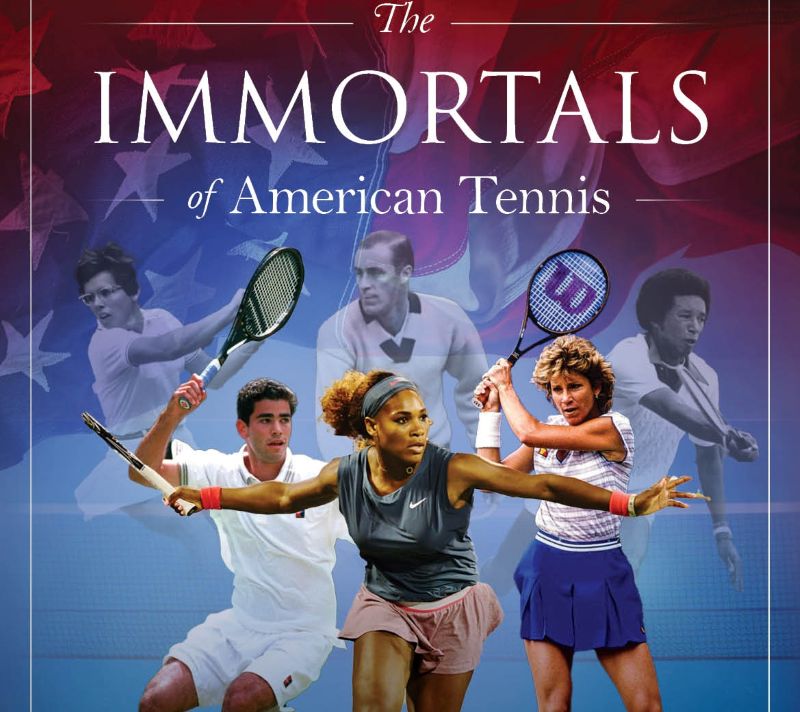
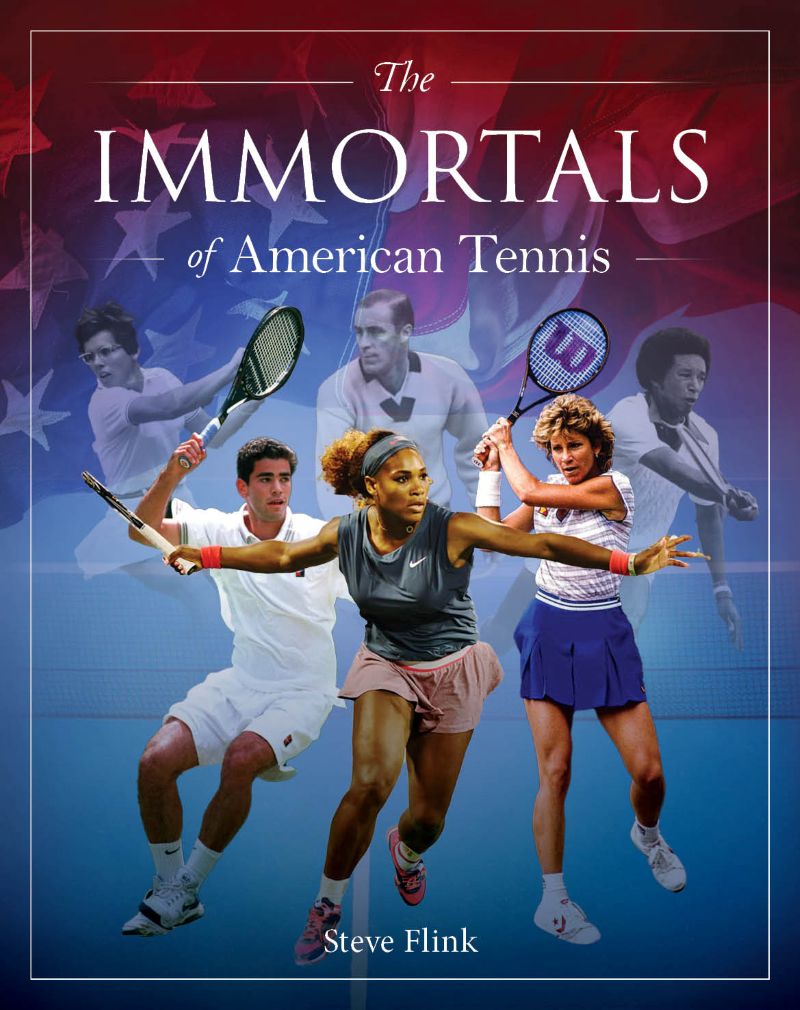
In his new book The Immortals of American Tennis, Hall of Fame journalist Steve Flink selects the 19 most important champions in American history— from Big Bill Tilden through Venus Williams and Serena Williams—and tells their stories through their most memorable matches, striking career stats, captivating photos that chronicle the expanse of their careers and one-on–one interviews Flink conducted with these icons throughout their lives. Flink examines their varied journeys to the top of the sport—and makes the case for what makes each of the 19 players featured in the book true tennis legends.
Published by Geldingstreetpress.com, The Immortals of American Tennis will be available on Amazon and leading bookstores, including Barnes & Noble, starting on Tuesday, August 4th. Click the link to order the book.
The book brings a lifetime of reporting into an insightful recount of the pioneers, renegades and fighters who combine to create a glorious American championship history on the nation’s 250th birthday.
With the exception of Maureen “Little Mo” Connolly, who died tragically of ovarian cancer at the age of 34, Flink interviewed virtually every champion in the book—and the 11 outstanding Honorable Mention champions, including several former world No. 1 players.
If you think of American tennis as a massive family tree, what are the essential elements—the competitive DNA, the deep desire, the impact of growing up in a hard-court nation—that bond these immortal U.S. champions?
Flink is uniquely qualified to cite the most towering champions in a crowded United States’ tennis forest. A long-time writer and editor for World Tennis Magazine, Flink served as a lead writer for Gene Scott’s Tennis Week Magazine from 1992-2007 and later regularly wrote for Tennis and Tennis Channel from 2007-2021.
These days, Steve Flink is a columnist for Racquet Sport Industry Magazine.
Born in California and raised in Connecticut in New York, Flink attended Wimbledon for the first time at age 12.
Four years later, Flink and his father ran into legendary Pancho Gonzalez on the flight from JFK to London and gave the combustible Gonzalez a ride from airport to his hotel. The book is filled with personal anecdotes, like the first Grand Slam champion, Don Budge, describing just how hard it is to win the calendar Slam after running into Flink at JFK Airport. Or a veteran Jimmy Connors confessing to Flink he surprised himself winning Wimbledon because “everything Wimbledon was, I wasn’t.”
We caught up with Hall of Famer Flink in a New York City suburb that was once the hometown of his friend, Arthur Ashe, for this interview.
In this Q & A, Steve Flink discusses his new book, assembles the ideal American champion stroke-by-stroke, names the best big-match American player in history and details what Serena Williams’ comeback means for her legacy—and how far he expects to see the 23-time Grand Slam champion go should she play US Open singles.
We also asked Flink to assess the state of American tennis journalism six weeks after the nation’s leading tennis-centric website, switched from leading news site to scoreboard status. Is AI the future for tennis coverage in America? Flink shares his favorite classic and current broadcasters and names the one American man he believes will break through to win a Grand Slam singles championship and become the first U.S. man to hoist Grand Slam singles silverware since Andy Roddick defeated David Nalbandian and Juan Carlos Ferrero in succession to capture the 2003 US Open title.
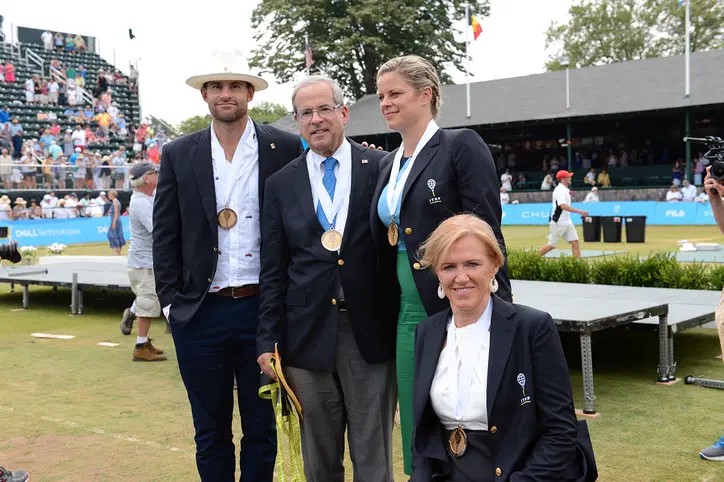
Photo credit: International Tennis Hall of Fame. The Class of 2017 Hall of Fame inductees (left to right): Andy Roddick, Steve Flink, Kim Clijsters and Monique Kalkman-van den Bosch.
Tennis Now: Steve, what inspired you write the book? The cover is quite striking with three immortal champions—Sampras, Serena and Chrissie—in the foreground. Why were they chosen as the cover champions? What was the biggest challenge writing this book?
Steve Flink: The publisher, an Australian publisher Gelding Street Press, asked me. They did a series of immortal books—boxing, golf—and they were zoning in on American sports in a lot of cases. They came to me and we just discussed it. Was it going to be one book on the men and one book on the women?
I thought it was better to combine the men and women. I thought if you’re going to do immortals you have to do pre-Open Era champions too. The challenge is they like to keep their books to certain lengths. It’s heavy on the photos—the photos are great—but it’s not like they wanted to short-change me on the text. It was a challenge because it was basically coming out to about 3,000 words per player.
You asked about the cover. They asked me: How many players do you want and which ones on the cover? I said well, I want Tilden, Billie Jean, Arthur, Pete, Chrissie and Serena. And they selected the shots. I thought they did a phenomenal job. They got the players I wanted, but I thought they did an extraordinary job with the flow and the symmetry. It’s just a beautiful cover. Sampras with his forehand follow through, Serena the forehand swing, Chrissie the backhand backswing. And then you have Billie Jean, Tilden and Arthur. The three in the front of the image are more important in terms of giving the cover the elegance, but I still wanted the others in there. Their art director did a wonderful job.
Tennis Now: On the visuals, one of the things I love about it is each champion’s chapter starts with an image of the champ as a younger player. So you see like a 16-year-old Chrssie, you see Stan Smith with a full head of hair, you see Arthur Ashe, in a rare action shot not wearing glasses and swinging a wood racquet instead of his Head. Was telling a visual story part of the design of the book as well?
Steve Flink: It was a combination of things. The publishers sent me a lot of different photos. We went through thousands of photos. In the end, they worked with another agency that came in at the last minute. The bottom line is I got to choose a lot of the photos that the publisher could then choose from for the final book.
Like they might say: On each player give us the best five to seven shots you see. I was looking to make sure we got the players at every stage of their career.
The combination of the black and white and color images is good too. You and I both know a man named Gene Scott, who ran a certain publication called Tennis Week. And he would have lectured both of us and said: This should have been all black-and-white photos. I think the combination of the two is great.
Tennis Now: One of my favorite things about the book is you share anecdotes about talking tennis to these immortals off court and out of the press room. There’s a cool exchange with Don Budge at JFK Airport where he explains how tough it was to win a Grand Slam. Or when Jimmy Connors tells you he’s amazed he actually won Wimbledon a couple of times because: “Everything Wimbledon was, I wasn’t.” Or Pete Sampras confessing the final 30 minutes of his US Open final loss to Stefan Edberg changed the next 10 years of his career. Can you share the anecdotes or moments just talking tennis with these immortal champions that struck you or resonated with you?
Steve Flink: Those are all very good ones. I think those are some of the best examples. There were many conversations with Jack Kramer like that.
I was out at at dinner with him in ‘86 as a friend of mine did a portrait of him from ‘46. So we did a photo of Jack Kramer in ‘86 looking back at Jack Kramer in ‘46. I was with Jack and a friend of ours and he sat in the front seat. The driver had a Sunday night Frank Sinatra show on. So we saw Jack obviously enjoying Sinatra’s music. Just seeing him in that setting was a reminder of how Jack Kramer, in his own way, was the Sinatra of his world.
I would say you pulled out the right ones from the book.
Tennis Now: There’s another great Connors quote where he says the 11 days of his run to the ‘91 US Open semifinals were the best 11 days of his career.
Steve Flink: Which I was amazed he said that. You would never hear Sampras say that. And I’m not knocking Jimmy, I’m saying it’s what made Jimmy different: That he would single that out.
Tennis Now: It would be almost a little like Federer saying the greatest moment of his career was losing the greatest match to Nadal at Wimbledon
Steve Flink: Exactly. I think it was just such a gratifying fortnight—11 days as he puts it—but such a gratifying tournament coming from wrist surgery and there he is at ‘91 and he’s 39 years old making that run. And even he did not anticipate.
The one I like from Jimmy was during the ‘74 US Open. Of course this was a different world then that I could even get him to do an interview during the US Open then would not happen now. I said to him, which I thought was an innocent question: Arthur Ashe said as an American, he’d rather win the US Open than any other tournament.
And Jimmy, who has won Wimbledon at this point hasn’t yet won the Open, he’s like: Well, everyone said Wimbledon was the biggest, now I win it and they try to tear it down. Ask Arthur if he won Wimbledon, which one would be the biggest?
I thought that comment was the essence of Connors and maybe what made him succeed. Jimmy had a little bit of a chip on his shoulder, like no one is going to tell me anything. He also went off on the ATP in that interview: They want to tell you where to play, when to play, when to hit an overhead.
There’s a defiance to Jimmy that’s actually there to this day. To this day.
Tennis Now: If Jimmy Connors reads this book, I believe he would be proud. There’s a line where you write, and I’m paraphrasing from memory: Jimmy Connors wasn’t the greatest American champion, though he’s certainly in the conversation, but he was the greatest competitor American tennis ever had. That’s very high praise.
Steve Flink: He is. He is. I mean, I only rank Jimmy just very slightly behind Rafa in terms of day in and day out competitive champion.
That comment said a lot about Connors, who he is, his outlook and how he operated. For Jimmy, it was me against the world—especially in his prime.
Tennis Now: History repeats itself sometimes and we see historical situations recur in the book. Like Maureen Connolly, who won the Grand Slam, talks about how working with coach Harry Hopman was good for her because he simplified the game and she competed with much more positivity than out of anger. Fast forward a few decades and Harry Hopman pops up again working with another young American star with anger issues named John McEnroe. It’s a similar scenario.
My question is: If you look at immortal American tennis as a family tree what is the shared DNA, the common connectivity, at its roots? Like for me one through line is how many of these immortals sprung from public park tennis courts: Don Budge, Billie Jean, Kramer, Pancho Gonzalez, Chrissie Evert, Connors, Sampras, Capriati, the Williams sisters.
Is there a defining champion’s character or essential elements and traits these American immortals shared?
Steve Flink: Well, you summed it up well. When I wrote it, I wasn’t thinking conceptually in those terms. I was thinking: Who belongs in this book?
But when you think about it in overarching themes, yes it’s there.
Tennis Now: For me, there are similarities in the Gonzalez story and the Williams sisters stories. They all learned the game in Los Angeles public parks, they were all outsiders, game-changers, who shook up the establishment, self-taught in many ways. All three took breaks from tennis at various points, all three were written off at various points, all three were world No. 1 champions, all three great instinctual players also students of the sport, all three could be charming or completely blow off media after matches depending upon their mood that day and all three won Slam titles at young ages and eventually played pro tennis into their 40s.
Steve Flink: It is. There absolutely is a similarity and I think the reader is going to see that connection.
Tennis Now: Serena is a hot story in tennis right now. You write about her extensively in this book. My question is: How do you assess what you’ve seen from Serena in this comeback? If Serena does indeed play the US Open, how do you envision her performing? Lastly, what is the end game here? Why is Serena motivated to comeback in the first place?
Steve Flink: First of all, I don’t think it’s going to go well [at the US Open]. Because I think that what I saw at Wimbledon was very impressive to see a 44 year old can still play at that level and go three sets with anybody.
But on the other hand, there are so many players in that draw, a 128 draw, just about anybody in that [US Open] draw can beat her potentially. Certainly, by the second or third round [she can be beaten].
So I don’t really know what she’s after. I don’t understand the driving force behind the return. Other than the fact her daughter seems to have struck a chord. The daughter seems to be an engine saying I really want to see you play.
But Serena knows at 44, watching Venus, and Venus has been struggling to win matches for years, and then she sees Novak who has never stopped. He’s just cut back and he’s 39 and she sees how hard it is and the dedication of him to be making the semifinals of Wimbledon or the finals of Australia. Maybe, Serena thinks: Okay if I can do that…
But Serena is five years older. Frankly, I don’t get it.
To me, it’s a mystery and she hasn’t clued us in. It’s not as if she came in after the match and talked about it and the press was given more understanding of what was behind the return.
So now, we hear the Open is on the horizon, but I’m not optimistic about it in terms of how well she can perform. And also, by the way, she jarred her knee. We couldn’t see that at the time. There’s gonna be more of that because at 44 those things happen.
I think maybe because she lost all the weight, somehow that made her think I’m much trimmer now, but that alone is not going to compensate for 44-year-old legs. So I don’t full get it.
Look, Serena is entitled to do whatever she wants. I get that part. If she loves the idea of getting out in public again and having fans shower her with affection, okay. But Serena has standards too. To me, it’s still a mystery.
Venus is different. Her outlook. Her demeanor are just night and day from Serena. Venus, a long time ago, made her peace with it. She said: Okay, I may go on losing, but I’m going to have fun and I’m going to try. I think I’m still playing pretty well. Even that puzzled me to a degree, but not to this degree.
Serena is a different kind of champion altogether. She knows a lot of people consider her the Greatest Of All Time. This will have no bearing on that, but I still think great champions, is it gonna be worthwhile if she squeezes on a first-round win at the US Open? That’s what I’m gonna be asking.
Tennis Now: I was at Indian Wells in March and Novak suggested as defending Olympic gold-medal champion he really wants to play the Los Angeles Olympics. Do you think that could be a driving force, long-term, for Serena? Venus and Serena are four-time Olympic gold-medal champions. Do you think Serena may be envisioning ending her career where it all began in Los Angeles at the Olympics? Or do you think she’s not looking long-term at all, she’s more focused on playing the US Open, seeing how it goes and re-assessing after that?
Steve Flink: Maybe, maybe. I think those thoughts may be in the back of her mind, but not in the forefront.
It’s more what you just said: Let me see what I can do at the Open, I played okay at Wimbledon. I believe that’s how she would assess it: That she was okay. It was far from a disaster in terms of the tennis performance. So maybe she wants to try to build on that and see.
Tennis Now: I think you saw Marat Safin’s recent comments on his podcast. Safin essentially said both Sinner and Alcaraz are excellent players, that they would beat him, but he does not believe either of them are better than the Big 3 in their primes. Safin said he feels like not only are the Big 3 more complete players, but the depth of the game was much greater than when you consider Andy Murray, Juan Martin del Potro, Stan Wawrinka, Marin Cilic, David Nalbandian and on and on. Do you agree with Safin? Or do you think that every generation reveres its generation’s champions as the ideal?
Steve Flink: I don’t agree with him and I say that with the utmost respect for Safin’s opinion. It’s very hard to compare generations and say the prime-time Novak would beat these guys or destroy these guys.
Tennis Now: Although, in Safin’s defense, we just saw a 38-year-old Novak beat Sinner, and look damn good doing it, in Australia.
Steve Flink: Oh yeah, and I’m not trying to subscribe to the theory that automatically the new generation is better than the previous generation. I’m not saying that either. I’m saying, I think he’s being a bit disrespectful to two guys who are approaching their primes.
They’re close to their primes, we don’t know if this is their absolute primes. They’ve dominated the game, there were nine straight Slam finals that they won. I think Safin is being a little disrespectful to them in not allowing their careers to play out.
Tennis Now: To me, Alcaraz is the most complete player I’ve ever seen in my life. And he not only has all the shots, can excel from all over the court, he has the speed, power, explosiveness, athleticism—and the creativity to apply all that to these imaginative points he plays.
Steve Flink: He does. He does. Alcaraz is a virtuoso.
Safin was always opinionated. I always remember him saying, after he played his jewel of a final against Sampras in the 2000 US Open final, he was making those comments: “I’ll never play that way again.” His idea should have been: That really excites me, I didn’t know I could beat him the way I did and I know I can get so much better. So I never understood Safin’s philosophy on that.
Tennis Now: Roger Federer will be inducted into the International Tennis Hall of Fame with Mary Carillo next month. At Wimbledon, Roger did an interview with ESPN’s Mary Joe Fernandez and Patrick McEnroe where he said he called Sampras to gain some insight into how the Hall of Fame induction will feel? It sounds like Sampras told him it will be very very emotional. You’re one of the few people on the planet who knows exactly what it will feel like.
How do you see Roger reacting to that Hall of Fame induction and when you were inducted what was the emotions you were feeling as you’re standing there looking out into the crowd of iconic Hall of Famers? It seems like it must be a truly overwhelming feeling?
Steve Flink: It is overwhelming. It really is. In my personal case, I remember my wife went downstairs and I said: Good I’m gonna practice my speech.
And I did practice and I remember I got to the part about my father and I started choking up. I got all choked up. My father was 93 at the time. Then, when I went to give the speech, I was glad I practiced because I felt calmer. I got it out.
Pete was saying that, I’m sure, with full knowledge of Roger’s personality. Roger’s style and his sensitivity. We saw it from the first time Roger won his first Wimbledon in ‘03. We saw all that in him. We saw him crying when he lost to Rafa in Australia in ‘09. So I think Pete said it knowing Roger.
It was more unusual that Pete got so emotional because that was less like Pete. He was more self contained.
I think Pete’s advice was very good. He knows Roger well. Pete is not the only one to say that to Roger.
We had a Zoom call for Roger’s induction and Rosie Casals said to Roger: “I know you’re a cryer, so bring your kleenex.” And Roger smiled. I think everyone is expecting that and maybe he’ll surprise himself and he won’t, but I think at some point he will [cry].
The recognition of the magnitude of the honor—even for Roger Federer as an all-time great. Also, those fans are there for him. I’m told, I think the way it’s gonna work is that stadium will have a separate seating area. My understanding is Roger and Mary [Carillo] will go and greet those people too. It will all be sinking into him as he goes through this day and sees the big crowd at the stadium.
Not to mention, his own family, his own kids. Now, they saw him play, but the four of them are going to be sitting there.
Tennis Now: When Roger was at five or six Slams, your friend and fellow Hall of Famer Cliff Drysdale told me Federer was the most complete player he ever saw—and he saw most of the all-time greats. In fact, Cliff said after Roger Federer the next most complete player was Rod Laver.
Given all Novak has accomplished as Grand Slam king, you have to put Novak as GOAT. Stylistically, how do you assess Roger’s game? Is he the most complete player? The most stylish or elegant player?
Steve Flink: Yes, you have to put Novak there as GOAT. I believe there is some debate between Roger and Rafa.
Novak has a complete record, he’s an incredible all-surface player and Novak proved it even ending up with three French Opens and almost matched Roger’s Wimbledon total. His record is diversified. Novak showed he can adapt to anything, any surface.
Tennis Now: I feel like Novak does not get enough credit for all the ATP Finals championships he won and his dominance indoors. Look at his record in Asia.
Steve Flink: Yes, that’s what I mean. Rafa never won the year-end ATP Finals and he had some bad losses at Wimbledon. He lost to Steve Darcis, Lukas Rosol, a lot of them. You look at Novak and Roger, that’s not so much the case with them.
Yes, Roger did lose to Sergiy Stakhovsky, but that was the one bad year in 2013 when he was struggling with his back [issue].
To get back to your original question: You can argue Roger Federer is the most complete player. I don’t think Federer volleyed as well as Sampras volleyed. But then again, Pete didn’t have Roger’s backhand.
So these are trade offs. I think Roger is certainly in the conversation for most complete player of all time—no doubt about it.
There’s a way to pick every player apart. In my mind, Sampras was superior to Federer at the net. Then, I also think Sampras’ overhead was the best. The leaping ability had a fan appeal, but Sampras’ standard overhead was unbelievable. He barely missed it.
My point is: Okay, let’s look at the Laver comparison.
Rod Laver had every shot in the book, but did Rod serve as well as Roger?
I don’t think so. I don’t think so.
Laver had a very good serve. Was it one of the great lefty serves of all time? No.
Compare Rod Laver’s serve to McEnroe or Neale Fraser or some of the other great lefty servers. I think Rod backed it up nicely, he was quick to get into the net for a first volley. There’s no doubt, Rod did have a very complete game and he too could play on every surface
Tennis Now: So what you’re saying is Roger Federer is one of the most complete players ever, but you would not definitively say he is the most complete champion ever?
Steve Flink: I would not necessarily be that definitive about it. But I clearly understand where Cliff is coming from and Cliff’s point of view on that.
Tennis Now: When I interviewed Toni Nadal the last time he said he felt each of the Big 3 champions were exceptional athletes—and just superior players to the rest of the pack. Toni said he felt both Federer and Djokovic were “smoother” movers than Rafa was. But Toni Nadal also said he felt Rafa was the best in the world at hitting good shots from bad positions on court. Do you concur with Uncle Toni’s analysis?
Steve Flink: It’s great analysis. I would not disagree with a word Toni Nadal said. It’s very fair-minded of Uncle Toni to say that.
Obviously, Federer is the smoothest mover, but Djokovic is very underrated in that area.
Rafa’s ability to hit those improbable winners from impossible positions is truly amazing. The passing shots off the forehand were just breathtaking, particularly in his prime.
If you go back and watch that ‘08 Wimbledon final to see what Rafa could do from those positions was mind-boggling.
Tennis Now: You’ve been a part of tennis media your entire professional life. You saw Tennis.com go from the nation’s leading tennis news site to a scoreboard after the French Open. You saw the scandal at Sports Illustrated a couple of years ago using AI to create fake writer profiles. You’ve seen the number of tennis magazines in America dwindle, particularly compared to the days when you were writing for World Tennis and Tennis Week.
When you look at the tennis media landscape in America, what do you see? Are you concerned about declining tennis coverage in the States? Do you see this as another evolution in media, as we’re seeing in legacy media, or is it more severe, more dire?
Steve Flink: Oh, no, I’m very concerned.
Tennis Now: Prior to your Hall of Fame colleague Richard Evans’ induction into the International Tennis Hall of Fame, I asked him about the future of tennis media in the States. Richard gave a nuanced reply saying he is concerned about AI, especially if left unchecked without a governing body, but Evans also said he doesn’t think AI can truly ever replace the concept of a real writer being at a real tournament reporting. On the other hand, I’ve seen Mark Cuban recently quoted predicting AI will largely replace media in the coming decade in America. Where do you stand on all of that? Could we see the human touch largely disappear from U.S. tennis coverage?
Steve Flink: Well, I agree with Richard Evans wholeheartedly. It does worry me the way things are going.
When Tennis.com made that choice I suppose there was a part of me that was shocked and a part of me that wasn’t.
I felt maybe they were headed in that direction. But it’s disturbing to think that it happened. You’re wasting the talents of people like Steve Tignor and Peter Bodo. I don’t get it. I don’t see why they think that’s in everybody’s interests.
I think Richard Evans’ concerns are valid concerns and ones I share. I share Richard’s concerns about AI, about where we are headed. Where sports journalism, particularly tennis journalism, is going.
It’s very saddening and very disillusioning. Look, the jury is still out on what’s going to happen with AI period.
To give you an example. My son went on AI, He wanted to see what he’d find on me on AI and he photographed it and sent it to me. A lot of it was very accurate. They even had my favorite meal on there, but then they had things totally wrong about me.
AI had me married to my high school sweetheart, which is completely wrong. Wrong name, wrong person, wrong Steve Flink.
When I saw it, I thought it was really interesting how much AI got right, in terms of my career, but also how much AI got wrong about my life. My marriage and my family, it got me completely mixed up with someone else with the same name. I don’t like it.
I’m already concerned enough about tennis journalism vs. tennis broadcasting. It’s become a tennis broadcasting world as you know, because you’re right in the midst of it writing for Tennis Now, so you get it. You see it.
Broadcasting takes complete precedence over print and print reporters are fighting for our lives in a way. It makes me think of the old days when the lengths of the press conferences were much longer, there was much more intimacy and trust and ease. The ease of the access was completely different.
So it’s definitely worrisome.
Tennis Now: Just to pick up on your points because you triggered some thoughts in my head. Ultimately, does the sport itself really care if print media exists?
To play Devil’s Advocate: If I am the USTA and I’m getting near $30 million a year from ESPN in US Open TV rights fees, why do I care about some writer from Tennis Now or another site coming and covering the tournament?
If I’m the USTA, I’m thinking: that writer isn’t increasing my bottom line, that writer isn’t giving me $30 million or even 30 cents to cover the Open. All that writer is doing is occupying valuable space, eating and drinking on my dime and maybe even covering controversy so why would I care if he’s there or not?
Why would I care if print coverage exists if I’m them? Particularly when they have USOpen.org and can profit directly from their own print coverage.
Not to be crass, but what’s in it for them?
You can argue, from their perspective, that reducing the media means they gain greater control of the message, shorter pressers for players.
Don’t get me wrong: I agree with your points. I’m just saying if tennis is a broadcast world, then it’s because that’s where the money is and in pro tennis the bottom line matters most.
Steve Flink: Well, that’s exactly the cold, clinical way they’re looking at it.
I think you just summed up how they view it these days.
I feel like Wimbledon still has an enduring respect for print reporters. That part, I find encouraging.
Tennis Now: If I asked you to assemble the most immortal American champion stroke-by-stroke based on the champions in The Immortals, what does that look like?
Steve Flink: Sampras would be easy for the first and second serve. Volley, I’d go with McEnroe because of all the feel and he was pretty unique. Jack Kramer had the best forehand volley.
Backhand, I will still go back to Don Budge.
Tennis Now: Wow, I thought you’d say Agassi.
Steve Flink: You could go Agassi or Connors for backhand. But I think Budge led the way for the backhand. I would still say as a pure stroke, the Budge backhand was probably the best. So I would go with him.
Tennis Now: As the late, great Gene Scott once wrote: “Nobody, and I mean nobody, served to Don Budge’s backhand until he was well into his 70s.”
Steve Flink: Yes. I would stick with Sampras on the overhead. Return of serve: Very close call between Connors and Agassi, but I’d give it to Agassi.
For forehand, I would say Agassi had the best forehand rally stroke and forehand return. Sampras had the best running forehand. And Kramer is in the conversation because his forehand approach shot was outstanding.
Tennis Now: What about court coverage and athleticism? Vines was known an amazingly versatile athlete, whom Don Budge called The GOAT in his day.
Steve Flink: Yes, Vines made my honorable mention list. Jack Kramer also spoke very highly of Vines. Kramer spoke in similar terms as Budge about Vines and his superb athleticism.
On the women’s side, Chrissie Evert is best backhand. Coco Gauff is getting there, but Coco isn’t in the book yet though she’s closing in on it.
Serena would be best serve—just like Sampras—best first and second serve.
Forehand, I don’t have an obvious easy candidate.
Tennis Now: Davenport and Capriati, both honorable mention, both had great forehands. I never saw Little Mo play live—only video—but I’ve been told she had a tremendous forehand. Little Mo, I’m told, was one of the biggest hitters of her time.
Steve Flink: Yeah, Little Mo had a great, great forehand. Little Mo’s forehand would be right up there as best. The best forehand among women, you can debate.
Little Mo had arguably the best forehand technique with Wills Moody right alongside her. Wills Moody hit the ball hard off that side and hardly ever missed. Ditto Connolly. Evert and Austin are near the top of the list. Chrissie for her variety with the flat and sidespin forehands plus her beautiful forehand drop shot, and Tracy because she never wavered with her flat forehand.
The volley, if you’re gonna package the forehand and backhand volley for best volley then it’s a dead heat between Martina Navratilova and Billie Jean King. They each had periodic problems with low forehand volleys. But the fact is they were both great off the forehand volley, they were both unbelievable off the backhand volley. As I say in the book: It’s a dead heat between King and Navratilova for best volley.
Tennis Now: This may sound like an odd question, but reading the book, I’m struck by how many legendary American champions were children of immigrants.
Don Budge’s father was from Scotland. Pancho Gonzalez came from a Mexican family. Martina Navratilova, Czech born. Andre Agassi’s dad, Mike, from Iran represented Iran as a boxer in the Olympics. Pete Sampras parents of Greek and Canadian heritage. Michael Chang, Chinese heritage. Jennifer Capriati’s dad, Stefano, was Italian. Monica Seles born in Yugoslavia. Even Venus and Serena from Compton, which at that time was erupting with gang activity and violence, must have felt like a whole different world compared to traditional tennis Grand Slam world.
Do you think that immigrant status—the outsiders trying to make their mark and prove their worth on this sometime ultra exclusive insider sport—kind of fueled many of these immortal champions you write about in this book? The drive that many of them had was beyond winning and losing matches: they wanted to really change their families lives. And they did.
Steve Flink: That’s right. I do think the immigrant status could well be a part of their drive.
Let’s face it, Agassi will carry to the end of his life certain resentments for his father and toward Nick Bollettieri. But without both of them, he would never have become the player that he was. They instilled that drive in him. I think he resented it at times.
Tennis Now: His memoir, Open, really went deep into the love-hate relationship with it as well.
Steve Flink: He didn’t talk enough about the love, his book was more about the hate. They made him who he was. I think Agassi needed that push as opposed to some of the others.
I mean, Sampras’ father set up the whole framework, got him to Pete Fischer. But I think Pete, at a certain point, just took ownership of his life and what he wanted to do. I don’t think, because of the way his parents stayed in the background, that he felt he was being pushed or exploited by his parents.
I never sensed any resentment from him. He signed on for it from a very young age and decided what he wanted to do.
I think your point about immigrants is well taken.
In some of these cases, there were pros and cons to it. In the end, they would not have been prodigious champions [without the families].
Tennis Now: The Immortals in this book are uniquely American family stories too. I was struck by how the family propelled these champions in some cases.
Don Budge’s older brother basically calls him out at the dinner table saying if Don wasn’t so lazy he could be a tennis champion. Billie Jean’s older brother, Randy, was a pro baseball player, who inspired her. Serena had Venus to aspire to, Chrissie Evert and Jimmy Connors both from devoted tennis families. McEnroe’s entire family was totally supportive and invested in his tennis. Can you speak to the role of the families of these immortals?
Steve Flink: It’s true the families were so important and the involvement varied.
Jimmy Evert got so nervous watching Chrissie and he didn’t want to make his daughter nervous that it wasn’t until she won the 1980 US Open that he saw her win a major in person. Chrissie had been around a decade by then.
Sampras’ parents just wanted to stay in the background. The famous story about the 1990 US Open final where Pete’s parents were walking around a mall during the final when he played Agassi.
So it shows you how much it varied.
The common thread, that ran through all of it, is they wanted their kids to succeed. The message was: Dream big, and we’re there with you and we support you and we want you to become the best that you can be. That was clear.
Gloria Connors, I’ll never forget being kicked in the back at Court 1 at Wimbledon when Connors played the ‘73 Wimbledon. He’s playing on Court 1 and she’s so excited I had Gloria Connors’ footprints on my blazer she had no idea she was brushing her feet on my back. She had no idea because she was so engrossed in his match.
I think Connors appreciated his mother. I think the one case of parental influence getting in his way was letting Pancho Segura go. He admitted in his book later on that’s one of the few times I’ve ever heard him question one of his decisions. That he should have stood up to his mom and said Pancho needs to stay. But Gloria Connors was enormously appreciated by what she did for Jimmy. Had she not been this guiding force what would have happened to Jimmy? It’s amazing this macho competitor was trained by two women.
Tennis Now: “Trained by women to conquer men,” as the late, great Frank De Ford once wrote.
In this book, you write Pete Sampras was the best big-match American player and you write Jimmy Connors was the best competitor among American champions.
My question: Who was the best adaptive champion? The best at varying their game to beat the opponent? The best chameleon champion in U.S. history? Because if you look at Sampras and Connors, though their styles were different, their approach was: I will impose my game on you. I will be me and you will have to adapt to me. But who was the best at adapting to different styles?
Steve Flink: Arthur Ashe became that way as his career progressed. It wasn’t true when he won the US Open in 1968, it was true by the time he won Wimbledon in ‘75. Arthur had adapted, he came much more cerebral.
I think Stan Smith was very good at it though his style was pretty straight forward serve-and-volley.
Pancho Gonzalez was underrated in that regard. I mention a match when Gonzalez beat the young Connors in L.A. Gonzalez beat Connors from the baseline. His ground game won him the match and no one would have expected that.
The one who stands in a class of his own in adaptability is Bill Tilden. Tilden was such an incredible student of the game. He knew how to play different guys and what to do. He later became a coach, wrote three great books. Tilden, even more than any of the guys we talked about, for adaptability is in a class of his own.
Tennis Now: Prior to Richard Evans’ Hall of Fame induction I asked him to name four Hall of Famers—living or dead—he’d most like to spend time with again. Richard Evans picked Billie Jean, Chrissie, McEnroe and Ilie Nastase—he wrote the first bios of McEnroe and Nastase of course.
After writing this book, if you could pick four of these American immortal champions—living or dead—to revisit, talk tennis with again, watch play again, share a drink with, who would you pick?
Steve Flink: Among the men, Jack Kramer and Arthur Ashe would be the two.
For the women, Helen Wills Moody would be one. I was lucky enough to interview her on the 60th anniversary of her famed match vs. Suzanne Lenglen in Cannes, France so it was’86. My biggest regret is that I didn’t ask her to do a follow-up interview on her whole career. The premise for the interview was to only talk to her about that match. She was terrific and charming and her recall was not bad at all.
She was undaunting—she was not intimidating to talk to at all.
Maureen Connolly would be another one because she’s one of the few in the book I never met her or talked to her. She died so young. I heard her once doing commentary at Wimbledon in 1966 calling the Wimbledon women’s doubles final with Nancy Richey and Maria Bueno winning the doubles title and Maureen was just superb, doing commentary and very likeable on the air. I like the fact she saw the excitement of Richey winning this title and related to it so well.
Althea Gibson is the other one. I had one meeting with Althea. She too was quite likeable. I wish I had more time with Althea. She’s one I wish had another opportunity to interview. But just about every other champion in the book I’ve interviewed multiple times.
I did re-interview Stan Smith, Billie Jean, Martina, Chrissie and Tracy for the book. Tracy was terrific in recapping her life. I know some people may wonder about including Tracy and Stan Smith in this book.
I do feel like they both absolutely deserve to be in. Each of them are essential lifelong American tennis figures.
Tracy was cheated, in a way, because of her body breaking down so young. Imagine being a two-time US Open champion by the time you are 18 years old and getting to No. 1 in the world and winning Wimbledon mixed doubles with her brother. That era she played in was so important.
The point I make is: No disrespect to Lindsay Davenport or Jennifer Capriati, who were great players, but I did not see them being one of the immortals of Tracy.
Tennis Now: Touching on the Honorable Mention immortal players you chose for this book, was there any player you really had to grapple with? Someone that you really went back and forth on, that you felt really deserved to be an immortal?
For me, Monica Seles is the one.
Of all the Honorable Mention players, I feel like Monica Seles has the true credentials to be an American tennis immortal. I interviewed Connors in like ‘92 or ‘93 at the Westchester Country Club during the senior tour tournament.
I asked him: Who reminds you of you?
Initially, he said “nobody reminds me of me.”
Then, he thought on it for a few seconds and said: “Monica Seles plays with the intensity and the way I played: go even bigger on the bigger points.”
I thought that was very cool to see an all-time great male champion of Jimmy Connors status citing a connection with a female champion.
Steve Flink: Totally. Seles and Ivan Lendl are the two I really wrestled with. Those are the two most complicated [Honorable Mention Immortals.]
In Martina Navratilova’s case, she became a U.S. citizen by ‘81. So much of Navratilova’s life was over here, playing as an American, playing for the [Fed Cup] team.
And Monica played for the [U.S. Fed Cup] team too.
I wrestled with Seles and Lendl. Ultimately, in the end, those were really tough calls. Two all-time greats, no question, all-time greats.
On the other hand, especially in Lendl’s case, he played Davis Cup with the Czechs and though he wanted to he was never really able to be part of the [U.S.] Davis Cup team. I thought so much of him was in the grooming he got as a kid [in Czechia]. The case was stronger for Martina, in my view, than for Lendl.
I hated to do it to Seles. I hated to do it to Lendl.
Those are the types of decisions you have to make when you’re writing a book like this one. It’s very difficult and you spend a lot of time on it. I felt like you have to do an Honorable Mention section and then explain in the Honorable Mention why you made that choice. And I did.
Another one, who I was sorry I could not get in the main list of immortals was Tony Trabert.
The Cincinnati Open honored Tony Trabert yesterday, naming Stadium 3 at the Lindner Family Tennis Center for the former No.1. #CincyTennis pic.twitter.com/UxdV3RApbz
— Cincinnati Open (@CincyTennis) August 10, 2026
Tennis Now: I swear to God, I was just about to say Tony Trabert.
Because not only did he nearly win the calendar Grand Slam, which people tend to forget, not only did he win on every surface, look at all the other things he did. Tony Trabert, a tremendous Davis Cup captain with some volatile players, a great coach, a highly-respected TV analyst on CBS for decades, a Hall of Fame leader, a total class ambassador for the sport in every way on every level.
Steve Flink: Exactly. Tony was fantastic. He was totally an ambassador for the game and he might have been the best U.S. Davis Cup captain ever, which is saying quite a lot.
In my view, he was because he had a tactical mind, he was tough, but fair. I will never forget Tony Trabert telling me when John McEnroe would get all angry and aggrieved and out of sorts about questionable calls and obviously he was obsessed with that, but Tony told me a story about it.
Tony said to McEnroe: Look John, the linesmen are gonna make a lot fewer mistakes then you’re gonna make unforced errors. John, your thinking should be: I’m going to cut my unforced errors in half. And that, you can control.
He said McEnroe was pretty receptive to his message. But I think Tony Trabert is one of the few people who could have even thought of saying that to John McEnroe without John getting irate. But John had tremendous respect for Tony.
Tennis Now: Because he knew Tony Trabert was a no-nonsense, no BS kind of guy.
Steve Flink: No BS. And you mention Tony’s commentary. I think Tony Trabert was one of the all-time great commentators.
I always remember about his commentary if he was in the booth with Pam Shriver or Arthur Ashe or somebody and they could make a good tactical or technical comment. And Tony would say: You know what, Pam? I agree with that, but let me just add this. And he would always have something to add.
In other words, being around someone else with great knowledge would only encourage Tony and spur him on. You can call it competitive, but he didn’t do it in a way that could be seen as competitive. The viewer would not see it as him trying to embarrass his partner in the booth. He was not, he was trying to make a deeper point.
That was hard because Tony had the great ‘55 season when he won three of the four Slams. It was close for him in this book. In the end, it would have meant keeping Stan Smith out. I felt Stan had to be in.
Tennis Now: It’s interesting to me how various immortal champions’ minds work. I did a clinic with Chrissie Evert one time and she told me: “Honestly, 20 minutes after I step off the court, I really can’t recall the rallies unless you show me video of it.” Chrissie basically said she played so many matches in her life, she just can’t recall even pivotal rallies in Grand Slam matches unless you showed her video or walked her through it.
At the other end of the spectrum, I’ve been in Agassi pressers where he can reconstruct a point he played vs. Nadal or another champion shot-by-shot. And then you go back and watch the video of the match and you see his recall is absolutely spot on.
Steve Flink: Yes, but, but, but. Let me just add the but—it was selective memory in Agassi’s case.
And I understand it because I suppose he hated re-living losses like the two losses to Rafter in the Wimbledon semifinals in 2000 and 2001. He would come into press afterward and say: I can’t be objective, as far as I’m concerned, the match sucked.
The reason I am bringing that up is I think he also put the details of the match out of his mind. But when he won, he had a steel-trap memory.
I don’t mean that critically, by the way, I just mean that’s how Agassi’s mind worked.
Tennis Now: For some of these immortal champions you write about, it seems like the process of losing is really a process of grieving.
I interviewed Pancho Gonzalez’s children, including his son, Richard, they said after a tough loss, he would sometimes just sit in his room for a couple of days. He invested so much into it emotionally and was so upset and just did not want to be around people after a tough loss. It was like the major losses scarred him emotionally.
Sampras suffered ulcers at one point, his hair was falling out from stress at one point. Agassi basically left the game for a while, admitted to doing meth for a while. Champions kind of pushed to breaking points by loss and the aftermath of loss.
Steve Flink: Gonzalez could be like that after a win, too.
When I was 16, my father and I were on the same flight as Gonzalez going New York to London for Wimbledon.
We gave him a lift from the airport to his place in London, had a great conversation on the way into London. I saw him around Wimbledon a few times and he introduced me to a British kid, who was his hitting partner. Gonzalez was great during that trip.
A couple of years pass, I’m stuck out at Wembley. The underground had stopped running because the matches had run so late that night. The tournament desk said: We have one more car going back, but it’s for Mr. Gonzalez. You’re going to have to ask him if you can ride. And I did ask. He came up and I said do you remember me? He said, no I don’t.
So I told him how we met, how I had no other way to get back to London, Gonzalez said: Get in.
Well, we had a 45-minute ride of almost total silence. I couldn’t get him to talk about anything and he had won his match that night.
So Gonzalez was quite an interesting character. The other interesting thing about Pancho, when Bjorn Borg got voted into the Hall of Fame, the first year Bjorn was elected he didn’t want to come because he wanted to be on the lake in Sweden.
This is true. They wanted to send a plane for him, but he didn’t want to come and he came over a year later.
So I interviewed people about it at the time. Dennis Ralston, was going in that year. Dennis was like: I can’t believe Bjorn wouldn’t do it. This is the greatest honor of my life. Why wouldn’t he do it? Jack Kramer says the same thing: I can’t believe Bjorn won’t get out of bed for the Hall of Fame.
I go to Gonzalez for his reaction. And Gonzalez says to me: Why should he go? I wouldn’t have gone either!
So, you know, he carried that rebellious streak, that defiance, across his entire life. That made Pancho fun to write about in a way that was similar to Connors. But Pancho could be very intimidating. You really had to have a very thick skin to talk to Pancho Gonzalez.
Tennis Now: With Gonzalez, there is no filter. It’s like what you see is what you get. Of all the champions in this book, who was most like his or her playing persona off court? Which immortal was least like their playing persona off court?
Steve Flink: I think that’s Chrissie to a large degree. Because Chrissie has such a great sense of humor, she’s such an interesting person and she’s a person who has a lot of layers of emotions.
Chrissie hid that on the court and Arthur Ashe was the same way. They both believed in not giving anything away to your opponent. Stoicism on court, but each of them were such fascinating people off the court.
The public wouldn’t have known that from watching them play.
While with Martina Navratilova or Billie Jean, you got more of a sense of the person—they were emotional off the court too. So Billie Jean would have a tirade about something and sometimes as a player, she would go at the officials. She could really explode at the officials. So she let it fly. That was just Billie Jean.
Martina, obviously in the documentary The Final Set, they had a section how when Martina was dominant how hurtful it was to her that the crowds were always rooting for Chrissie. You see Martina all the gestures on court, the frustration, it was right out there in public view.
I think with Chrissie and Arthur, there was a lot hidden. They were both fascinating people with deep personalities, but you had to know them.
Tennis Now: Last question on writing the book, when you were writing it, which of these immortal champions was most challenging to write about? Which was the most fun to revisit and write about?
Steve Flink: I think that Gonzalez, because his career spanned the amateur and Open Era. He had his big amateur success in the late ‘40s and then played pro tennis, then re-emerged later. It was fun to write about Gonzalez. I enjoyed that chapter a lot.
I enjoyed writing the Connors chapter. Don Budge was fun to write about because I had a number of interviews with him, so I knew him a bit. I mention in the lead to the Don Budge piece, I talk about how he was known as “J. Donald God.”
And that was true. And I don’t think Budge minded that at all. I think it gave him a certain edge. It was how he carried himself—a completely calm and confident individual. No inner doubts in Don Budge—he knew how good he was. I thought that was fun.
You and I had talked about this before. I had done an interview for Gene Scott for Tennis Week on the 60th anniversary of Don Budge’s Grand Slam. Gene didn’t want me to do it initially because he thought it was too easy, but I talked him into it. Gene liked Budge a lot, but he just wanted a story that he thought would stretch me more. But I persuaded him to have Don talk about that Grand Slam, share his memories of it a few years before he died.
On a personal level, to me the most interesting chapter to write was Connors. The most satisfying to write was Kramer. Because I am a big, big believer in him. As I wrote in the book, Kramer, to me, was the man of the 20th century in tennis.
All the things Kramer did as an amateur player, pro player, pro promoter, analyst on television, great analyst for BBC and our networks, the first executive director of the ATP, the Jack Kramer Wilson racquet. Jack Kramer did so many great things and I struck such good fortune with him.
When I was working for World Tennis I did instructional pieces with him. Jack was in L.A. and I was in New York so we’d have these phone conversations. We’d spend 15 or 20 minutes to get the instructional piece down and then another hour talking about other things every single month. So a friendship grew out of it and more so I came to understand how he thought and get his honest reflections on his career and others.
He would talk to me off the record about players. I wrote some pieces of him and he’d call me up and say: You made me a hero with my grandkids. I just thought Jack Kramer was a great man. You look at the complete Kramer and we’ve never had anyone quite like him in tennis.
Tennis Now: In the book, if you take Jack Kramer and Billie Jean King together—they were not only colossal champions, they are the architects of pro tennis. I mean if you take Jack Kramer and Billie Jean King out of tennis history what is pro tennis? What does it look like? How does it exist?
Steve Flink: It’s ironic that you’re bringing Billie Jean up in that way.
Tennis Now: Because they didn’t get along?
Steve Flink: Not just that they didn’t get along. When people saw the Battle of the Sexes movie on Bobby Riggs and Billie Jean King, what people who saw the movie and don’t know tennis, don’t understand is that is not a fair depiction of Jack Kramer.
And they didn’t get to the essence of Kramer. They made him look like he was some sort of lowly promoter. So people misunderstood him.
Jack Kramer was no different from Barry MacKay or any other promoters at that time who didn’t believe, at that time, that women’s tennis could draw on its own.
So it was a business perception—and they were wrong—but they all felt the same way. For Kramer to have been singled out…that’s why I didn’t get into that in the chapter on him. Other than by him being made the scapegoat and the villain, then maybe he did them a favor, maybe he spurred them on.
But he tells a great story that I didn’t use in the book. Like six years later, Gladys Heldman called him up and says: Jack, you and I are going to go into business, we’re going to run the game together or something to that effect.
I think people who had political squabbles always respected him, his principles, his intellect—all of it. So it was Gladys, who was on the opposite end, fighting him over the inception of the Virginia Slims circuit. She’s calling him years later saying: We need to join forces to run this game.
Jack had his political battles, but he didn’t want lifetime grudges. Grudges didn’t linger in his mind.
Tennis Now: Our old boss, Gene Scott, used to say that nearly every player memoir or autobiography is an attempt to settle old scores. That the competitor in elite champions never dies even after they hang up the racquet. I was thinking about that when Jimmy Connors wrote his book and he said even to this day if he’s in a room with McEnroe the old feelings, the tension, excitement starts building. Do you concur with Gene on that?
Steve Flink: No, I don’t agree entirely.
If you read the Pete Sampras biography that Peter Bodo did and I did a separate book that was a bio of Sampras. But if you look at either book, it’s the same thing: Sampras never wanted life-long lingering feuds. That wasn’t him.
Sampras wanted to continue to get along with people. That’s always been his way.
Tennis Now: That’s why I felt the Serena Hall of Fame induction speech for Maria was such a beautiful moment for tennis, for sport, for rivals in life. Like these were two bitter hard-core rivals who seemingly could not stand each other and took shots at each other.
But they did come to terms, they did talk it out, they do indeed seem to be real friends. It’s a great lesson. I was watching it feeling like: If these two can hug it out, then there’s hope for the rest of the world.
Steve Flink: That’s a good example of two people working it out and coming together. Maria called up Serena, asked her to do the speech and Serena readily agrees.
In fairness, Gene Scott was a wise man and he could well be right in a lot of cases—but not all of them. That’s not their purpose for some—they want to tell their story, it’s not about offending others.
Andre’s book, I felt, was a little bit in between. It was a really interesting read, but he was very critical of Brooke Shields and other people. Andre was very tough on Sampras, I felt very unfairly, and he was very tough on Nick.
And none of them could answer.
I think Richard, one of the reasons you like Agassi’s book so much, and why many did is it’s all in the present tense.
Tennis Now: Right and that device makes you feel like you’re right next to Agassi beside him throughout the book. Also, I felt it was a brilliant opening to the book. He’s sleeping on the floor of his hotel because of his back pain and one page into the book he takes you into the doctor’s visit where he has a seven-inch needle stuck in his back for a cortisone shot to kill the pain.
So I felt he was really effective opening up the curtain and sharing a rare look at the pro athlete’s life outside the pressure of match play and the 20,000 screaming fans in a stadium.
Steve Flink: Right, exactly. He does that, but he also keeps driving along the highway—he doesn’t ever stop. Do you know what I mean?
There’s no chance for reflection. The only time I saw that was with Courier where Andre had said some critical stuff about Courier in the book and then he runs into him at one of the Australian Opens in the early 2000s.
Jim was interviewing Andre on television and there he does a little reflection like: Jim’s a good guy. But I don’t think anyone else got that benefit from him. But I also don’t think the purpose of the book was vengeance.
The purpose of Agassi’s book was to tell his story as honestly as he could tell it. So I think Gene Scott is partially right, but I don’t entirely agree with him on that observation.
Tennis Now: In addition to your writing career you’ve been a broadcast journalist too. When you watch tennis on TV these days who do you like to listen to? I was at Wimbledon most of the time so I only caught Andy Roddick at the end of it on ESPN, but I thought he was very good and very insightful setting up matches, telling you which patterns to look for, etc.
Also, which commentary voices do you miss? We discussed CBS legends Tony Trabert and Pat Summerall earlier. I always loved the ESPN team of Cliff Drysdale, Fiery Fred Stolle and Mary Carillo as well. The three distinct accents and different points of view and just so much knowledge they all brought.
Steve Flink: Everyone loves Roddick’s podcast. And he tries really hard, I think, to look at things in a positive way by the way.
In his criticism, sometimes he’ll get really angry about things. For the most part, there is a tennis fan in Andy Roddick that emerges in a lot of these podcasts that I really like.
Also, he breaks down the game so beautifully. So I wasn’t surprised that he went to the booth at ESPN and he was great in the studio and he was great in the booth. So I think Roddick has an incredible future in broadcasting, he can do whatever he wants on the air.
Roddick has a very facile, sharp mind. He’s thoughtful, very cerebral.
You mentioned Fred Stolle and I miss him and of course I miss Cliff Drysdale’s voice. Together, they were terrific. Mary, I think, is the best reporter the game has ever had on the air—the best journalist on the air.
Mary found a way to be critical of top players at times—very selectively, but she won’t shy away from it when it’s called for—but she’s also so enamored of the sport and so appreciative of everyone. She does her homework so well, she always comes prepared.
Mary is pretty unique in the way she approaches it—all the enthusiasm—and the personality is just so different from everyone else. Obviously, I think she’s so worthy of going into the Hall of Fame. I think Mary is also deeply appreciated in tennis by both fans and players alike. You could hear that from Roddick in his podcast with her. Even if his parents didn’t like it, his point on the podcast was: Stop it, she’s being honest.
There’s so many good commentators. Nick Lester is very underrated. Sometimes we get him on Tennis Channel and I think Nick is very underrated.
I think Robbie Koenig is great. In fact, I remember once interviewing Martina Navratilova and she went out of her way to say: The guy that I like, because every time he says something it’s what I’m thinking, is Robbie Koenig.
I thought Darren Cahill was very good. I know he had to eventually choose between Sinner and the commentary and there were time when he was a little trapped. Like he’s not going to go there and get negative on Sinner, why would he?
I remember at the 2023 Open, Cahill and Cliff worked the Medvedev win over Carlos in the semis of the US Open. They did a great job together. And then Cahill was on the final between Medvedev and Djokovic and I thought he was just excellent. I love Cahill’s mind.
Tennis Now: Last question, when I was growing up, I always read Tennis Week with Gene Scott, Bud Collins, Richard Evans, you, Vic Braden, Andrea Leand, Linda Pentz and on and on. The knowledge and experience and insight was so deep in that magazine it felt like reading it was a college education in tennis. Also, that Gene took this collection of esteemed writers with widely disparate points of view and allowed each writer to have their own voice, their own point of view in his publication without trying to impose his on them—which is increasingly rare today and one of the reasons it was so special.
Who do you like to read now? Who did you like to read then? We talked about the talents of writers Pete Bodo and Steve Tignor earlier. There are so many great writers in tennis like Christopher Clarey, Joel Drucker, Alix Ramsay and on and on. Who do you read?
Steve Flink: Chris Clarey is excellent. I like his work a lot. I miss seeing it in the New York Times.
I’m happy the general public is seeing more of him now because of the books. And he’s already done Federer and Nadal and I’m sure there will be many more books to come. So we get him in the longer form and he was quite good in the shorter form as well.
I go back to days gone by, people like Neil Amdur in the New York Times. I loved his daily reporting. I loved David Gray in the Guardian before he went to the ITF. Scott Price, SL Price, some of the profiles he wrote in Sports Illustrated were tremendous. Of modern writers, he’s the best sportswriter we have today. Because he can write on any sport any topic, he just did a book on lacrosse.
Scott’s work in tennis, he wrote profiles on Becker, on Djokovic, on Gonzalez, on Sampras that were just outstanding.
Tennis Now: Remember the Gonzalez profile opening with Mike Agassi, Andre’s father, briefly contemplating hiring a hitman to take out Gonzalez, who was married to Mr. Agassi’s daughter, Rita.
Steve Flink: Right. Those are the writers I like.
I also had great admiration for Bud Collins. I really got a kick out of Bud’s writing and he could be incredibly funny.
Bud wrote a piece on Paolo Bertolucci for World Tennis once, the Italian who was in the era of Panatta and Barazzutti. I’ll never forget Bud writing: “Bertolucci looked like he was about to lose the match—and lose his lunch. Which one would be the greater tragedy?”
So Bud always had the sense of humor. I loved him even more in the booth.
Tennis Now: Last question: Will we see an American man win a Grand Slam title in the next five years?
Steve Flink: I think so. I think it’s going to be Ben Shelton. People are souring and okay he had two bad majors in a row after a good Australian Open this year. But he’s been in a couple of semis of majors previously, but he’s won three titles on three different surfaces, he’s gone deep in Slams.
Shelton even had a good French Open last year when he lost to Carlos and you can see he’s getting even better on clay with a clay title this year.
As we speak, he just did a press conference in Washington, DC, and I like that he just seems to own things. He doesn’t make excuses. I still feel like here’s this guy who can serve 143 to 146 miles an hour, when he wants to, the serve will become an even greater weapon.
The location is going to get better over time, I’m convinced of that. It will become even more formidable. I feel like the variety Shelton’s gonna have in his game, the leftiness, I think the return will get better. I don’t think he will be stuck in a career-long syndrome like the way John Isner was in terms of Isner’s ability to break serve. Shelton, I think, will get better at breaking serve.
Above all, Shelton has the mentality. He is going to demand it of himself.
It’s true that Taylor Fritz, in the last few years, was brave enough to say: I won’t be satisfied at the end of my career unless I have won a major. So all credit to Taylor for trying hard and for playing a US Open final and a Wimbledon semifinal.
I just think, for me, the ceiling is much higher for Shelton than for any of the other Americans. Shelton is a superior athlete. We’ve got some terrific Americans out there with Tiafoe and Tommy Paul and Tien could be great. Tien is very smart and has a perfect coach in Chang. Ben Shelton, it make take two years, it might take three years, but he is going to make some serious strides.
I don’t worry about Shelton. He can just get so much better and he knows it. Plus, he has a father who is very honest with him. Shelton will be our next Grand Slam champion, for sure.
For the women, Coco is going to get more. Pegula and Anisimova can break through. I thought at Wimbledon that was a wasted opportunity for Pegula because Pegula if she wins after winning the first set against Coco, then she plays Muchova in the semis. It’s 50-50, but I might have made it 52-48 for Jess. I wonder if maybe some of the stuff was swirling around her head too much. I thought she tightened a little bit against Coco.
All I can say is if I do a follow-up sequel to the book in 10 years, I expect Ben and Coco to be in there.
Tennis Now: Steve, thanks very much for your time and for answering so many questions. I really appreciate it. Congratulations on the book. I think American tennis fans will love it.
Steve Flink: Thanks Richard.
Amazing! Its genuinely remarkable piece of writing, I have got much clear idea on the topic of
from this article.
Highly energetic post, I loved that a lot.
Will there be a part 2?