By Raymond Lee | Tuesday, August 25, 2026
Photo credit: Elgrafico.com.ar/Wikimedia Commons
Next year will be the 50th anniversary that the US Open has been played at the USTA-Billie Jean King National Tennis Center in Flushing Meadows, New York.
That’s a long time.
But did you know that the US Open, known as US Nationals before the Open Era was
played at the old West Side Tennis Club in Forest Hills, New York 60 times?

Forest Hills is a community in Queens not far from Queens Boulevard, the major road in the area. It was then and is now a quiet residential community.
The US Championship which later in 1968 became the US Open was played there from 1915 to 1977, usually on a grass court. Many great legends played there like Pancho Gonzalez, Alice Marble, Billie Jean King, Margaret Court, Jack Kramer, Rod Laver, Ellsworth Vines, Henri Cochet among a zillion others.
Things were a lot different than those days. It was a lot quieter and a lot less corporate.
With the advancement of tennis and the need for a larger stadium eventually, they had
to move it to a bigger facility in Flushing Meadow Park.
I grew up attending the US Open, which as you can imagine, looked a lot different back in the Forest Hills era.
During the early days of the Open Era, it was a huge transition from the amateur days to a big money professional business. You did not see the mobs of people and all the corporate sponsorships. Tickets had to actually have been bought at the ticket booth not on the Internet and scanned on a smart phone.
I’m sure some people don’t even know what a ticket booth is nowadays. Everyone buys
off the internet.
When I went to the US Open for the first time. I saw the end of the Julie Heldman versus Billie Jean King match in which King was upset in the third set by Heldman. The heat was sweltering although I really didn’t notice. I probably should say King retired in the third set rather than using the term upset since the match wasn’t fully completed with King down 1-4 in the third set.
So, when I left the West Side Tennis Club, I thought perhaps I could get tickets to the quarterfinals even though it was just a few days away. I went to the ticket booth there outside the stadium and asked if quarterfinal tickets were available.
Now the quarterfinals were on Wednesday that year. The staffer at the ticket booth said quarterfinal tickets were sold out. That was expected. I figured they would be sold out.
Disappointed, I decided to make a joke. I said “Well, if you don’t have quarterfinal tickets, do you have tickets for Wednesday?”
It was a joke in that it was the same day. I just assumed he would know.
Then he goes to me, “Yes, I have tickets for Wednesday!!” Shocked, I kept a straight face and did not say a word! I paid him in cash and walked away very rapidly. I had no idea what happened and I was not going to ask.
I was just walking around the stadium that Wednesday for the quarters then. I sat down in one of the upper-level seats. Suddenly I saw Bud Collins and Rod Laver sitting down a few feet from me to watch the Vijay Amritraj versus Ken Rosewall match. Vijay had upset Laver earlier in the tournament in a five-set match. I was tempted to talk to them, but I didn’t want to disturb them. I became a good friend with Bud later and I told him about that first time I saw him in person.
To give a little information on Vijay Amritraj, Vijay in 1973 was a very young teenage player, 19 years old I believe then. He had the perfect classical strokes with an excellent forehand and nice backhand. He had a big first serve and a very good volley and overhead. I believe his second serve wasn’t the greatest from what Vijay has said. Vijay was an extraordinary talent.
The gifted young players of that time were Vijay, Bjorn Borg and Jimmy Connors. Some thought Vijay was the most gifted of the three which says a lot for Vijay’s talent. I would also add Guillermo Vilas and Raul Ramirez to the young group the tennis experts thought had huge potential.
There is a famous story about the first match Vijay played against Ken Rosewall in his book Vijay. The basic gist of it was that his coach was the great Pancho Gonzalez. Gonzalez kept mentioning to him not to serve to the legendary Rosewall backhand. He was constantly mentioning it to Vijay.
Vijay served first and Rosewall apparently moved extremely far to his right to receive, almost in the alley. So, despite Gonzalez coaching and advice not to serve to one of the legendary shots of all time, the Rosewall backhand, Vijay thought Rosewall left too much of an opening and thought a decently paced serve down the middle would be effective, perhaps an ace.
Vijay hit a good first serve down the middle to the great Rosewall backhand and of course the return zoomed past him. He thought it was a fluke. He served three more times to the Rosewall backhand, each time with the same result. Four good first serves, four Rosewall return winners.
Not exactly the best way to start a match against the legendary Rosewall. Vijay was amazed. Gonzalez I am sure was not amazed. Gonzalez left the stadium!
Vijay was now left without his coach which could not have helped his mental state of being.
I was not watching Rod Laver’s or Bud Collin’s reaction, but I am sure they thought to themselves that what just happened to Vijay looked very familiar and that Rosewall had everything under control.
I believe Laver and Collins left around the first set or perhaps early in the second set. Rosewall for those of you who are curious easily dissected Amritraj in straight sets 6-4, 6-3, 6-3.
The next year they both met again at the US Open. Vijay won the first set against Rosewall 6-2 and led 3-1 in the second. One of the fans there, who I used to see at various tennis courts in the area turned to me and said “He (meaning Vijay) is going to blow right through him!” I didn’t think so because at that point I thought no one could blow by Ken Rosewall except Rod Laver or John Newcombe at times. Rosewall proceeded to win the next five games to win the second set 6-3 and won the next two sets by 6-3 6-2 to complete the win.
Vijay was capable of reaching great heights against great players. He did very wellagainst Connors, Laver, Nastase, Vilas among others. I enjoyed his playing style and smoothness. He was a great talent and could play well on all surfaces.
On the same day, I don’t remember if it was prior to Amritraj/Rosewall or afterwards, but a match was played that to me was essentially the final of the 1973 US Open. It was a young upcoming great player who had possibly the greatest return in history and probably the best groundstrokes in the world at that point in time versus a former No. 1 who was one of the greatest serve and volleyers of all time.
It was Jimmy Connors versus John Newcombe!
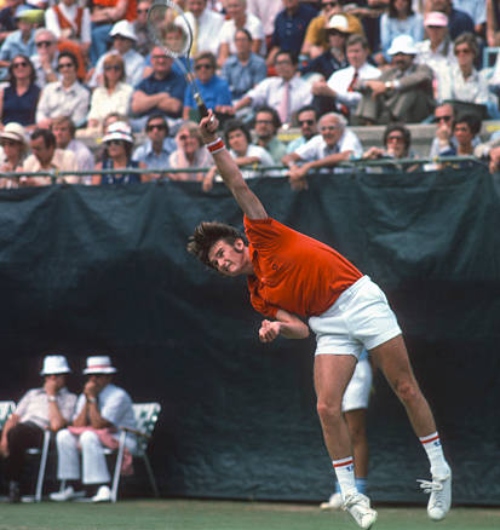
Newcombe won the Australian Open earlier in the year but had not lived up to the level
people expected of John Newcombe since then.
However, he was slowly playing himself into form. When Newcombe played Connors in this quarterfinal, he was the Newcombe that won several Wimbledons.
Connors was pretty close or perhaps at the same level as he would be in 1974 in which he won 3 majors out of three entered with a 99-4 record or a 93-4 depending on the source. It’s such a shame Connors was not able to enter the French. We will never know if he could have won the Grand Slam that year.
In many ways you could argue Connors’ season in 1974 is superior to Laver’s Open Grand Slam season or Budge’s Grand Slam in 1938. The percentage record of Connors that year is superior to Laver’s or Budge’s Grand Slam years. Connors won 15 tournaments on every surface. He won on clay, hard court, indoor carpet and of course on grass. He played super players like Rosewall, Borg, Ashe, Nastase, Solomon,
Gerulaitis.
I’m not saying it is superior to Laver’s Grand Slam 1969 season, but it could be argued to be so. I do think it is clearly superior to Budge’s Grand Slam season considering most of Budge’s main rivals were in the Pros or unable to play the amateur circuit.Connors was in good form in that tournament. He defeated Charlie Pasarell in four sets and Tom Okker in straight sets to reach the quarterfinals against Newcombe.
The grass at the US Open at the West Side Tennis Club was not nearly the same as the grass they have at Wimbledon today. The grass at Wimbledon today allows players to hit strong groundstrokes from the baseline.
The grass in those days at the 1973 US Open was so bad and chewed up you couldn’t have decent rallies. Often the ball wouldn’t bounce up at all. This would favor a player with a huge first service and volley
like John Newcombe over one of the greatest baseline players ever in Jimmy Connors. Newcombe had good groundstrokes also by the way.
To call Jimmy Connors a baseline player of course is not fully accurate. Connors was a tremendous all court player. He could serve and volley if he wanted to, but his groundstrokes and his return were the best in the game at the time in retrospect.
This was a true battle of titans. Newcombe broke Connors once in the first set and served out to win the set 6-4. Typical super-efficient set by Newcombe at his best.
The second set, with both players holding serve throughout went into a best of nine tiebreaker. Yes, you read that correctly. It was a best of nine. First player who wins five points takes the tiebreaker. You did not have to win the tiebreaker by two points.
The tiebreaker went to 4 points apiece. It was set point for both players! Newcombe won the next point to win the tiebreaker 5 points to 4. He now had a two-set lead.
The third set also had both players holding serve throughout. Again, in the tiebreaker it was again tied at 4 points apiece. It was set point for Connors but match point for Newcombe. Newcombe again won the ninth point of the tiebreaker to win the tiebreaker 5 points to 4.
This was an extremely well-played match between possibly the two best players in the world at that time. Yes, I know Nastase was number one in 1973 at the end of the year but at this point I felt both Connors and Newcombe were better.
Amazingly efficient match by Newcombe. To not lose serve once against possibly the greatest returner of all time says a lot. Still if Connors won the ninth point of each tiebreaker, he would have been ahead two
sets to one. It was that close.
Newcombe played Rosewall in the next round and defeated him fairly easily in straight sets 6-4, 7-6, 6-3.
I think Connors, if he had won his quarterfinal against Newcombe would have also beaten Rosewall. We know now from history that Connors’ power attacking game and return was a big problem for Rosewall’s great game.
Connors had a 6-0 lifetime record against Kodes so while Kodes is capable of great heights I do think Connors would have defeated Kodes that year also. But you never know. Kodes played exceptionally well in losing to Newcombe in five sets in the final.
Still if it was Connors facing Kodes in the 1973 US Open final I would take Connors.
The finals of the Women’s Championship had the great Margaret Court, in her last great year versus Evonne Goolagong at or near her peak at age 22. Court reach the finals by defeating another up and coming future superstar in Chris Evert by 7-5 2-6 6-2.
Court defeated Goolagong 7-6 5-7 6-2 to win her 24 th and last major. As of August of 2026, that is still the all-time record for majors won. The fantastic thing about this record is that Court had two pregnancies and retired for a year because she was married. She probably would have won a number of other majors. The 24 majors were won in only 47 majors entered. She won more than half of the majors she entered.
For 1973 Court won 18 of 25 tournaments with a 102-6 record. One of a number of seasons in which Court won over 100 matches. She won the Australian, French and the US Open for another one of her seemingly typical years. But it would be the last great year of her career.
Newcombe won the final against Jan Kodes. The final was very well played. Despite the fact that Kodes was the higher seed, I think most favored Newcombe in the final. As usual Newcombe won the final in five sets 6-4, 1-6, 4-6, 6-2, 6-3. He always seemed to win big matches in five sets.
Later in the year Newcombe may have played in the best match of the year in the Davis Cup against Stan Smith.
To quote Bud Collins’ great book The Bud Collins History of Tennis-“Newcombe set the mood by beating Smith in the opener 6-1 3-6 6-3 3-6 6-4. Artistically, this might well have been the match of the year. Newcombe—an enforced absentee from Davis Cup since 1967—came back from 1-3 and a break point in the fifth set with some sublime play, featuring thoughtful baselining to go with his volleying.”
1974: Connors Looks Invincible and King Holds off Goolagong
The next year 1974 was the last year that the U.S. Open at Forest Hills was played on grass. Jimmy Connors on the basis of winning the Australian open over Phil Dent and Wimbledon in crushing fashion over Ken Rosewall was the top seed.
The defending champion John Newcombe was the second seed.
Perhaps the star of the show was again Vijay Amritraj who did his usual spectacular upset before losing to his nemesis Ken Rosewall. In the second-round Vijay played someone who would be very familiar with the tennis fans, a young teen named Bjorn Borg. Borg won the French Open that year over Manuel Orantes, coming from two sets down to win the last three sets 6-1, 6-1, 6-1. Borg’s heavy topspin was considered to be strange in those days. Some thought he may injure himself because of the violent topspin he imparted on the ball.
Borg was also a power on the WCT tour, reaching the WCT finals before losing to John Newcombe. Borg was the fourth seed at the US Open that year at age 18. Vijay was 20. It was interesting that when Bud Collins and Donald Dell interviewed Borg on Public Broadcasting several weeks prior to the US Open that Borg said he would face Vijay Amritraj in the second round.
Borg clearly knew how dangerous Vijay was, especially on grass. Vijay started quickly and hit a number of outright winners pass Borg to easily win the first set 6-1. The second set was closer, but Vijay pulled it out in a tiebreaker 7-6. Borg took control in the next two sets winning by 6-3, 6-1. It looked as though Borg was
going to make another one of his incredible two set comebacks.
In the fifth set, which is the set that is usually owned by Borg, Vijay broke to take a 4-2 lead. The next game seemed to last forever as Borg desperately tried to break back. The game went to 9 deuces. Borg had 4 break points to get back on serve but Vijay held off the seemingly relentless Borg.
Amritraj held for a 5-2 lead and then broke Borg again to win the match 6-2 in the fifth. Despite the seemingly one-sided score in the final set, it was a very tense set. If Borg broke in the seventh game, he very well could have won the match.
An astonishingly well played match played by two of the most gifted players in the world. Vijay lost to his arch nemesis Ken Rosewall later. In a way it’s a shame that Vijay won. It would’ve been great to see a young Bjorn Borg versus the veteran Ken Rosewall. Borg defeated Rosewall in their only meeting.
Billie Jean King and Evonne Goolagong reached the finals on the Women’s side. Evonne defeated Evert 6-0 6-7 6-3 in the semi-finals. Goolagong led Evert 6-0 4-3 when the match was postponed to the next day by rain. They waited for many hours hoping to resume the match but to no avail.
I think the rain delay favored Evert. She was not playing at her usual level as it seemed. Perhaps a better reason was that Goolagong was preventing her from playing at her usual level. Whatever the case, Evert won the tiebreaker 5 points to 3. Evonne, however, won the match 6-3 in the third on a controversial call.
The final was to be Billie Jean King against Evonne Goolagong in the final. King had advanced to the final by getting revenge on Julie Heldman in the semifinals 6-1 in the third set.
Goolagong won the first set 6-3 and Billie Jean returned the favor by winning the second set also by the score of 6-3. In the final set, Goolagong got off to a quick start and led 3-0 in the third. The US Open seemed hers for the taking. King, however, rallied to tie the match at 3 and eventually won the final 7-5 in the third.
The Men’s final was a repeat of the Wimbledon finals that year. Rosewall upset Newcombe in the semifinals.
This was a horrible match up for Rosewall. Rosewall, for most of his career had the most consistent groundstrokes in the game. This, along with his great volley and quickness made him one of the all-time greats. The problem was that Connors’ groundstrokes were superior and his power was much greater than Rosewall’s force.
The Rosewall serve, which was generally good enough against most players was not powerful enough against the great Jimmy Connors return. Rosewall was unable to serve and volley against the great Connors return so he had to stay back only to be outdueled from the baseline.
It was a massacre. Connors won 82 of 124 points played with 31 winners against either 11 unforced errors or 16 unforced depending on who did the scoring. The final score was 6-1, 6-0, 6-1. It is amazing because on the bad grass of Forest Hills in those days, you figured a top player would be able to win more than 2 games because it was much easier to hold serve.
Pat Summerall, around the 3:14 mark in the video I will leave a link to, said that the Rosewall backhand was unmatched. Yes, generally it was but at that point I would say it was more than matched by the Jimmy Connors backhand, just across the net.
For tournaments won and majors won, this was Connors best year and one of the greatest tennis years ever. Jimmy won 15 tournaments, including the Australian, Wimbledon and the US Open. He won a lot of other tough tournaments too like the US Clay Courts over Borg in the final.
For winning percentage in the Open Era Jimmy Connors in 1974 was the second best next to John McEnroe in 1984 when McEnroe won 82 and only lost 3 matches.
Connors, depending on the site won 99 and only lost 4 or won 93 and only lost 4. At any rate it was incredible. After crushing Rosewall again, he just seemed in another league. Much of the summer tennis circuit in 1974 basically became the Summer Clay Court.
So players like Guillermo Vilas, Harold Solomon thrived on this circuit. Vilas became perhaps the most popular player on the circuit since he was on TV so often on Public Broadcasting with Bud Collins and Donald Dell.
The Manuel Orantes Miracle and Chrissie Evert Starts her US Open Dominance
In 1975 it was no different except that the West Side Tennis Club also joined the parade and the US Open switched to har-tru which was a claylike surface. The new surface changed much of the tennis hierarchy at the US Open. No longer were the favorites for the US Open, the great serve and volleyers like John Newcombe (who was a terrific clay courter also), Stan Smith, and Arthur Ashe but some of the great baseliners like Vilas, Orantes, Solomon.
The serve and volleyers I mentioned were also excellent clay courters too by the way but their huge serving power and volleying would be diminished on the slower Har Tru surface.
Jimmy Connors was the top seed and he probably was the best player in the world. The Top 10 seeds were in order Connors, Vilas, Orantes, Ashe, Borg, Okker, Roche, Nastase, Laver and Tanner. Laver was 37 years old at this point and clearly past his prime. He was still very dangerous however and capable of defeating anyone.
Laver played Borg in the fourth round and lost in four sets 6-1, 6-4, 2-6, 6-2. Excellent showing by Laver against a player who would be the dominant player in the world in a few years, especially on Har Tru, commonly called “American green clay” like type of surface where Borg would reign supreme. Here’s small clip of this match at the end.
These are two players who both have been argued to be the GOAT of tennis although neither one is quite at their peak. Laver, as I mentioned was past his peak and Borg was yet to reach his peak.
Jimmy Connors played Bjorn Borg in the first semifinal that day.
At that point in time, Borg and Connors were tied in their rivalry at one match apiece.
Still Connors was considered to be almost unbeatable at that point in time and was thought to be the clear
favorite.
It was a very odd match in that the sequence of games was absolutely the same in every set. Connors held serve the first game. Borg held in the second. Connors held in the third game and broke Borg in the fourth game of the set. Connors held in the fifth game to lead 4-1. Borg held to 4-2. Borg broke Connors in the seventh game for 4-3.
Borg held to tie the set at 4. Connors held and Borg held and the set was even at 5. Connors held and broke Borg in the twelve game to win the set.
It was exactly the same in the second and third sets. So Connors won 7-5 7-5 7-5. Connors was back in the final again.
Guillermo Vilas was on a great hot streak going in the US Open in 1975. I believe at one point he won 21 matches in a row. Many considered Vilas the favorite to win the tournament. Vilas did seem invincible at the US Open until he reached the semifinals.
Perhaps his most impressive match was his annihilation of two-time French Open champion Jan Kodes in the fourth round by 6-2, 6-0, 6-0.
Vilas was in some ways the predecessor of Rafael Nadal. He had great strength and great groundstrokes with heavy topspin. He was very fast and had good stamina. His one-handed lefty backhand was terrific. His forehand was very powerful although some considered his backhand to be the better overall shot. A good but not great volley and he had a good serve.
However, in watching that tournament I was fascinated by the great touch and artistry of Manuel Orantes. Orantes had often given Vilas great problems on clay. That year, coming up to the US Open, Orantes defeated Vilas 3 out of 3 times. There seemed to be nothing that Vilas could do to hurt Orantes. When Orantes was on his game, he had the ball on a string, and he seemed to put the ball anywhere he wanted.
Still, going into the semifinals, Vilas was the favorite to win. Vilas just looked awesome in this tournament, losing only 18 games up to the semifinals against Orantes.
Vilas looked invincible in winning the first two sets 6-1 6-4, which made it 14 sets that he won in the tournament without a loss. Still the rallies were long and grinding. Vilas was known for his stamina so you would think this would favor him.
The powerful Vilas immediately broke to lead 2 love in the third set. You would think as a spectator that the match is going to be over shortly. Not so. Orantes, as he often was capable of, went into one of his own type of zone. Usually when you think of a player going into the zone, it could be like Sampras at Wimbledon in which the player just overpowers the opponent with the great power of his strokes.
With Orantes, yes he could put away shots if need be but of one so many strengths was that he was able to put the ball exactly where he wanted that annoyed his opponent. It was to use the old term, playing cat and mouse. He would drop shot, the opponent would run to get it and somehow Orantes would be standing in the perfect position to execute whatever winner he wanted.
From 0-2 down, Orantes won 6 straight games in what seemed like a blink of an eye to win the third set 6-2.
Vilas, however, methodically pounded away with his heavy topspin power and soon led 5-0 15-40 on Orantes’ serve, double match point. Many of the people in the old stadium were moving to the portals to get ready to leave. They would have to wait a long time.
Orantes saved 5 match points and won 7 straight games to win the set 7-5. There was still one set to go but I think most in the stands thought Vilas now had little chance to win. Rallies were of course approaching infinity with these two, but Orantes eventually prevailed 6-4.
Here’s a little video on that comeback:
The logic was that Orantes had to be exhausted. This was coupled by the fact that Orantes had a plumbing problem at his hotel that same night so he went to sleep even later than expected. However, I thought he was playing as well as any player in the tournament. With his variety and skills, I thought he could beat Connors.
Incredibly enough Orantes defeated Connors in straight sets 6-4, 6-3, 6-3.
Possibly the most improbable win in a major in history. It may have even surpassed Henri Cochet’s
magical victory at Wimbledon in 1927.
Here’s the match against Connors:
On the women’s side, the new change to Har Tru was perfect for Chrissie Evert, who had
the best groundstrokes in the game.
Evonne Goolagong Crawley was at least to my mind seeded too low, reached the final against top seed Chris Evert. It was a great battle and very few could give Evert any sort of battle on this clay type surface. Evert won 5-7, 6-4, 6-2.
1976: Connors Conquers Borg, Evert Rules US Open Again
Connors was having another one of his great years in 1976. He would eventually win 12 tournaments for the year but when the US Open started, he had not won a major tournament.
Borg, who this year won his first Wimbledon was having a fantastic year. Borg won, besides Wimbledon, another “major” or at least it was considered a major at the time, that would be the 1976 WCT Championship that Borg won over Guillermo Vilas.
Connors and Borg were seeded 1 and 2 for the tournament. Probably the most interesting match of the tournament was Borg’s match against the incredible Manuel Orantes in the quarterfinals. Orantes won the first set 6-4 but Borg blitzed him in the second second 6-0 and then the third set 6-2. Borg proceeded methodically to lead 4-0 in the fourth set. It looked like it was over. At this point Borg had won 16 of the last 18 games.
But this was Orantes on a clay court surface.
Somehow, even against the great Borg, Orantes rallied to win the fourth set 7-5. Sounds like a familiar script, doesn’t it?
But his opponent here was not Vilas, it was Bjorn Borg. Borg, as he often seemed to do, won the fifth set 6-4 to advance to the semifinals against Ilie Nastase.
Borg defeated Nastase in straight sets and Connors did the same to Vilas.
The top two players in the world faced each other in the final. Connors won the first set 6-4 and Borg responded by winning the second 6-3. It went to a third set tiebreaker in which Connors fought off several set points to win 7-6 and he finished off Borg in the fourth set by 6-4.
Many called Connors the top player in the world for 1976 because of this win. This is debatable since Borg won essentially two majors and was in the finals of a third.
1977: Vilas Is Irresistible Force, Evert Steamrolls All
Borg, Connors and Vilas were almost invincible this year. Borg won 13 of 20 tournaments with an 82-7 record. Connors won 8 of 21 tournaments with a 70-11 record which frankly was an off year for him.
Vilas won 17 of 33 tournaments with a 145-14 record. Vilas also won, depending on what site 46 or 50 in a row. I would tend to go with 50 in a row because they all were legitimate tournaments.
Combined they won 38 tournaments out of 74 played.
Chris Evert had her usual year in those days with a 70-4 record. Chris won 11 tournaments out of 14 played.
Evert was not quite as dominant as she was at the 1976 US Open but like 1976, she won the tournament without losing a set. Evert’s only minor problem was when Wendy Turnbull took her to a tiebreaker in the first set of the final. Of course, Evert won the tiebreaker and won the second set easily 6-2. Evert was the US Open Champion again for the third year in a row.
The men’s tournament was thought to be between the superstars of Borg,
Connors and Vilas. Borg was top seed with Connors second seed, surprisingly to me at least Brian Gottfried was the third seed with Vilas the fourth seed.
Just a little minor note, the great Spanish Champion Manuel Santana played his last major at this US Open but unfortunately faced Vilas in the first round and lost 6-1 6-0. Borg unfortunately had a shoulder injury just prior to the US Open. The surface was almost built to Borg’s specifications. If he was healthy he clearly would have moved deeper into the tournament, most likely the final.
However, injuries do happen. That is a part of tennis.
Vilas was on an unbelievable streak at this point. In the last six months of 1977, Vilas won 13 of 14 tournaments and 80 of 81 matches! Borg defaulted to Dick Stockton in the fourth round with the sets tied at 1. Connors continued easily to the finals. On the way he got revenge on Manuel Orantes in straight sets in the quarterfinals.
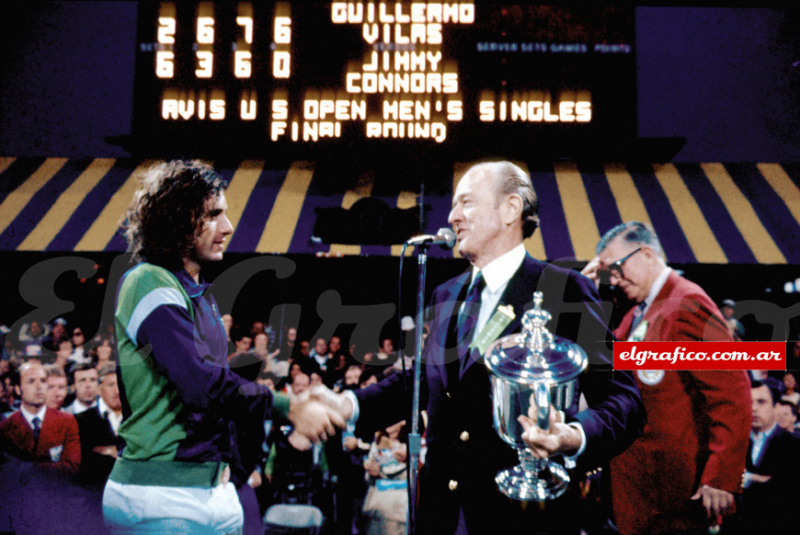
The final was Vilas and Connors in the finals. Connors had defeated Vilas the previous year in the semifinals by 6-4 6-2 6-1. In observing that match it seemed to me that Vilas was not used to the great Connors flat power. Not exactly an observation that most wouldn’t see but true nevertheless.
The same thing happened in the first set of the final. Connors overpowered Vilas 6-2. Vilas however, came back to win the second set 6-4 and the third in a tiebreaker 7-6. Vilas was on a roll and won the first five games of the fourth set. Connors did not give up and hit what he thought was a winner on match point against him.
However, the ball was called out and Vilas was the 1977 US Open champion.
Here’s the match:
By today’s standards Vilas would have been world No. 1 for the year in 1977.
Vilas won the French and US Open plus he was in the finals of the 1977 Australian, losing to Roscoe Tanner 6-3 6-3 6-3. This was the last US Open held at the Famed West Side Tennis club in Forest Hills.
Afterward they held the Tournaments of Champions here for a number of years on the WCT tour. Among the winners were John McEnroe, Vitas Gerulaitis, Ivan Lendl, Yannick Noah, Eddie Dibbs, Andres Gomez and Andre Agassi.
The US Open moved to its present location in Flushing in 1978 and switched to a hard-court surface called Deco Turf. As I mentioned earlier in the article it had to be done since the tournament was getting so big they needed the space. In many ways it’s a shame but tennis was becoming a big business so the change was inevitable.
Is the viewing experience nicer now than it was at the West Side Tennis Club?
Obviously, technology is a lot different now and they can set up that we have a different type of great viewing experience.
However, there is something to be said about the old charm of going to a tennis major in those days.
The West Side Tennis Club still exists.
It was home to such much amazing tennis history long may the stadium stand.
0 comments