By Richard Pagliaro | Monday, June 8, 2026
Photo credit: Robert Prange/Getty
Women stars stepped into Roland Garros’ night session spotlight for the first time in three years.
When world No. 1 Aryna Sabalenka defeated former No. 1 Naomi Osaka on the evening of June 1st in Paris, it marked the first time a women’s match was staged on Court Philippe Chatrier at night in three years.

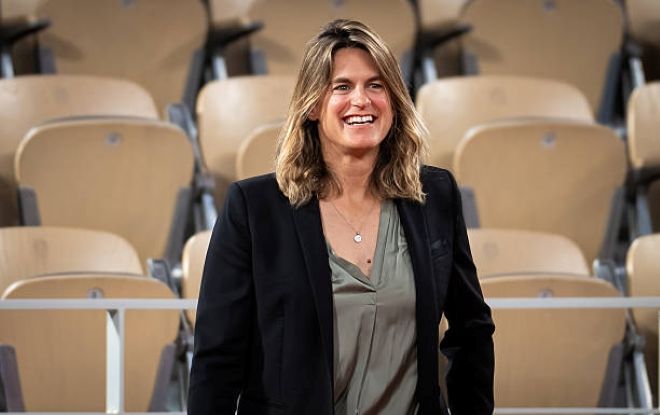
In a tournament-closing press conference, Roland Garros Tournament Director Amelie Mauresmo shed some light on the future of French Open night sessions.
Hall of Famer Mauresmo said it’s unlikely the tournament will schedule two singles matches at night on Court Chatrier out of concern a late evening conclusion could physically deplete a player for the rest of the tournament. Mauresmo also stopped short of committing to routinely schedule a women’s singles match at night, asserting the day-session matches are more widely viewed in France than night sessions.
“I would like to remind you also, and I’m doing this probably every year, that two women’s matches and two men’s matches are happening on center court, on Philippe Chatrier and on Suzanne-Lenglen, and all the other courts that we have, including our big courts every day,” Mauresmo said. “Just so that you know, in France the biggest, how do you say, audience is not the night session, by far. It’s the day
sessions.”
Two-time Grand Slam champion Mauresmo has repeatedly said one reason the Court Chatrier night schedule has been nearly entirely men’s matches for the last three years is because men play best-of-three-set matches, which the tournament believes gives ticket-buying fans a better value of one night session match than a women’s singles match, which is best-of-three sets and could potentially end in less than an hour.
The Tournament Director said “The Show”, a major evening session, requires a substantial plot to engage the audience.
“I mean, we’re going to continue to try to satisfy as many people as possible with many factors that we have to put together before making the scheduling decision every day, day or night,” Mauresmo said.
“As I said, the length or potential length of match is one of the factor that we have, that we have to acknowledge also. The show is there. There’s no question on this.”
Asked about the prospect of adopting a US Open-style night session with one women’s singles match followed by one men’s singles match, Mauresmo said there are no plans to pursue that schedule because of the potential physical stress it can pose in demanding clay-court matches.
“It’s not our desire to have two matches in the night session, because tennis is an uncertain sport in terms of length of matches, so we have talked about it at length,” Mauresmo said. “We would talk about time slots that could be very long.
“Then you have the issue of recovery for the players and for the general public. If a player was to start his or her match at 11:00 p.m., it wouldn’t be satisfactory. So all this has to be taken into account.”
In addition to satisfying ticket-buying fans and international TV right holders, longer night matches are more profitable for Roland Garros as the tournament makes more money on concessions.
In a clash of Grand Slam champions, the top-seeded Sabalenka defeated Osaka 7-5, 6-3 in a night-session match that lasted 87 matches on June 1st.
The previous evening, 28th-seeded Joao Fonseca fought off two-time finalist Casper Ruud in a men’s four-set match that spanned three hours, 55 minutes.
On June 2nd, 26th-seeded Jakub Mensik swept Fonseca in a three-setter that lasted two hours, 44 minutes.
Critics say Roland Garros is minimizing women’s tennis and devaluing its appeal to fans by almost exclusively focusing the night-time spotlight on men’s singles. Mauresmo said night scheduling comes down to two primary considerations:
*Does the match feature a star or champion player who can fill Court Chatrier?
*Will the match be compelling and last long enough to give fans value for their ticket?
“We have to take it into consideration as to the 15,000 spectators coming in for the night session,” Mauresmo told the media. “Since men’s tennis is played at the best-of-five sets, three sets will be played at a minimum. It’s complicated for us to do otherwise.”
Some players have suggested the tournament could add a doubles match to the night session after a singles match to ensure the night session would last more than two sets even in the case of a women’s singles blow-out match.
The 2025 Roland Garros champion Coco Gauff suggests starting the night session at 7 p.m. instead of 8:15 and scheduling a women’s singles match first followed by a men’s singles match.
“You feel what’s best for fans, but I feel like we produce some high quality tennis and have some great stars on the women’s side,” Coco said. “From my experience playing at US Open, night match at 7:00 p.m. with Novak following me, and he’s the greatest player of all time, people were almost just as excited to see me play as him.”
0 comments