By Gabe Jaramillo | Friday, September 18, 2026
Photo credit: Dustin Satloff/USTA
Watch a match at the US Open, and your eyes follow the ball.
A blistering serve. A desperate passing shot. A winner that brings the stadium to its feet.
But keep watching after the point ends.
Someone darts forward, collects the loose ball, and disappears back into position. Across the court, another person is already anticipating what the server needs. Within seconds, everything is ready again.
It looks effortless. That is the idea behind one of the best ball crews in tennis.
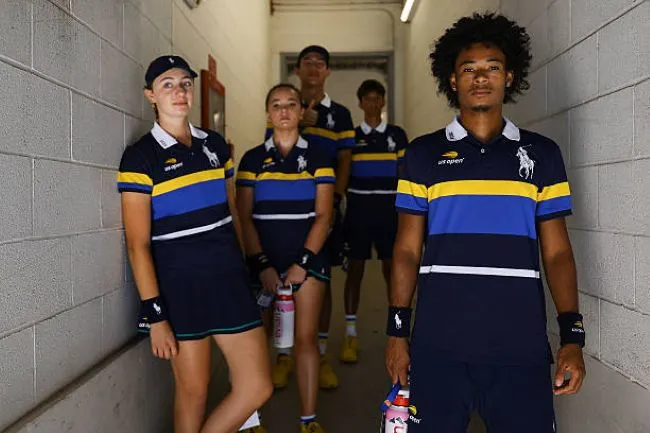
One ball boy, back for his fourth US Open, helped me see how much work goes into those few seconds. Through his account, a different tournament emerged: one measured in concentration, sore feet, long commutes, and the satisfaction of doing a difficult job so well that almost nobody notices.
His return began with an application. Again. Having worked the previous tournament, he explained, does not excuse a crew member from applying for the next one. Experience matters, but returning still requires a commitment.
For newcomers, the path includes an on-court audition. Before they can stand beside the best players in the world, they must show that they can move quickly, handle a ball accurately, follow instructions, and keep their attention where it belongs. Tennis-playing experience is not essential. Good hands, quick feet, and a dependable attitude are.
Evaluators also watch what happens after a mistake. Anyone can look composed when everything goes perfectly. A ball that escapes at the wrong moment reveals something more useful: whether a candidate can recover and get on with the job.
Those selected rehearse ball handling and match situations before the tournament. They learn where to stand, when to move, and how to cooperate without turning the court into a conversation. They are joining a crew that includes teenagers and adults, with members arriving from far beyond the tournament’s New York neighborhood.
For some, the daily journey alone takes hours. The boy described colleagues making a long trip to the grounds and back, then doing it all again the next morning. The chance to share a court with the world’s best makes an early alarm easier to forgive.
There was a time when moving the balls around was almost a show of its own. Crew members would throw from one end of the court to the other, sending a lightweight tennis ball across a considerable distance with remarkable accuracy. The catches looked automatic. Anyone who has tried that throw knows otherwise.
Today, the skill is quieter. The ball travels along the ground. As the boy explained it, rolling helps put boys and girls on a more equal footing by removing the demand for that long throw. But the standard remains exacting: a proper roll stays down. No hopping, no bouncing, no little adventure on its way to the receiver.
A good roll should be rather boring to watch. Producing one under pressure is another matter.
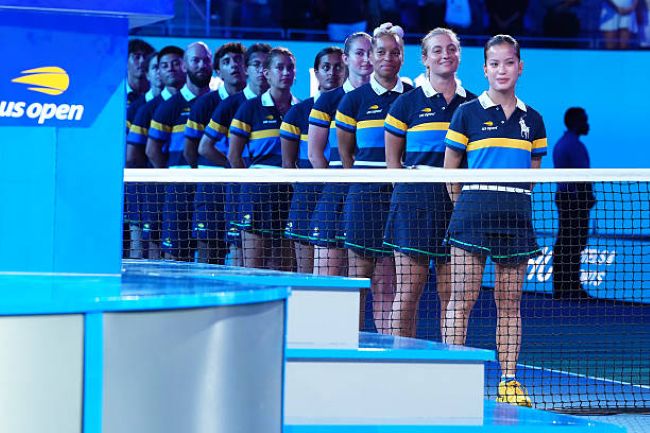
Photo credit: Garrett Ellwood/USTA
The working day has its own choreography. In his description, morning crews arrive before the opening matches and take their positions while the court is still waiting for its stars. A later group joins around midday, and the night crew takes over the evening assignment. Members indicate their preferred schedules, and court rotations alternate sustained stretches of duty with time to recover.
Those breaks matter. Standing still in the heat requires endurance; repeatedly exploding into a sprint requires more. Supervisors watch for anyone who needs replacing because of dehydration, inadequate food, or exhaustion. Keeping the match moving depends on keeping the crew well.
As the tournament advances, the workforce changes. Some younger members return to school, leaving more of the work to older colleagues. The boy described matches handled by a smaller crew, with fewer people covering the baselines and the net. The court does not shrink to accommodate them. They must anticipate more, cover more ground, and concentrate even harder.
Then there is the uniform, perhaps the most recognizable reward for making the team. He described receiving several complete changes of clothing, along with wristbands, a warm-up outfit, and a backpack. Shoes tell their own story. Someone working mainly at the baseline may need fewer pairs than a teammate repeatedly sprinting from the net. For those carrying that workload deep into the tournament, the supply can grow considerably.
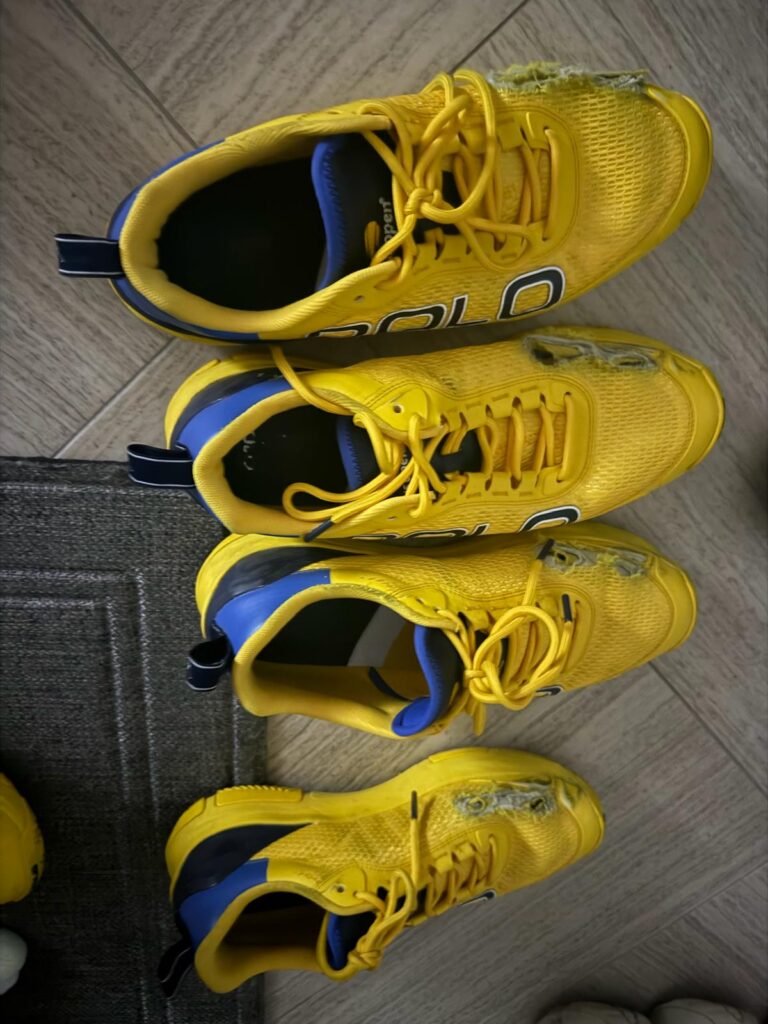
Photo: US Open Ball Boy Shoes after the tournament
The outfit looks glamorous from the stands. Inside, it is someone doing a demanding shift. The ball boy told me that when they’re stationed at the net, they wear through five right shoes in just two weeks.
There are practical rewards, too. He reported earning nineteen dollars an hour, with a daily meal allowance of forty dollars to spend around the grounds. He also described a staff dining area tucked beneath the stadium, away from the public, where ball people eat alongside officials and other tournament workers. For a while, everyone can sit down and enjoy a meal instead of watching the next point. They can watch matches after their shifts.
Back on court, discretion is part of the job. Crew members do not initiate conversations with players, even though they stand close enough to hear the private struggle behind the public performance: the frustration after a missed opportunity, the instructions toward a player’s box, the argument an athlete appears to be having with himself.
They may also believe they have spotted something an official missed, perhaps a faint touch of the net on a serve. Their role is to remain neutral and leave the decisions to the officials. Hearing everything does not mean reacting to everything.
And sometimes the next assignment is simply a towel and a patch of sweat. Before another spectacular point can happen, someone has to make the surface safe.
What stayed with me most, however, was a moment when the usual arrangement changed. According to the boy’s account, Sascha Zverev gathered the ball boys and girls who had worked his match, sat among them, and posed for a photograph.
For once, they were invited to stay in the picture.
Keep in mind that out of the 350 ball boys and ball girls, only 10 are selected to work the finals.
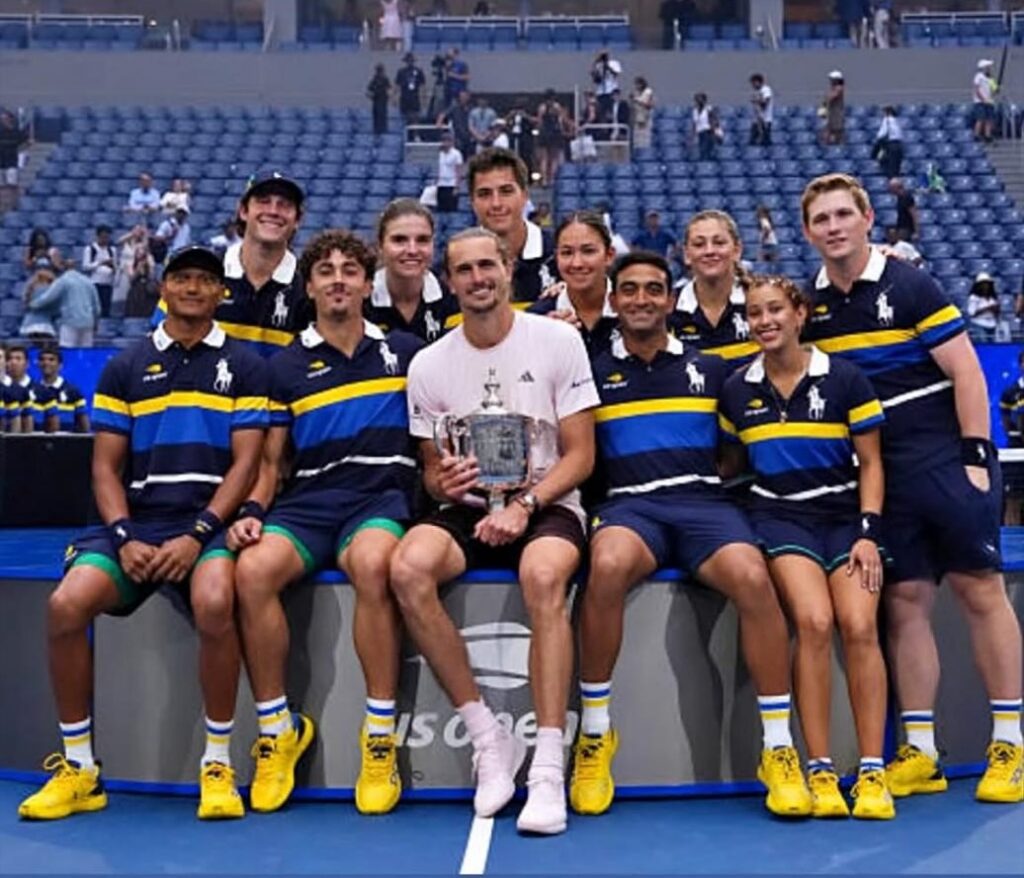
Photo credit: Dustin Satloff/USTA
For a player, it may have taken only a moment. For someone who had applied, trained, commuted, sprinted, and stood quietly through the heat, it could become the memory that outlasts every aching muscle.
The next time you watch the US Open, follow the ball for a little longer after the point ends. Notice the person who collects it, the teammate waiting to receive it, and the smooth roll that puts everything back in place.
The next serve is ready because they are.
About Gabe Jaramillo
Gabe Jaramillo is an internationally recognized tennis coach who has worked with 11 world No. 1 players, including Andre Agassi, Pete Sampras, Monica Seles, and Maria Sharapova. Founder and CEO of RPS Academies and author of How to Make Champions, he brings decades of experience developing champions at the highest levels of tennis. You can follow Gabe’s website here.
The Invicible work of many that make the tournament one of the best in the world. Great article.
So nice to see these unsung heroes get some recognition. They do an incredible job of keeping the matches running smoothly. Thanks for this great article.
Yes they are hard working dedicated and I’m glad to see they don’t have to hand sweaty towels to the players anymore. That was a bad habit and unfortunately in Cincy they were still doing it. They have enough to do. Go ball kids!
Without the effort of them, the event couldn’t happen in the same way, they deserve the recognition.
Without these people a tournament does not go on. It’s similar to going to a restaurant – no waiters, dishwashers, cooks, table breakers, etc. the restaurant can not function. I rode on a volunteer bus at the Cincinnati tournament. I sat next to a ball boy who was mid 30’s. Two younger ball boys in front of me. I started asking questions. How did they like what they were doing (for 2+hrs in the sun)? Loved it!! Then I learned there is even more going on behind the scenes. I had noticed some players , who after each point when serving wanted to check the condition of the balls. Some were user friendly and directed a rejected ball back to the ball boy. Some made it more work for them by just dropping the ball with no intent to make it easier for the ball boy. A young ball boy said “Oh yeah, there are players who make it more difficult. WE HAVE A LIST”. I couldn’t help but ask “like who”? He told me and it was exactly who I thought he might name. The behind the scenes efforts of a lot of people make tennis touraments happen. Good to see players recognizing them.