By Richard Pagliaro | Wednesday, September 9, 2026
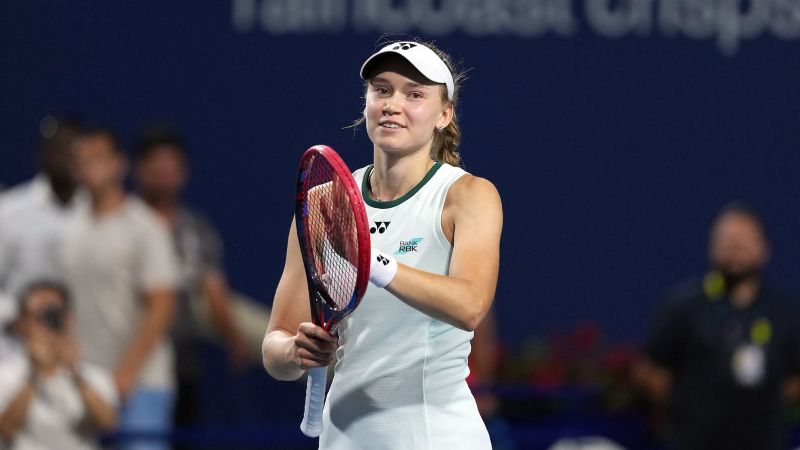
Photo credit: National Bank Open Facebook
NEW YORK—Rising from the former Valley of Ashes, Elena Rybakina reached the summit of the sport.
In a career-changing clash, Rybakina rallied past Zheng Qinwen 3-6, 6-1, 6-4 to advance to her maiden US Open semifinal and seize the world No. 1 ranking for the first time.
Australian Open champion Rybakina, who defeated Aryna Sabalenka in the Australian Open final in January, surpassed current No. 1 Sabalenka to seize the top spot. When the new WTA rankings are released on Monday, the 27-year-old Rybakina will top the world.
“Well, it means a lot, of course, but as I was saying before, I don’t think about it so much,” Rybakina said of No. 1. “It’s a great achievement, and I feel like you will appreciate and think about it even more when you finish your career.
“Like now, you still need to keep on going, and it’s nice whenever you’re done to say, Okay, I won these
tournaments, I’ve been No. 1, it’s amazing, but right now it’s great.
“You never know how long you’re going to stay. It’s still many things. I want to win the titles still in the tournaments, so all my thoughts are just for the next match.”
Joining an elite club, Rybakina is the 30th woman in WTA history to hold the world No. 1 ranking.
Flushing Meadows Corona Park was built on a once desolate dumping ground for coal ashes. F. Scott Fitzgerald famously described the wasteland “the Valley of Ashes” in his classic The Great Gatsby.
Rybakina realized a dream reaching the top spot, but said her ultimate goal is to capture the US Open championship on Saturday.
“It’s just a number right now,” Rybakina said. “Of course I’m in the semis. My goal is to win the tournament.
“It’s an amazing achievement, but you know who quick everything can change in tennis ranking wise. So I just have to enjoy my game and try to recover.”
The two-time Grand Slam champion will play her fifth major semifinal tomorrow night when she takes on 2023 champion Coco Gauff.
The fourth-seeded Gauff saved two match points in the tiebreaker repelling reigning Roland Garros champion Mirra Andreeva 2-6, 7-6(7), 6-2.
“If I play Coco, of course I will expect that a lot of people going to support her. It’s normal,” said Rybakina, who is 1-1 vs. Gauff. “We practiced many times. We played recently also, so we know each other.
“Again, I just need to stay aggressive. Try not my emotions not let me play, and yeah, just enjoy. I think from where I was coming to this tournament, being injured and not practicing, I think we came pretty far.
“Now we just last pushes and important to still enjoy. Yeah, hopefully it’s going to go my way.”
The winner of that semifinal will face either two-time reigning champion Aryna Sabalenka or 2024 finalist Jessica Pegula in Saturday’s US Open final.
World No. 121 Zheng, who cried on court after winning her third qualifying match to reach the main draw, was bidding to become the first qualifier in Open era history to defeat three Grand Slam champions at the same Slam.
Down Love-5 on Labor Day, Zheng roared through seven straight games, shocking Iga Swiatek 7-5, 6-3 to rally into her third US Open quarterfinal in the last four years. That rally came one round after the Zheng was down Love-5 in the deciding set vs. 2025 Australian Open champion Madison Keys. Then the 2017 US Open finalist completely lost the plot and unraveled. Zheng saved a match point in the sixth game against Keys sparking a seven-game run that saw her shock the American 1-6, 7-6(3), 7-5 on Grandstand.
Today, Zheng exploited Rybakina’s sub-par 43 percent service percentage in the opening set to punish second serves. In the final set, Zheng had a break point and a clear look at a backhand pass down the line. Had she made that strike, Zheng would have broke for a 5-3 third set lead, but she sailed it long and Rybakina slammed shut the dooor.
“Well, obviously I think that passing shot I miss make some difference, and of course I think maybe when she serve second serve, I could be more aggressive sometimes and make a bit less mistake in the return,” Zheng said. “Because when the rally gets long, I think is where I get more points.
“I mean, today is just few points makes the different. That’s it.”
The Olympic gold-medal champion threw down successive shutout holds for a 4-3 lead. Then Zheng hammered a bounce smash into the corner for break point in the eighth game. Rybakina’s forehand crashed into the tape, popped up and plopped on her side of the net as Zheng broke for 5-3.
Closure was complicated. Zheng fought off three break points, but could not convert three set points.
On her fourth set point, Zheng slid an aggressive second serve down the T, closing a challenging 13-and-a-half minute hold to snatch a one-set lead. Zheng doubled Rybakina’s winner total—10 to 5—and saved all five break points she faced in the opener.
“I didn’t start that well. I was too much negative,” Rybakina said. “It wasn’t easy because all the matches here I played at night. So basically this is the first match under the sun. So it was a lot of unforced errors then I was just telling myself to keep on fighting.”
While Zheng left the court, Rybakina remained taking shadow swings behind the baseline.
That eagerness to play was evident as Rybakina rolled a crosscourt forehand to break for 2-0. Saving a break point in the fifth game, Rybakina torched an ace holding for 4-1.
Though she’s know for a tendency to predictably play her forehand crosscourt, Rybakina lashed some damaging drives down the line off that wing. Rybakina fired a forehand down the line to break for 5-1.
Whipping the wide serve, Rybakina held at 30 to wrap the second set and force a final set.
Stamping her third level hold, Rybakina leveled the decider at 2-all.
Two hours into the match, Zheng pressured the Kazakh’s serve at 15-30 in the eighth game.
Denying her opponent access to angles with a deep forehand drive down the middle, Zheng zapped a 90 mph backhand bolt down the line for break point.
On the 10th shot of the ensuing rally, Zheng had a good look at the same shot but adrenaline kicked in and she sailed a backhand long. Had she made that shot, Zheng would have served for the semifinal. Instead, Rybakina rallied to even the set at 4-All.
Strengthened by that stand, Rybakina sent a flat forehand winner down the line then drew a netted drive for triple break point. On her first set point, Rybakina netted a routine backhand return. Zheng lashed a forehand winner down the line to save the third break point only to badly miss a backhand down the line.
On her fourth break point, cumulative pressure caused Zheng to crack as she sent a double fault deep ceding the break and a 5-4 lead.
When Zheng pasted a forehand into net, Rybakina wrapped a two hour, 14 minutes.
She walked on the court as world No. 2. Rybakina walked off second to none.
Sorry to say, Watching Rybakina play a match is like watching paint peel.