
By Richard Pagliaro | Wednesday, August 19, 2026
Photo credit: Adelaide International Facebook
Nick Kyrgios has been a caustic critic of players who fail drug tests.
Now, Kyrgios is one of them.

The International Tennis Integrity Agency announced Kyrgios has been provisionally suspended since August 4th after testing positive for cocaine at the ATP grass-court tournament in Mallorca. Kyrgios submitted a urine sample on June 22nd. On July 17th, a World Anti-Doping Agency (WADA)-accredited laboratory confirmed the presence of benzoylecgonine, a metabolite of cocaine.
“Cocaine is a stimulant and substance of abuse on the WADA Prohibited List and is banned in competition under the Tennis Anti-Doping Programme,” the ITIA said in a statement. “If taken out of competition, reduced sanctions apply for substances of abuse.
“Because of the nature of the substance, a provisional suspension is mandatory and has been in place since August 4, 2026.”
Read the ITIA’s full statement on Kyrgios’ case here.
The mercurial Kyrgios shared he tested positive for cocaine following a failed drug test in Spain in a social media post.
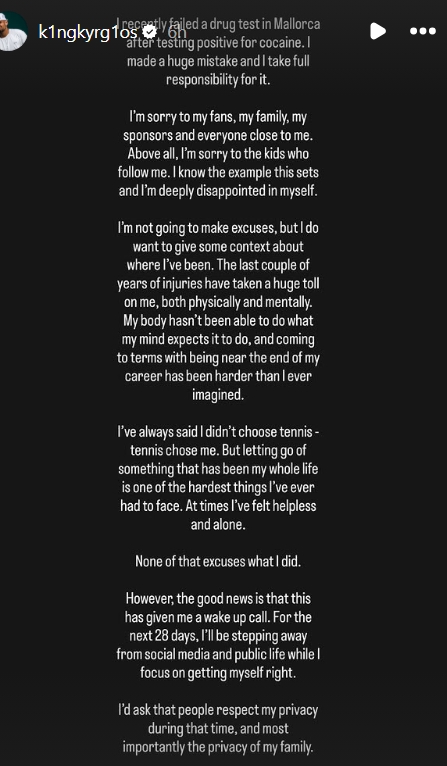
“I wanted you to hear this from me first. I recently failed a drug test in Mallorca after testing positive for cocaine,” Kyrgios said in a statement posted to his Instagram page.
“I made a huge mistake and I take full responsibility for it.”
Though the 31-year-old Kyrgios had a reputation as a partyer in his younger years, he was known for frequenting bars and being a drinker.
The Good Trouble podcast host said he found trouble with cocaine after suffering a slew of injuries that “have taken a huge toll on me, both physically and mentally.”
In a statement to Instagram Stories, Kyrgios apologized to his family, friends and fans.
“Above all, I’m sorry to the kids who follow me. I know the example this sets and I’m deeply disappointed in myself,” Kyrgios in his post. “I’m not going to make excuses, but I do want to give some context about where I’ve been.
“The last couple of years of injuries have taken a huge toll on me, both physically and mentally.
“My body hasn’t been able to do what my mind expects it to do, and coming to terms with being near the end of my career has been harder than I ever imagined.
“I’ve always said I didn’t choose tennis – tennis chose me. But letting go of something that has been my whole life is one of the hardest things I’ve ever had to face. At times I’ve felt helpless and alone.”
Former world No. 13 Kyrgios has received mixed response on social media with some fans showing support, while others blasted Kyrgios as the ultimate hypocrite.
Kyrgios continuously ripped world No. 1 Jannik Sinner, who claimed inadvertent contamination when he tested positive for the banned substance clostebol. Sinner later served a three-month suspension to settle WADA’s appeal of his case. Kyrgios was a harsh critic of Novak Djokovic during the COVID-19 era though the pair later settled their differences after squaring off in the 2022 Wimbledon final and have maintained a friendly relationship.
The explosive Kyrgios is not the first high-profile player to test positive for cocaine.
Former world No. 1 Martina Hingis was hit with a two-year ban in 2008 after testing positive for cocaine at the 2007 Wimbledon. Hingis denied ever knowingly taking cocaine, however her ban was strictly enforce and she was not even permitted to play World TeamTennis during the two-year suspension.
Daniel Evans tested positive for cocaine in 2017 and served a one-year suspension. Evans, who called his ban a wake-up call, returned to the Tour and played some of his best tennis eventually rising to British No. 1.
In 2009, Frenchman Richard Gasquet tested positive for cocaine at the Miami Open and was hit with a one-year ban. Gasquet appealed, successfully arguing he was accidentally contaminated kissing a woman named Pamela at a Miami nightclub who had cocaine on her lips.
Ultimately, Gasquet was reinstated after a few months.
“The player has been exonerated from any fault or negligence,” the Court of Arbitration for Sport (CAS) said in Gasquet’s 2009 case after rejecting a joint appeal from the International Tennis Federation (IFT) and World Anti-Doping Agency (WADA), calling for a one to two-year ban.
0 comments