By Richard Pagliaro | Saturday, August 29, 2026
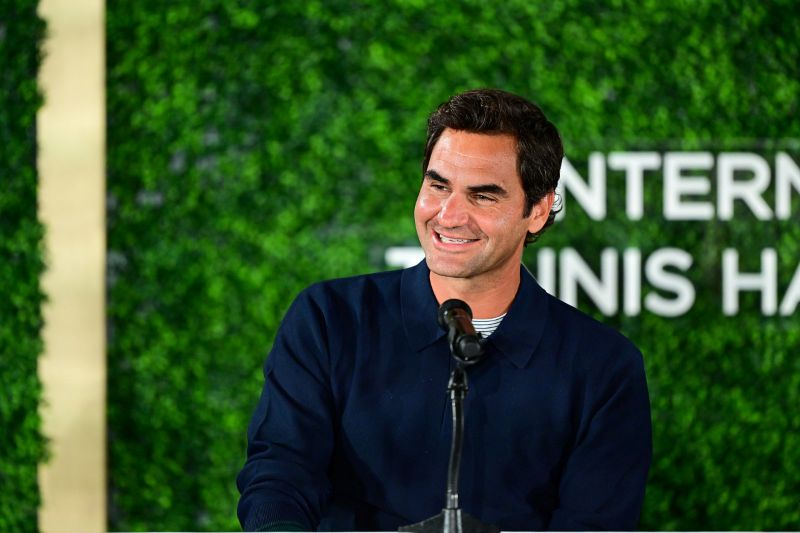
Photo credit: Ben Solomon/International Tennis Hall of Fame
NEW YORK—Long before Roger Federer became the most artistic of Grand Slam champions, he was fully invested in another occupation.
The young Federer was a pick-up artist.
As a junior, Federer served as a Basel ball boy for stars ranging from Jimmy Connors to Martina Hingis, who would go on to partner Federer in a Swiss Dream Team that won Hopman Cup.
Looking back on his rise from talented Swiss junior to 1998 US Open boys finalist to the world No. 1 ranking to the first man to capture 20 Grand Slam singles crowns to his induction into the International Tennis Hall of Fame at 6 p.m. today, Federer said he’s relished the ride—and still wonders sometimes what fueled him to such historic heights.
“Great question, and I think that’s one that I will always also try to seek to answer for myself, because I think you know me well enough that I’ve gone about my life in a very normal, natural way,” Feder told the Swiss writer at the International Tennis Hall of Fame’s press conference introducing Class of 2026 inductees Federer and pioneering broadcaster Mary Carillo.
“Sure, I’m very professional. I had the most incredible team and great coaching throughout my life, great parents that have supported me just the right amount, and all those things. I must have, when I’ve gotten to, I don’t know, crossroads in my life — and I’m sure it’s the same for Rafa and Novak, as well — is when you come to those crossroads in life, you have a choice to make.”
Ultimately, Federer believes decision-making skill—and pure passion to face the pressure and play on the game’s greatest stages for the sport’s biggest prizes—helped him sustain excellence and hold the world No. 1 ranking for a record 237 consecutive weeks.
“I’d say I would have wrestled with myself to the right decision, and then when it was taken, I was free again, and I was able to express myself in I guess the best way possible,” Federer said.
“Then I wanted it. I felt like I was a winner early. I liked to be on center court. I preferred center court over Court 5 or Court 18 or whatever it was.
“Yeah, I wanted to be that person, you know? So I think I embraced the pressure. I wanted that, even though it’s been nice retired and not having to face that music anymore. So I would maybe explain it a little bit that way, yeah.”
The 45-year-old Swiss captured 103 career championships in his storybook career and said this Hall of Fame honor feels like a career culmination. You can follow Federer’s Hall of Fame induction ceremony live here.
“I mean, obviously it’s a huge, huge honor. One of the greatest we can achieve, I think, in this sport, but it’s like a, how do I say, becoming Sportsman of the Year, but like with asterisks all around it,” Federer said.
“It’s something you cannot really you feel you can control, even though maybe this one to a certain level you can. Receiving those honors are unusual, and that’s why I think only when it’s all said and done, I’m going to be able to explain and tell you actually how it truly feels.
“Right now we’re on the eve of it, and I’m just very excited. Of course, very proud that this is the year of my induction. It’s been amazing to see how the fans and my friends and my partners and everybody has been so happy for me. I’ve been also embracing the moment.”
Fellow Class of 2026 inductee Mary Carillo said given the magnitude of the moment—and the fact Federer’s four children, parents and closes friends have all made the trip to Newport for today’s induction—said she got choked up seeing both the Hall of Fame exhibit dedicated to her illustrious career and the Hall’s Federer exhibit that includes his Basel ball boy credential photos.
“If you haven’t been into the museum, there are a couple of credentials of Roger Federer as a ball boy at the Basel Tournament that’s so damn adorable you can’t even believe it. His sons look just like him now,” Mary Carillo said. “It was very moving. It was beautifully wrought. It’s a lovely display. It makes me realize, you look at a credential or a picture or you look at a ski cap and, Oh, God, I remember that (laughing). That was funny. That was painful. That was whatever it was.
“The Olympics have really taken me to places, mountains I never would have gone to just covering tennis. I’m just — it is a beautiful display. I got a little choked up seeing it, frankly.”
While we’ve seen Federer share deep and powerful emotion throughout his career, one rival says his ability to stay chill under pressure was one of his greatest assets.
While Federer is widely regarded as one of the most graceful players in the history of the game, Andy Roddick says a primary reason for the Swiss’ longevity is between the ears: He’s remarkably relaxed.
“It’s nuts, but I think looking back 10 years ago if you were gonna say who’s gonna have the most longevity as long as they’re happy playing, we all probably would have pointed to Roger,” Roddick said. “Not only because his game is less taxing on the body because he’s such a natural and he has different options, he can choose to shorten points if he wants to.”
Stress management sets Federer apart from many elite players—a skill he honed as his career advanced.
“But physicality aside, I’ll tell anybody the part where I was the most jealous of Roger was how laid back he’d be before matches,” Roddick said. “I was a mess. I was nervous. I was tense. I was tough to be around, and moody and that takes a toll on you as well as the physical stuff. How he’s able to kind of compartmentalize, ‘Okay, I’m relaxed up until I’m playing and then I’m focused.’ And Pete kind of had the same thing. That’s probably the part I’m most envious of and I think that’s why he’s still competing at the highest level.”
Looking fit in his Roger Federer an Icon Returns exhibition at the US Open alongside Roddick, Andre Agassi and John McEnroe, Federer still moves smoothly and can make the strings sing.
The man who held the top spot a total of 310 weeks says these days he plays primarily with his kids. Federer said he draws the greatest joy from just hitting rather than playing sets and derives the most pleasure from playing finesse shots to make the ball slide and slinky around the court.
“Well, nowadays you have a choice that when you do go out on court, it’s because you actually want to be there, right, unless I have to go coach my son, because he hasn’t played, or my girls really want to play with me. But even there, that’s a pleasure, because that doesn’t happen every day,” Federer said. “So I say I love to still play. I love the feeling of the ball on the strings. I love to see the shapes and everything that the ball — what I’m able to produce and create with my racquet.
“Then when I’m able to play sort of in front of people, you know, it goes down memory lane, and it just feels, oh, it’s like a friendly reminder, those were the good old times. Something is nice to tickle those.
“Yeah, I have still a lot of joy playing tennis. Actually it’s more hitting balls rather than playing points for me. So, yeah, I love also volleying and slicing, everything that has a bit of feel to it. I think I don’t have to crush the ball. I mean, that’s less fun. I don’t know, maybe the body hurts”
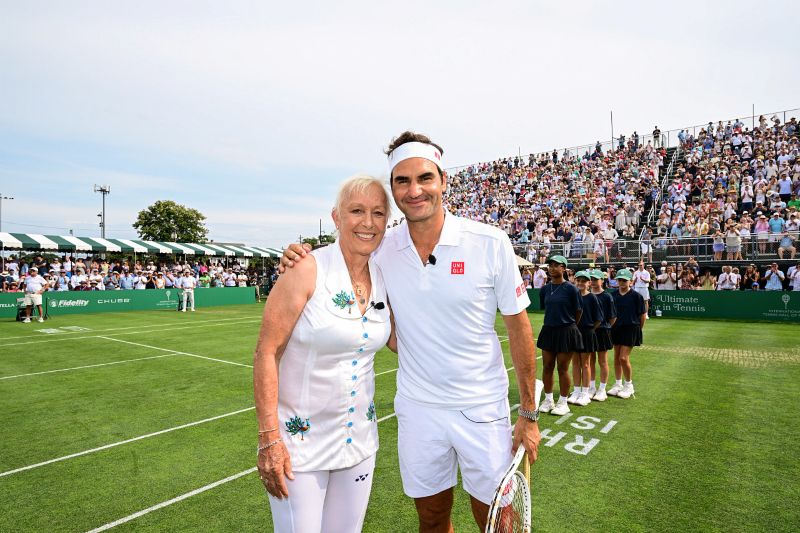
Photo credit: Ben Solomon/International Tennis Hall of Fame
Will we see the Swiss Maestro return to Grand Slam tennis as a commentator in the future? Asked that question, Federer suggested he could make an occasional appearance in the booth, but reiterated his primary passion in tennis going forward is to help junior players—either at the Swiss Federation Academy he once attended or at the Rafa Nadal Academy in Mallorca he’s visited several times.
“I feel very comfortable now not commentating, but who knows down the road or maybe I’ll pop in and out of a booth maybe,” Federer said. “It’s maybe simpler and just test the waters, but I have no plans there really.
“Then, of course, I would love to still support in some shape or form juniors and mentoring down the road. I’m always open with that maybe if it’s Swiss Tennis or academies, like Rafa’s or others. If they need my help, I’m always open for those calls, as well.
“I would like to give back to the sport. That’s why I always try to attend, you know, three, four, five events throughout the year, so I stay connected, and it also rejuvenates me I think mentally to see what could I be doing in the sport that is also meaningful down the road?”
Reviewing his career, Federer said he feels it transcended forehands and backhands and wins and losses—it was about touching lives and pursuing dreams.
“Sure, it’s good that you hit a good, little, fuzzy tennis ball that’s the color of yellow, but actually it’s irrelevant until all of a sudden it kind of — you touch some people’s hearts, and you make it kind of important for some people,” Federer said. “You realize actually it’s kind of cool.
“Yet, still having a perspective that it’s just tennis. You are able to change the world to some extent or at least for some people.
Then little by little you start dreaming bigger, and then dreams become reality, and then everything grows.”
0 comments